Asperger’s in adults: what happened to the diagnosis

Asperger’s in adults is no longer given as a separate diagnosis: since 2013 the DSM-5 system places these traits within autism spectrum disorder (ASD). A person with the old diagnosis or a suspicion stays in the spectrum and simply carries a different name. Below we look at what changed, how it looks in an adult and how an assessment works.
If you came across the word “Asperger” in a book, a series or an old certificate and are trying to see what it means for you, this is the right place. There are no diagnoses from a description here, only a map that makes the next step easier.
What is Asperger’s in adults
This was the name of a separate diagnosis for people with difficulties in social interaction and repetitive interests or actions, who by the old criteria had no marked delay in speech. Many adults received it in childhood or youth. Others learned the term from culture and try it on for themselves.
- A person with a long-standing diagnosis that still sits in their records.
- An adult who uses the word as a self-description and feels it is theirs.
- Someone who suspects such traits in themselves and is looking for a start.
All three situations are common, and each needs its own step. The first needs a conversation about living with an old label, the second respect for the choice of words, the third an assessment.
The question about the old name arises more often in adults. Many grew up in years when such traits were hardly noticed in children, and they learn about them later in life, after burnout, a change of job or a diagnosis in their own child. This is a normal path, and late interest in the topic devalues nothing.
Why the diagnosis stopped being given
The American DSM-5 system came out in 2013 and merged the earlier subtypes, Asperger’s among them, into one ASD diagnosis with a note on severity. The idea was that the lines between subtypes are blurred in practice, and one shared category describes people more accurately.
This was tested on data. In the study by Huerta and colleagues (2012), the DSM-5 criteria were applied to 4,453 children with earlier diagnoses from the pervasive developmental disorder group. Based on parent report, 91% of them fit the new single diagnosis. For Asperger’s and atypical autism the new criteria turned out more precise than the earlier ones. An important caveat: the sample was children, so for adults this is indirect support for the logic of the change.
The WHO classification followed a similar path. ICD-11 was approved in May 2019, and reporting on it began on 1 January 2022 (Reed and colleagues, 2019). Category 6A02 describes autism spectrum disorder as a single diagnosis, and the details are in the official ICD-11 browser. Countries move to it at different speeds, so records in one country may still use the earlier wording while another already uses the new one.
Instead of a set of subtypes, the current system uses one diagnosis plus specifiers. They show whether support is needed in everyday life and how much, and they describe a person’s profile more precisely than a label.
- One diagnosis instead of several: autism spectrum disorder.
- Specifiers: whether intellectual disability or language impairment accompanies it.
- Levels of support needed, from the first to the third, covered in detail in the piece on mild autism in adults.
Where a person with the earlier diagnosis stands today
Current systems place these traits within the autism spectrum. A person who received a diagnosis under the earlier criteria has lost nothing: their earlier assessment remains a fact of their history. In Huerta’s study, most people with earlier diagnoses stayed in the spectrum under the new criteria too.
How you speak about yourself is your choice. Several wordings fit.
- “Autism spectrum disorder” in medical and official documents.
- “Autism without intellectual disability” to describe a profile.
- “Autistic traits” if you have no diagnosis yet.
- “Asperger” as a personal self-description if it feels comfortable.
If your records carry the earlier name and you are unsure it will do for work, study or support, ask a specialist and the organisation that needs the certificate. Requirements depend on the country and the institution.
The spectrum describes a set of different profiles. Support needs differ across areas of life and can change over time, so two people with the same diagnosis look and live differently.
A new assessment is not mandatory, though it can be useful. Consider it if the earlier diagnosis was made in childhood without a detailed assessment, if your needs have changed, or if a document requires current wording. A long-standing diagnosis gives no reason for doubt: it was made by the criteria of its time.
Signs in adults and how they look from outside
Signs in adults rarely resemble the textbook description. Many people spend years learning to adapt and from outside it looks like a perfectly successful life. Below is what people most often describe. These are pointers for a conversation, and no test can be built from them.
- Conversation. Hints, irony and unwritten rules are hard to read, and speaking directly feels more natural.
- Contact. Meeting people and keeping friendships takes effort, and after gatherings you need time alone.
- Routines. Unexpected changes of plan cause strong tension.
- Interests. There is a topic you dive into deeply and for a long time.
- Senses. Noise, bright light, smells or textures wear you out more than others.
- Emotions. It can be hard to name what you feel, as covered in the piece on alexithymia.
- Movement. Repetitive gestures or sounds help you cope with load, with more in the article on stimming in adults.
From outside a person may speak well, work and build relationships. Inside, this costs a lot of energy. In the study by Hull and colleagues (2017), 92 adults with autistic traits described how they mask them to fit in, and named exhaustion among the consequences. How this builds up is covered in the piece on masking and burnout.
More on the signs adults describe is in the article on signs of autism in adults. And if you have met the words “mild” or “high-functioning” autism, read what they mean and where they came from.
Similar difficulties occur in other conditions too. Fatigue from socialising may come from social anxiety, and trouble with attention and organisation from ADHD. A specialist can tell them apart when needed. For neighbouring topics see the pieces on autism or ADHD in adults and on social anxiety.
Asperger’s in women
Women with autistic traits are more often missed during assessment. The authors of the research discussed below speak of a diagnostic gender bias: the system notices women less.
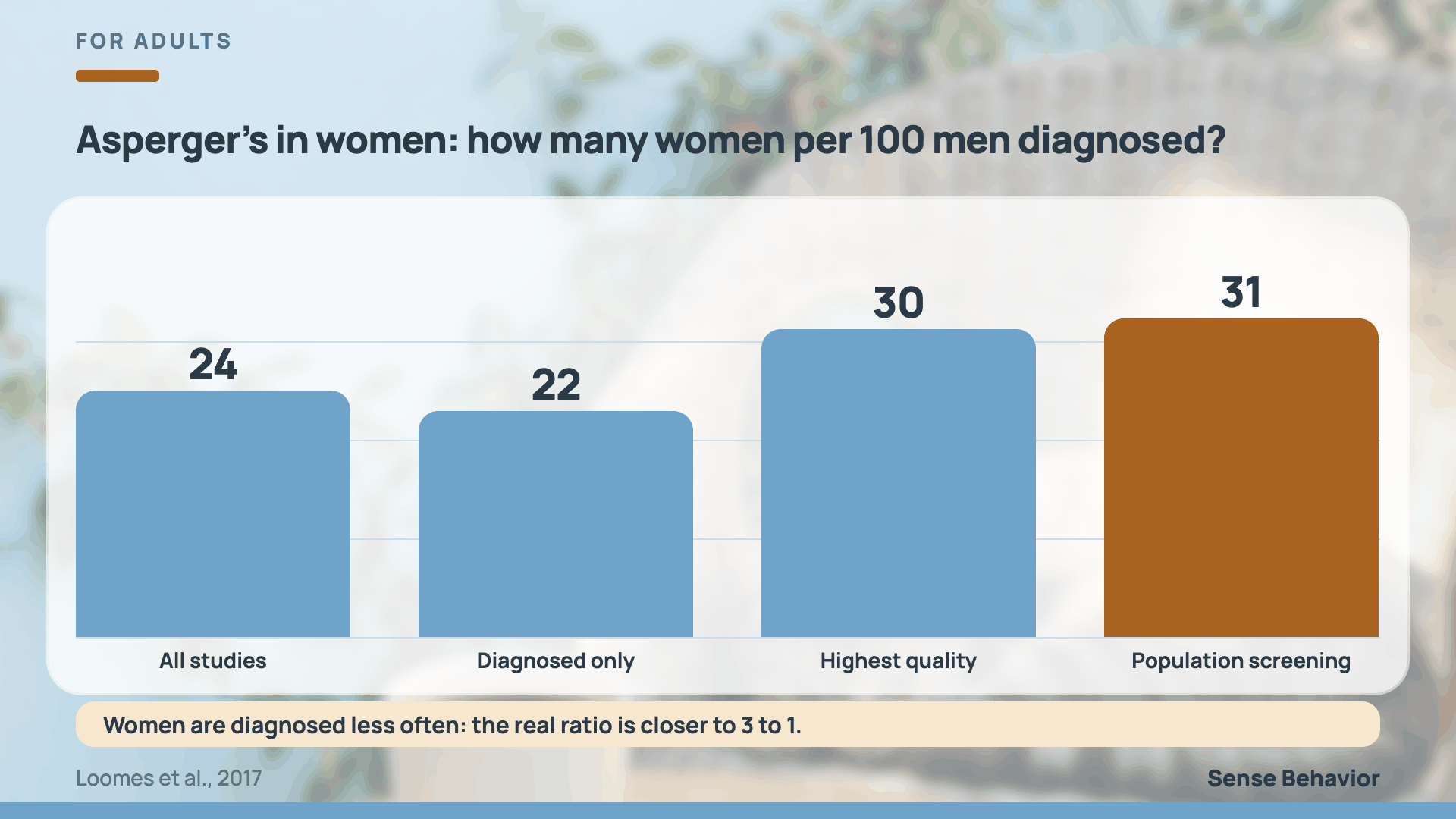
The meta-analysis by Loomes and colleagues (2017) combined 54 studies and 13,784,284 participants. The overall male-to-female ratio among those with a diagnosis was 4.20. In the highest-quality studies it was 3.32, and in studies screening the general population 3.25. Among those who already had a diagnosis it reached 4.56. The authors conclude that the true ratio is closer to 3 to 1 than to the usual 4 to 1, and that girls and women who meet autism criteria are more likely to go undiagnosed.
Per 100 men with a diagnosis, that is about 24 women across all studies, 22 counting only existing diagnoses, 30 in the highest-quality work and 31 when screening the general population.
What can help a woman prepare for an assessment:
- Describe childhood and school: who you were friends with and how you handled noise and change.
- Give examples of situations where you rehearsed a conversation in advance or copied someone else’s behaviour.
- Name your suspicion of autistic traits, so the specialist looks for them.
- Tell them about fatigue after socialising, which often goes unnoticed.
Personal accounts point the same way. In the qualitative study by Bargiela and colleagues (2016), 14 women diagnosed in late adolescence or adulthood said they had been “pretending to be normal” and that professionals missed their traits because of their gender. The sample is small, and these are lived stories, not statistics.
If you recognise yourself in this description, read the piece on autism in adult women. It will help you put into words what you want to tell a specialist.
How an adult assessment works
An assessment takes several meetings and is not reduced to one test. The specialist builds a picture from the story of your life, observation and, where possible, the recollections of people close to you.
- Preparation. Write down situations that are hard: contact, noise, change. Concrete examples beat general words.
- Choosing a specialist. Look for a psychiatrist or clinical psychologist experienced in autism in adults.
- Screening. A short questionnaire shows whether to go further. It is not a diagnosis.
- Full assessment. An interview about development since childhood, observation and sometimes a parent’s or partner’s account.
- Report. A diagnosis or an explanation of what exactly you see, with recommendations.
Before booking, ask questions that save time:
- Whether the specialist has experience with autism in adults and which methods they use.
- How many meetings the assessment takes and what it costs.
- Which documents you will need and what you will receive at the end.
- Whether someone close who has known you since childhood can take part.
An assessment can be tiring and stressful. Agree on breaks, bring written notes and do not hesitate to ask again if a question is unclear. These are ordinary working conditions, not a weakness.
The detailed order is described in the piece on autism diagnosis in adults, and what questionnaires show is covered in the article on the autism test for adults.
Do you need a diagnosis
A diagnosis is not a mandatory step. The decision depends on what you need. It helps some people and turns out unnecessary for others.
- Why it may be useful: to explain past difficulties to yourself, to get support and adjustments where they exist, to find a suitable specialist.
- What to consider: cost and waiting time, possible consequences in your country, how those close to you will react.
- The option without a diagnosis: use the descriptions and methods that suit you and return to the question later.
If you decide to go for an assessment, take a copy of the report afterwards and discuss the recommendations. Whom you tell about the result is up to you. How people approach that decision at work is covered in the piece on talking to an employer about autism.
If you do not need a diagnosis but have many questions, begin with observations. Write down when your energy drains fastest and what helps you recover. Often this is linked to sensory load, and then the article on sensory overload in adults will help. Such notes are useful in a conversation with a specialist too, should you decide to book one.
If you want to move from thinking to doing, here is a plan for one week:
- Write down five situations that are hard for you and what helps.
- Pick two reliable sources and read them in full.
- Find out who carries out adult assessments in your country.
- Book a consultation or put your questions to a specialist.
We do not diagnose online. We help you make sense of your request: what exactly you want to find out, what to bring to a specialist and which steps are realistic in your situation. If you want to talk through your case, write to us using the link at the bottom of the page.
Sources
- Huerta M., Bishop S. L., Duncan A., Hus V., Lord C. (2012). Application of DSM-5 criteria for autism spectrum disorder to three samples of children with DSM-IV diagnoses of pervasive developmental disorders. American Journal of Psychiatry, 169(10), 1056–1064.
- Reed G. M., First M. B., Kogan C. S., Hyman S. E. et al. (2019). Innovations and changes in the ICD-11 classification of mental, behavioural and neurodevelopmental disorders. World Psychiatry, 18(1), 3–19.
- Loomes R., Hull L., Mandy W. P. L. (2017). What is the male-to-female ratio in autism spectrum disorder? A systematic review and meta-analysis. Journal of the American Academy of Child & Adolescent Psychiatry, 56(6), 466–474.
- Hull L. et al. (2017). “Putting on my best normal”: social camouflaging in adults with autism spectrum conditions. Journal of Autism and Developmental Disorders, 47(8), 2519–2534.
- Bargiela S., Steward R., Mandy W. (2016). The experiences of late-diagnosed women with autism spectrum conditions: an investigation of the female autism phenotype. Journal of Autism and Developmental Disorders, 46(10), 3281–3294.
- WHO. ICD-11: 6A02 Autism spectrum disorder (официальный браузер классификации).
This material is for informational purposes only and does not replace a consultation with a specialist.