Social Anxiety: How It Differs From Shyness and From Autism

A call where it is hard to turn the camera on. An invitation that is easier not to answer than to explain. If you searched for "social anxiety," you probably recognize yourself in this and want to understand what it is: shyness, a trait of character, autism, or a disorder of its own. The short answer: they look alike on the outside, their causes differ, and a specialist tells them apart.
Below is how to tell social anxiety from shyness and from autism, how it is identified, and what helps. The article helps you get your bearings, and only a specialist can make a diagnosis.
What Is Social Anxiety
Social anxiety is intense fear and embarrassment in situations of interaction that make a person avoid meetings, calls, presentations and other situations. The UK's NICE guideline suggests suspecting it from two questions: whether you avoid social situations or activities, and whether you are fearful or embarrassed in social situations. If the answer to either is yes, or if the short Mini-SPIN questionnaire scores 6 or more, a full assessment is arranged (NICE, 2013).
How Social Anxiety Differs From Shyness
Shyness is a trait you can live with at no great cost, while social anxiety affects life strongly. The assessment looks at the degree of distress and at difficulties in work, relationships, and communication (NICE, 2013). These are the pointers:
- Shyness. You feel awkward in a new group but manage and relax after a while, and your life does not noticeably suffer.
- Social anxiety. Fear of evaluation makes you avoid situations in advance, lasts a long time, and gets in the way of work, study, or relationships.
How Social Anxiety Differs From Autism
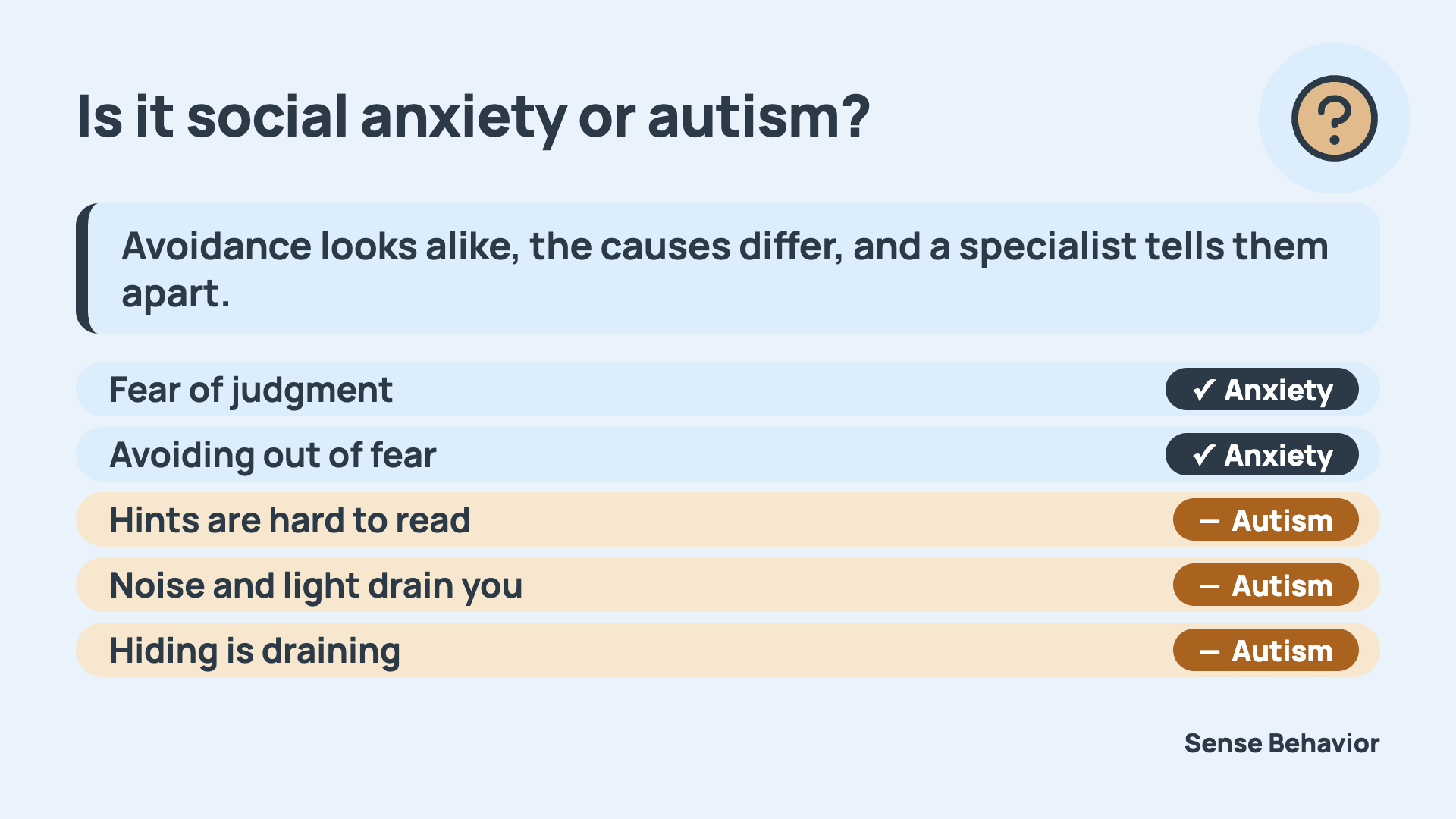
From outside, avoiding contact looks alike, but the causes differ. In social anxiety, avoidance comes from fear of being judged, while in autism contact can be draining because of differences in perception, unwritten rules, unpredictability, and the effort of hiding your differences. The NICE guideline names social anxiety among the conditions ruled out in an autism assessment (NICE, 2012). It also happens that the conditions combine, and then the picture only comes together during an assessment. This is how they are told apart:
- What stands behind avoidance. In social anxiety it is fear of judgment, in autism it is tiredness, overload, or unclear rules.
- Reading hints. Difficulty with hints and unwritten rules is part of the picture of autism.
- Surroundings. Light, noise, and crowds drain in autism, while in social anxiety it is other people's gaze that is frightening.
- History. The features of autism were there from childhood, while social anxiety can appear later.
We cover autism in more detail in the pieces on signs of autism in adults and masking and burnout in autism, and the link with anxiety in the piece on autism and anxiety in adults.
What Helps With Social Anxiety
For adults NICE suggests individual cognitive behavioral therapy developed specifically for social anxiety, and advises against automatically preferring group CBT because it is less cost-effective. For those who decline CBT, CBT-based supported self-help is offered (NICE, 2013). Therapy results are usually tracked with questionnaires such as the SPIN.
What to Do If You Recognize Social Anxiety in Yourself
Write down what causes the fear and when, and discuss it with a specialist. You can start today:
- write down three situations from the past month where you avoided contact and what scared you in them;
- note how it ended: whether it got easier after avoiding and what you missed;
- think about how long it has been like this and whether anything similar happened in childhood, because that helps tell it from other causes;
- look at what autism tests for adults show if you doubt whether something else is going on too.
The general picture of anxiety is described in the piece on anxiety in adults, and how to cope with it in the piece on how to cope with anxiety.
You can work out where to start in your own situation with no commitment, through the bot, which asks a few questions and suggests a next step, and how the center's work with adults is set up in general is on the For Adults page.
Sources
This material is for informational purposes only and does not replace a consultation with a specialist.