Sensory overload in adults: what it is and what helps

Sensory overload in adults happens when there is more sound, light, smell or touch around than you can process, and the urge comes to leave, cover your ears or go quiet. It is not a whim or a weakness of character. Adults with autism and ADHD describe similar experiences, but a single feeling is not enough to draw conclusions about a diagnosis.
If you come home from an open-plan office completely drained, and the hum of a fridge or a label on a T-shirt sets you on edge, many people will recognise that. Below, in order: how overload shows up, what research says about it and what you can try today.
How sensory overload in adults shows up
People most often describe reactions to noise, bright or flickering light, smells, the texture of clothes and unexpected touch. It is not only loud things that bother: a quiet ticking clock, the smell of coffee from the next office or a seam on a sock can also take over your attention. Inside it can feel like tension, irritation, trouble gathering thoughts and a wish to leave the room. After such an episode many need time to recover. From outside it sometimes looks like sharpness or sudden withdrawal, although the person is simply at their limit.
In a 2021 study, 49 autistic adults described their sensory experiences in their own words. The themes the authors identified included control over the environment, tolerance and ways of managing, and the role of other people. It is a small qualitative survey that shows the variety of experience, not how common it is.
What research says about sensory sensitivity in adults
The largest summary covers autistic people of all ages. A meta-analysis by Ben-Sasson and colleagues (2019) pooled 55 questionnaire studies with 4,606 people: over-responsivity, under-responsivity and sensory seeking were all markedly higher than in people without autism. Of these three, only over-responsivity also set autistic people apart from other clinical groups. The summary has little data on adults specifically, so applying the numbers to yourself calls for caution.
Sensory differences are also part of the DSM-5 criteria for autism. But they are not found only there: in a study of adults with ADHD unusual sensory profiles appeared regardless of autistic traits. So overload alone does not point to one diagnosis. You can read more in our pieces on signs of autism in adults and ADHD symptoms in adults.
What helps with sensory overload at work and at home
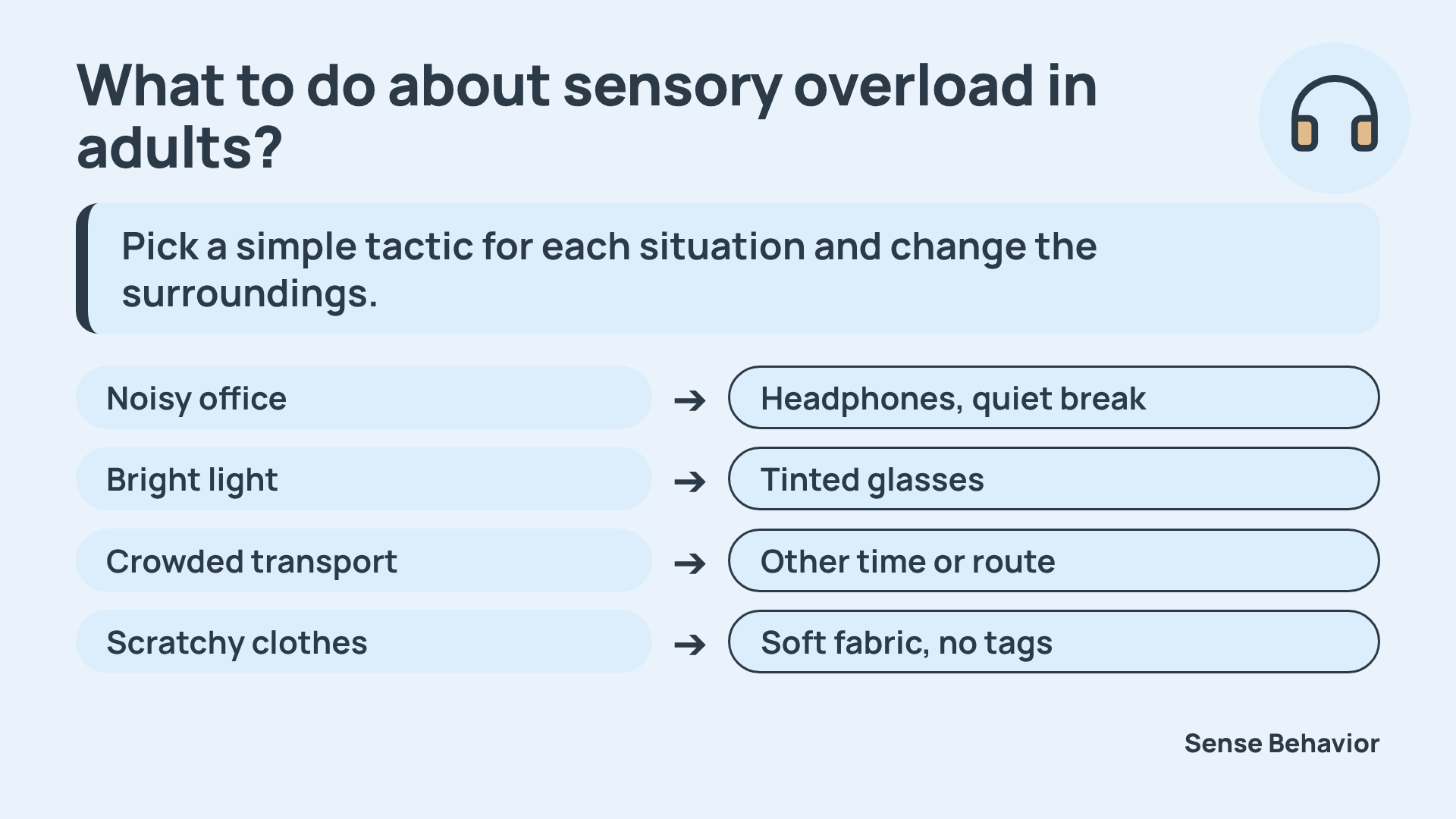
There is no proven set of tricks that suits everyone. Below are everyday approaches people most often call useful, and you can try them without risk:
- Noisy office: headphones and a quiet break.
- Bright light: tinted glasses.
- Crowded transport: another time or route.
- Scratchy clothes: soft fabric without tags.
Most of these approaches have not been tested in strict trials, so choose what works for you. If asking for changes feels awkward, that is normal, and you can take time to prepare for such a conversation. It also helps to shape your surroundings in advance: sit further from a speaker, arrange a quieter spot or shorten your time in the loudest hour. If you have been enduring and holding on for a long time, energy runs out fast, which we covered in the piece on masking and burnout.
When overload gets in the way of life and it is time to see a specialist
It is worth seeing a doctor or psychologist if overload interferes with work, sleep or relationships, repeats every week or grows. A specialist can help work out what causes it and rule out other reasons, such as anxiety or exhaustion. Self-diagnosis from a description cannot replace that.
Try one small step today. Write down three situations from the past week when overload was the strongest and what helped at that moment. Or well, just mark them in your phone notes. In a week you will see which conditions repeat, and that makes it easier to go to a specialist or change your surroundings. If you would like to talk through your situation, write to us through the link at the bottom of the page.
Sources
- Ben-Sasson A. et al. (2019). Update of a Meta-analysis of Sensory Symptoms in ASD: A New Decade of Research. Journal of Autism and Developmental Disorders.
- MacLennan K. et al. (2021). In Our Own Words: The Complex Sensory Experiences of Autistic Adults. Journal of Autism and Developmental Disorders.
- Atypical sensory profiles as core features of adult ADHD, irrespective of autistic symptoms. European Psychiatry.
This material is for informational purposes only and does not replace a consultation with a specialist.