Autism Diagnosis in Adults: Who to See and How the Assessment Works

If you searched for "autism diagnosis in adults," you probably have suspected autism in yourself or someone close for a while and don't yet know who to see or what to expect. The route to a diagnosis in adulthood is less obvious than in childhood. Diagnosis was built for a long time around vivid, easily noticed presentations, and people with a subtler picture were often missed (Lai & Baron-Cohen, 2015).
Below is a step-by-step walk-through: which specialist to contact, how the assessment works, what to prepare, and what to do if you weren't heard. It helps you get your bearings, and only a specialist can make a diagnosis.
Who to See If You Suspect Autism
As a rule, you start with a specialist who works with autism in adults, most often a psychiatrist or a clinical psychologist. According to the UK's NICE guideline, a full assessment is carried out by trained professionals and, where possible, by a team rather than one person in a single appointment (NICE, 2012). Job titles and the booking route depend on the country, so experience with adults matters more than the sign on the door. Before booking, it is worth asking:
- whether the specialist has experience diagnosing adults and not only children;
- which tools they use, whether a single questionnaire is enough or there is an interview and observation;
- whether a close person can take part and you can bring documents from childhood;
- how long the assessment takes and in what form the report is issued.
How an Autism Assessment Works for an Adult
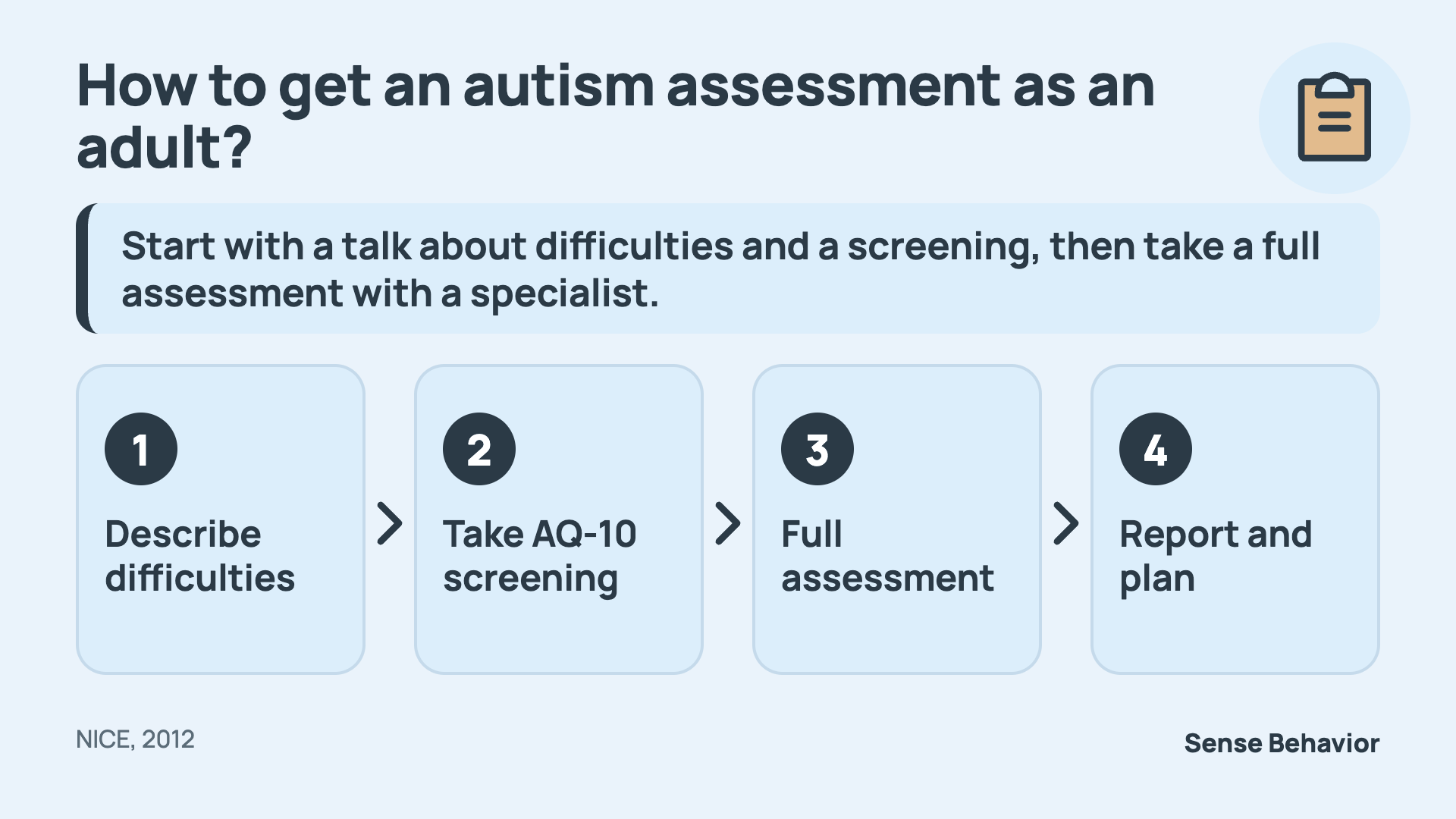
The process usually consists of a short screening and then a full assessment. The NICE guideline describes it like this:
- A conversation about difficulties. An assessment is worth considering when there are lasting difficulties in social interaction and communication, or rigid, repetitive patterns of behavior and narrow interests, together with problems at work or in study, in relationships, past contact with mental health services, or another neurodevelopmental condition such as ADHD (NICE, 2012).
- Screening. Adults without a significant learning disability are offered the short ten-question AQ-10 questionnaire. If the score is 6 or above, or the doctor has a clinical suspicion, a full assessment is offered (NICE, 2012). In a study of 149 people with autism and 134 people without a diagnosis, the AQ-10 performed close to the full 50-question version (Booth et al., 2013).
- History taking. The specialist asks about early development and school years and, where possible, involves a close person or documents such as school reports.
- Interview and observation. They assess whether the particular ways of communicating and behaving have been there since childhood and continue in adult life, how the person copes at home, at work, and in study, and whether there are sensory sensitivities. Formal tools are often used for structure, for example the ADI-R interview, the ADOS observation, or the DISCO interview.
- Ruling out other causes. They check whether depression, anxiety disorders, obsessive-compulsive disorder, or other conditions explain the picture. Blood tests, genetic tests, and MRI are not used as a routine part of an autism assessment (NICE, 2012).
- Report and plan. The results are discussed with you in person, with a close person alongside if you wish, and a support plan is drawn up that takes the environment into account.
What to Prepare for an Autism Assessment
The more specific material you bring, the more accurate the picture, especially about childhood because that is what confirms the differences have always been there. You can start today, and one evening is enough:
- write down five situations from recent months where communication, changed plans, or noise and light threw you off;
- find school planners, reports, and report cards, and ask your parents or older relatives what you were like as a child;
- list past diagnoses and treatment, including for anxiety and depression, and what helped;
- think about who close to you can confirm your differences and would agree to come to the appointment.
Why Autism Is Diagnosed Late in Adults
Because an adult often doesn't remember early development, has learned to hide difficulties, and has other conditions alongside that keep autism in the shadows (Lai & Baron-Cohen, 2015). Late or missing diagnosis says something about how the system was built and says nothing about whether you are autistic. How hiding differences works and what it costs we covered in the piece on masking and burnout in autistic adults, and why the diagnosis comes especially late for women in the piece on autism in adult women.
If you wonder why a diagnosis so often arrives in adulthood and what that says about autism itself, read can autism appear in adulthood.
What Happens After an Autism Diagnosis in an Adult
You receive a report and a plan that accounts for your differences and needs, and not necessarily treatment. If you worry that seeing a psychiatrist could bring consequences such as registration, the rules differ between countries. What happens when an adult sees a psychiatrist and what is and isn't worth fearing we covered separately: psychiatric registration in adults.
What to do next with a diagnosis in hand and what support to count on continue in can autism be treated in adults.
What to Do If an Autism Assessment Is Refused or You Disagree With the Report
You can ask for a second opinion from another specialist team. NICE names the situations where this is appropriate: doubt about the diagnosis, disagreement within the team or with you, a lack of local expertise in diagnosing adults, and complex coexisting conditions (NICE, 2012). Bring the same materials and explain what exactly in the report seems wrong to you.
You can work out where to start in your own situation with no commitment, through the bot, which asks a few questions and suggests a next step, and how the center's work with adults is set up in general is on the For Adults page.
Sources
- NICE (CG142, 2012, updated 2021). Autism spectrum disorder in adults: diagnosis and management.
- Lai M.-C., Baron-Cohen S. (2015). Identifying the lost generation of adults with autism spectrum conditions. The Lancet Psychiatry, 2(11), 1013–1027.
- Booth T. et al. (2013). Brief report: an evaluation of the AQ-10 as a brief screening instrument for ASD in adults. Journal of Autism and Developmental Disorders, 43(12), 2997–3000.
This material is for informational purposes only and does not replace a consultation with a specialist.