Should you tell your employer about autism? How to decide

Whether to tell your employer about autism is your decision, and there is no single right answer. Each option has a price: openness can bring understanding and the changes you need, while staying quiet protects your privacy but leaves everything on your own energy. Below is what a study shows and a way to weigh your choice. It applies to anyone thinking about ADHD, too.
If you are asking yourself this, you have probably been adapting to your work environment for a long time and feel tired of it. The article on masking and burnout in autistic adults covers the exhaustion of constant self-monitoring in detail, so take a look if it sounds familiar.
What a study shows about how people talk about autism at work
A research group led by Romualdez (2021) surveyed 238 adults in the United Kingdom who are autistic and have work experience. Most often they disclosed in application materials or after starting the job, rather than in the interview. Over a third told everyone. A little over a third said that telling a supervisor or colleagues had a positive effect. This is a survey from one country and it cannot predict how things will go for you. It does show that there is no single path and that the decision depends on the situation.
Whether to tell your employer about autism: five questions to ask yourself
Before you decide, it helps to answer a few questions in writing:
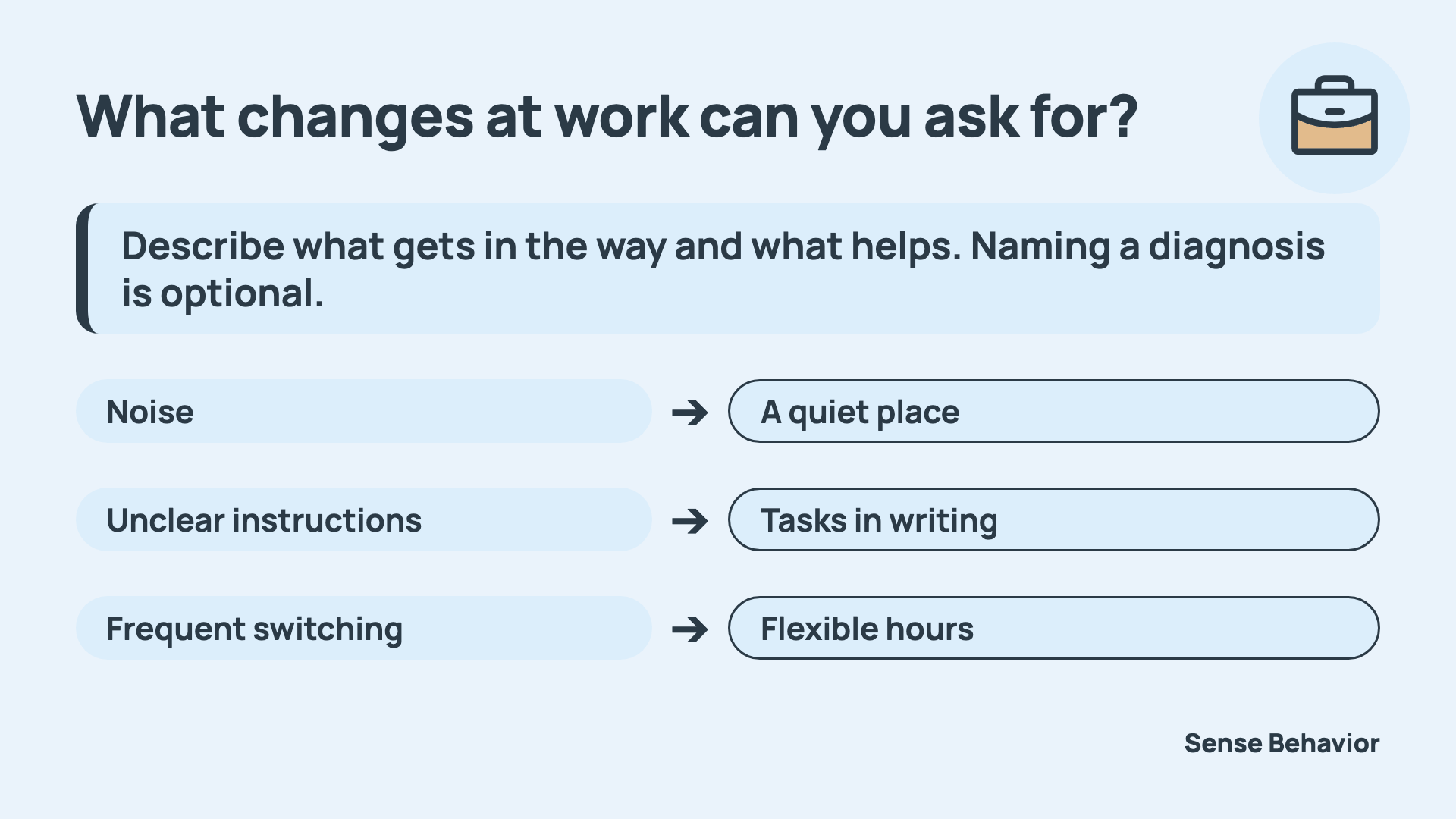
- What bothers you most at work: noise, unclear tasks, frequent switching, calls without an agenda?
- Which change would help: a quiet place when noise is the problem, written tasks when instructions are unclear, or flexible hours when frequent switching wears you out?
- Can you get that change without naming a diagnosis, simply by describing what helps?
- Who can make it happen: your direct manager, HR or neither of them?
- What happens if the reaction is poor, and do you have a fallback plan?
If there is no diagnosis and you only suspect autism, there is nothing to name. You can still ask for changes by describing the need. The signs that sources describe are covered in signs of autism in adults.
Whom to tell about a diagnosis at work, and when
There are several options and none is required. You can say it before hiring, in the application. You can say it after a job offer, when the decision is made. You can say it after a few weeks, once you see how the team works. You can tell only your manager or only HR and say nothing to colleagues. And you can tell nobody and simply ask for specific changes without explaining why.
Laws differ by country. Many countries prohibit discrimination based on health, but the terms of protection vary, so check them with a lawyer, a union or your country's labour authority. If a fear that seeing a doctor means being "registered" holds you back, it is covered in the article on psychiatric registration in adults.
What to say to your employer about autism: simple wording
A conversation is easier when it centres on tasks. You can start with what helps you work better:
If you decide to name the diagnosis, add briefly what it means in practice: what comes easily, what is harder and which change you are asking for. A diagnosis without specifics often leaves the listener confused.
Where to start preparing for a talk with your manager
Today, write down the three work situations that are hardest, with one helpful change next to each. Or at least one situation, if three is too many. This sheet will be useful in any scenario, even if you decide to say nothing.
If you would like to talk through what you need at work and do not know where to begin, the Sense Behavior team can help you sort it out. You can write to us through the link at the bottom of the page.
This material is for informational purposes only and does not replace a consultation with a specialist.