Stimming in Adults: What It Is and Should You Hide It

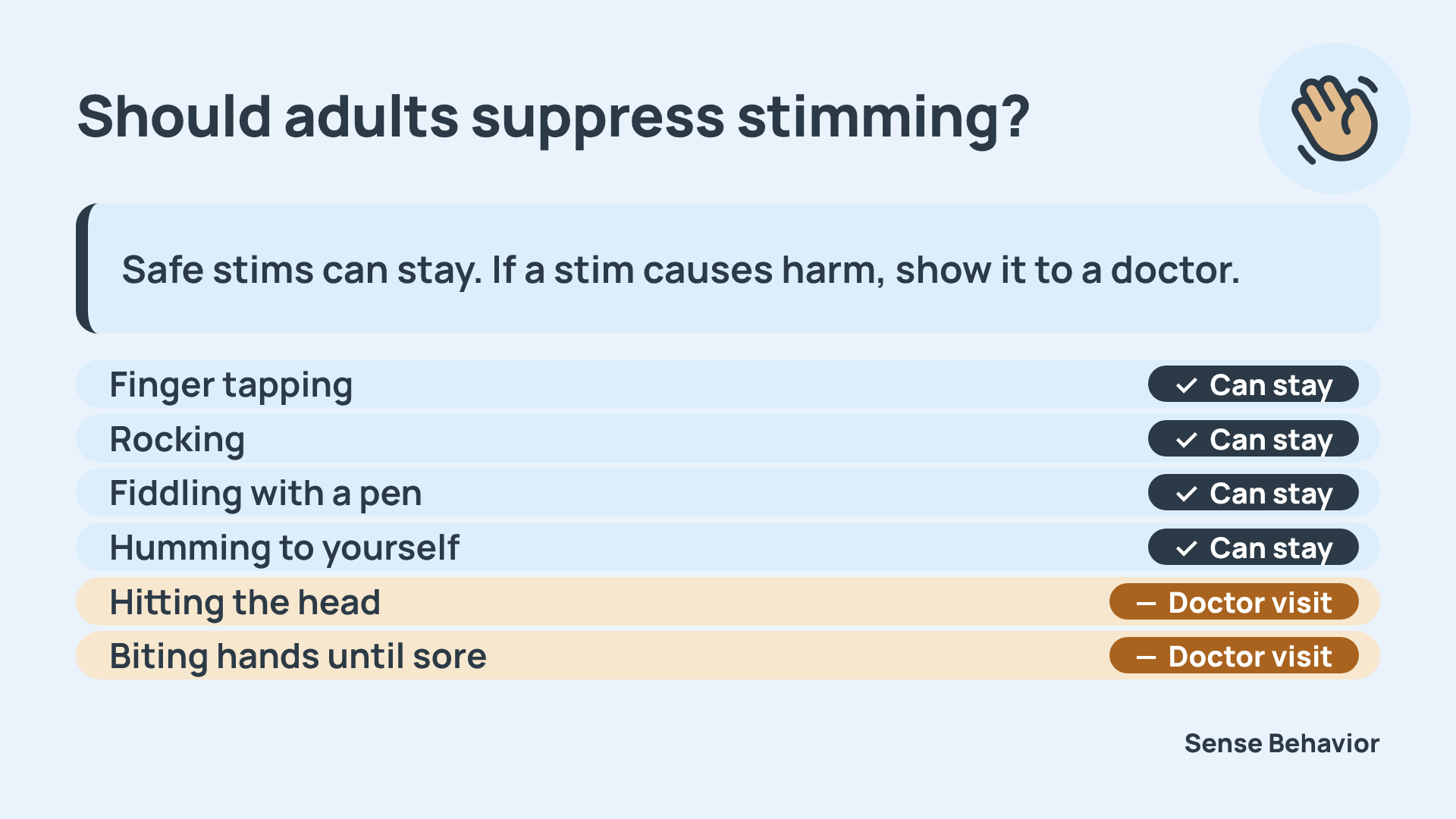
Stimming in adults means repeated movements, sounds or actions that help with tension, joy, boredom or overload. Rocking, finger tapping, fiddling with a pen and humming under your breath will look familiar to many people. In autistic adults stims are often more noticeable, but having them does not by itself show a diagnosis. There is no need to hide a stim if it does you no harm.
If you catch yourself tucking your hands away on the subway so you do not pick at a sleeve, or holding your leg still in a meeting with all your might, you are in good company. Next, in order: what stimming is for, what adults themselves say in research, what suppressing it costs, and what you can do today.
What is stimming in adults and what is it for?
Stimming, or self-stimulation, has long been described as repetitive behavior, but adults who use it explain it differently from older clinical texts. In a qualitative study by Kapp and colleagues (2019), 32 autistic adults talked about stimming in interviews and focus groups. Participants described it as a way to regulate themselves: it helps to soothe and to express intense emotions or thoughts. They objected to treatment aimed at removing stimming completely. Many also noticed that others accept stimming less readily, and that acceptance grows when people understand what it is for.
Cleveland Clinic describes stims as things a person does without much intention that usually serve a purpose, for example helping to regulate emotions. By its account, many people have similar habits, and autism is linked with them more often.
In adults with ADHD, similar movements are often called fidgeting. Research on stimming specifically in adults with ADHD is much thinner, so this article draws no conclusions that rest on it.
What does stimming look like day to day?
Stims differ, and everyone has their own set. A few examples of how it can look:
- Body movements: rocking, hand flapping, pacing in circles.
- Actions with objects: fiddling with a pen or keys, clicking, stroking fabric.
- Sounds: humming, tongue clicks, repeating a favorite phrase to yourself.
- Sensations: favorite smells, touch, watching glints of light.
The same stim means different things to different people. For some it brings them back after noise, for others it lets joy out, and others use it to hold attention on a text. Notice when your stim shows up, that is enough for first conclusions.
Should you hide stimming? What is known about suppressing it
Many adults hide stims at work and in crowded places for fear of judgment. The survey “Masking Is Life” (Miller, Rees and Pearson, 2021) included 144 autistic adults, plus people with other neurodevelopmental differences and people without any. The authors linked masking with the wish to avoid stigma and noted that suppressing stimming was one of the sides of masking more typical of autistic adults.
No conclusion about harm to a particular person follows from this. Sometimes you hold a stim back on purpose, say during negotiations, and that is your choice. But if holding back becomes constant and exhausting, it is worth talking about, and the cost of that habit is covered in more detail in the article on masking and burnout.
When is stimming worth discussing with a doctor?
Most stims are safe, and doctors usually advise leaving them alone. Worth discussing are those that cause harm, such as hitting the head or biting the hands until they are sore, and those that clearly get in the way of life, take hours or cause pain. If you suspect autism in yourself, you can describe stimming to a doctor together with other observations, since a diagnosis is never made from this one trait. The full picture is covered in the article on signs of autism in adults, and how an assessment goes is in the one on autism diagnosis in adults.
What can I do today to understand my stimming?
For a week, watch your stim and note in your phone when it showed up, what came before and how you felt. If a stim is safe, give it room where you feel comfortable, at home or on a walk. If its visibility bothers you, find a quieter option, such as a smooth pebble or a ring in your pocket. Results differ from person to person, and that is fine. And if nothing changes, no harm done, the notes will come in handy at an appointment.
If your stim is tied to noise and tiredness, the article on sensory overload in adults may help too. If you would like to talk through your situation, write to us through the link at the bottom of the page.
Sources
- Kapp S.K. et al. (2019). “People should be allowed to do what they like”: Autistic adults’ views and experiences of stimming. Autism, 23(7), 1782–1792.
- Miller D., Rees J., Pearson A. (2021). “Masking Is Life”: Experiences of Masking in Autistic and Nonautistic Adults. Autism in Adulthood.
- Cleveland Clinic. What Is Stimming?
This material is for informational purposes only and does not replace a consultation with a specialist.