Autism Test for Adults: What Tests Exist and What They Show

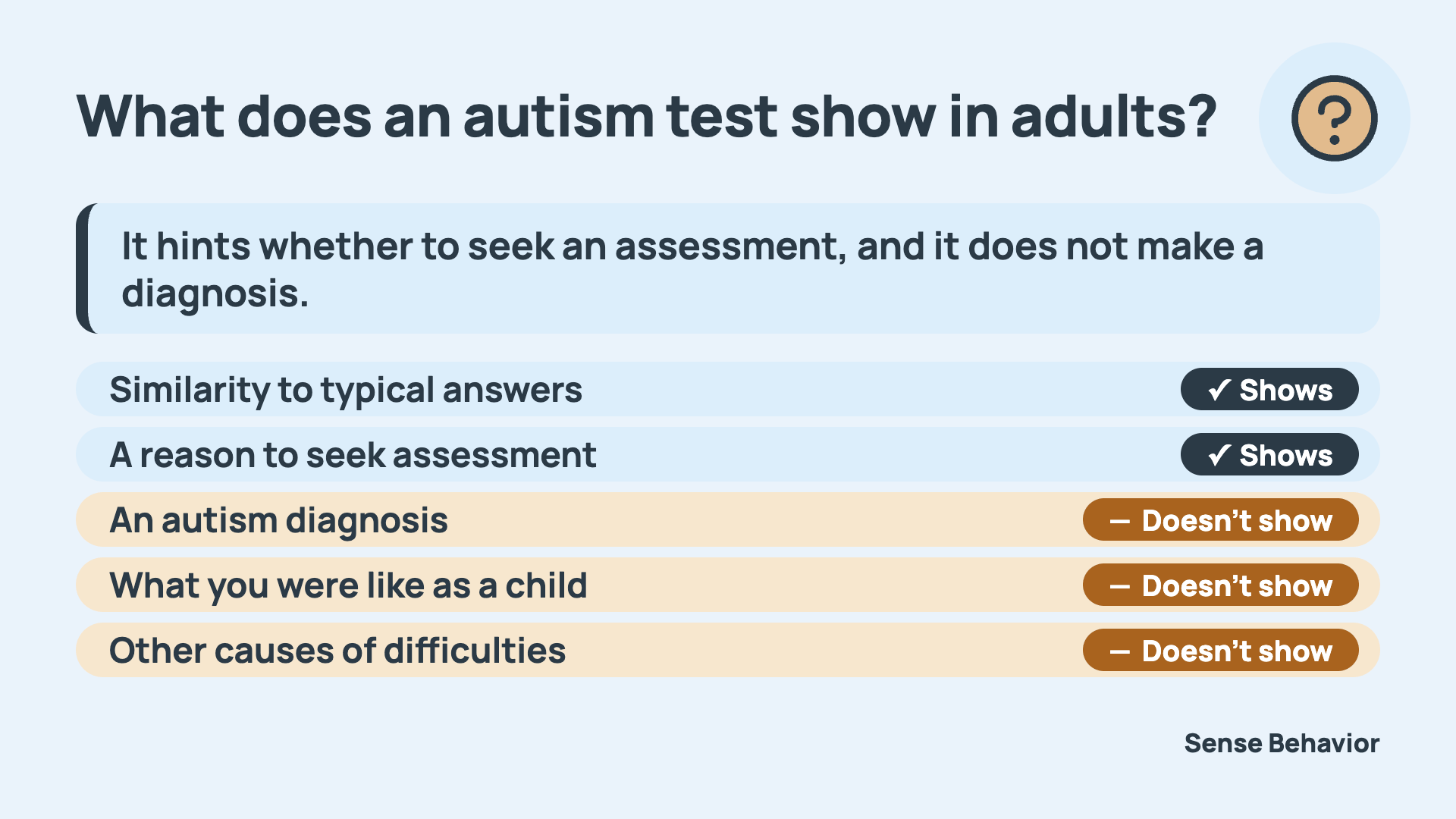
If you searched for "autism test for adults," you have probably already taken one or more online questionnaires, got a number, and don't know what to do with it. The short answer is this: a test shows how similar your answers are to the answers of autistic people and works as a reason to seek an assessment, but it is not a diagnosis.
Below is a practical walk-through: which tests exist, what exactly they show, why they should not be trusted as a diagnosis, and what to do with the result. It helps you get your bearings, and only a specialist can make a diagnosis.
What Autism Tests Exist for Adults
Three self-completed questionnaires are the most common for adults, and separately there are tools that only a specialist works with. These are the main ones:
- The AQ (Autism-Spectrum Quotient). A 50-question questionnaire with a score from 0 to 50. It was created by Simon Baron-Cohen and colleagues in 2001 to quickly assess how strongly an adult of normal intelligence has the traits of the autistic spectrum (Baron-Cohen et al., 2001).
- The AQ-10. A short ten-question version. The UK's NICE guideline offers it to adults with suspected autism and, at a score of 6 or above or with a doctor's clinical suspicion, recommends a full assessment (NICE, 2012).
- The RAADS-R. A long 80-question questionnaire about early and current traits. NICE includes it in the list of formal tools that can help with complex diagnosis.
- The ADOS, ADI-R, and DISCO. These are no longer tests for home but structured observation and interviews carried out by a trained specialist as part of a full assessment.
What an Autism Test for Adults Shows
It shows how closely your answers match those typical for autistic people and lets you decide whether to seek an assessment. In the original AQ study, adults with Asperger syndrome or high-functioning autism (58 people) scored 35.8 on average and the control group 16.4, and 80% of participants with a diagnosis scored 32 or above against 2% of the control group (Baron-Cohen et al., 2001). In a sample of 149 people with autism and 134 without a diagnosis, the AQ-10 performed close to the full 50-question version (Booth et al., 2013).
At the same time, a high score also occurs in people without a diagnosis: in the same work, 6% of Cambridge students scored 32 or above (Baron-Cohen et al., 2001). So the number alone settles nothing.
Why an Autism Test for Adults Is Not a Diagnosis
Because a diagnosis rests on developmental history, observation, and information from close people while a questionnaire sees only your answers over a single evening. According to NICE, a full assessment is carried out by trained professionals and, where possible, by a team, taking into account early development, behavior in different situations, and documents from childhood, and it rules out other causes, among them depression, anxiety disorders, social anxiety, and obsessive-compulsive disorder (NICE, 2012). There is also a flip side: a person who has hidden their differences for years may answer the questions in a more "typical" way than they feel inside, which is described in detail in the piece on masking and burnout in autism.
If you took the test for the first time as an adult and the result surprised you, can autism appear in adulthood may help.
What to Do With an Autism Test Result
Use it as a reason to take a closer look at yourself and talk to a specialist, whatever the result. You can start today:
- write down the result and the date, and next to it five situations from recent months where communication, changed plans, or noise and light threw you off;
- if the result is high, discuss it with a doctor who works with adults and tell them about your childhood;
- if the result is low but you recognize yourself in the descriptions, do not brush it off, because the test may have missed techniques hidden over the years;
- read what the signs of autism in adults look like and compare them with your own life and not only with the number.
If traits of ADHD ring true too, autism and ADHD in adults explains how the two differ and how they combine.
What Comes After an Autism Test for Adults
If you decide to seek an assessment, the piece on autism diagnosis in adults will help you work out who to contact and how it goes, and if you need a general reference point on what this is all about, take a look at the breakdown of what autism in adults is, in simple words.
While you wait for an appointment or think over a result, reading can help, and a few books worth starting with are listed in books about autism in adults.
You can work out where to start in your own situation with no commitment, through the bot, which asks a few questions and suggests a next step, and how the center's work with adults is set up in general is on the For Adults page.
Sources
- Baron-Cohen S. et al. (2001). The autism-spectrum quotient (AQ): evidence from Asperger syndrome/high-functioning autism, males and females, scientists and mathematicians. Journal of Autism and Developmental Disorders, 31(1), 5–17.
- Booth T. et al. (2013). Brief report: an evaluation of the AQ-10 as a brief screening instrument for ASD in adults. Journal of Autism and Developmental Disorders, 43(12), 2997–3000.
- NICE (CG142, 2012, updated 2021). Autism spectrum disorder in adults: diagnosis and management.
This material is for informational purposes only and does not replace a consultation with a specialist.