Signs of Autism in Adults: What They Look Like and Why They Often Go Unnoticed
Feeling out of step with the people around you for as long as you can remember, without being able to explain why, is common among adults who first start wondering about autism. If that sounds familiar, you're probably looking for the signs of autism in adults to understand what's behind it. Here's a look at the facts: how it can show up in daily life, why it so often goes unnoticed for years, and what you can do next. It's here to help you get your bearings. Only a specialist can make a diagnosis.
Why Adults Find Out So Late
Autism spectrum disorder (ASD) begins early in life, but it isn't always noticed then. For decades, diagnosis was built around the most visible, obvious presentations, and it routinely missed people whose picture was more subtle. Researchers Meng-Chuan Lai and Simon Baron-Cohen called them the "lost generation" and estimated the prevalence of autism at around 1% of the population across all ages (Lai & Baron-Cohen, 2015). They also described why a first diagnosis in adulthood is hard to make: an adult may not have a detailed developmental history, may have learned to compensate for their traits, and often has other conditions alongside autism.
DSM-5-TR criteria account for this: traits must be present in early development, but may not become fully apparent until social demands exceed a person's capacity, or they may be masked by learned strategies. That's why many adults discover autistic traits in themselves only at 30, 40, or 50, sometimes after an article, a conversation, or a diagnosis in someone close to them. The sense that something about you has always been different wasn't in your head.
How Autism Shows Up in Everyday Life
The presentation varies a lot, and no one matches every point on a list. Some people recognize themselves in several items, others in just one, but very clearly. Here's what comes up most often:
- Conversation takes noticeable effort. You plan out what to say ahead of time, replay conversations in your head, and need time to recover after seeing people, even when it was enjoyable. Sometimes writing feels easier than calling.
- Unexpected changes throw you off. Cancelled plans, a different route, a sudden "let's do it right now" bring on tension, while a familiar routine is calming. NICE guidance lists difficulty with cognitive and behavioural flexibility among the typical features of autism.
- The senses react more strongly. Bright light, office noise, smells, clothing seams, and other people's touch can be irritating or draining. In a survey of 402 adults, people with autism reported heightened sensory sensitivity more often than people without it (Tavassoli et al., 2014).
- Emotions hit fast and take a while to fade. Sometimes it's hard to name what you're feeling until later. Overload can lead to a meltdown, or the opposite: a need to go quiet and withdraw. Difficulty with emotional regulation is also listed by NICE.
- Repetitive movements help you settle. Rocking, fidgeting with an object, repeating a phrase or a tune: these habits often help manage tension, and many people have long since learned to do it without drawing attention.
- There are deep, absorbing interests. A topic can hold your attention for weeks, and you end up knowing more about it than most people you know.
- Irony and hints need decoding. You say exactly what you mean, and you expect the same directness back.
Each of these traits shows up in plenty of people on its own. What's worth a closer look is a combination of several of them, the fact that this has been the case since childhood, and how much energy an ordinary day takes. A specialist assesses the signs of autism in adults as a whole picture, not one item at a time.
What It Looks Like at Work
At work, signs of autism in adults are often more about the setting than about the task itself: many people handle the work itself well, and what's hard is everything around it. An open-plan office where colleagues' conversation never stops. Calls with no agenda. Unwritten rules like "people grab coffee together here" or "emails get answered within the hour." Feedback where the actual point is buried between the lines. The task itself might take two hours, while the rest of the day goes into tolerating the setting around it and recovering after a meeting.
From the outside this is easy to read as a "difficult personality" or "being distant," while from the inside it's exhaustion from having to decode, minute by minute, how you're expected to behave. Such people are often told they're reliable and detail-oriented, and they don't mention what that reliability costs them. NICE guidance lists, among the features to consider in an assessment, problems in obtaining or sustaining employment or education, and difficulties initiating or sustaining relationships.
One participant in a study on camouflaging described social situations this way:
Participant in the study, age 49 (Hull et al., 2017).
Composite example. This is an illustration, not a real client's story. Picture an analyst in his mid-thirties. He handles his tasks well, and colleagues value his attention to detail, but after a day in an open-plan office and three calls, he has nothing left, and weekends go into recovering. For a long time he puts it down to "just having a bad attitude." Once he notices the link between the setting and how he feels, options open up: asking for quiet-focus time, agreeing on an agenda ahead of time, leaving a gap after calls. None of this promises that things will get easy, but it helps him stop treating the exhaustion as a personal flaw.
What It Looks Like in Friendships and Relationships
In close relationships, all of this becomes more visible, because there's someone nearby who sees you without the "work version" of yourself. You might need quiet time after a long day, and a partner reads that as coldness. You speak plainly, and it's heard as harshness. Your circle of friends may be small, and you value the people in it, but you're less likely than others to message first: coming up with a reply takes effort you don't have left.
When there's someone you can explain this to, relationships get easier. That's why many people find it helps to find the words to tell the people close to them what's going on.
Composite example. This, too, is a made-up illustration. Picture a woman in her late thirties. In the evening after work she goes quiet, and her partner is hurt, feeling she doesn't care about his day. After a day among people she needs an hour of silence, but she doesn't know how to say that and just goes to another room. The conversation starts to shift once words like "I need an hour without talking, then I'll tell you everything" enter the picture. An argument about whether she loves him can turn into an agreement about how to spend the evening.
Why It Often Isn't Visible From the Outside
A lot of this simply isn't seen by other people, because many adults spend years learning to appear "ordinary": rehearsing lines, copying facial expressions, working out how to act in a group. Researchers call this camouflaging, or masking. In a qualitative study of 92 autistic adults, people described doing this to fit in and build connections, and named exhaustion among the consequences (Hull et al., 2017). One participant put it this way:
Participant in the study, age 20 (Hull et al., 2017).
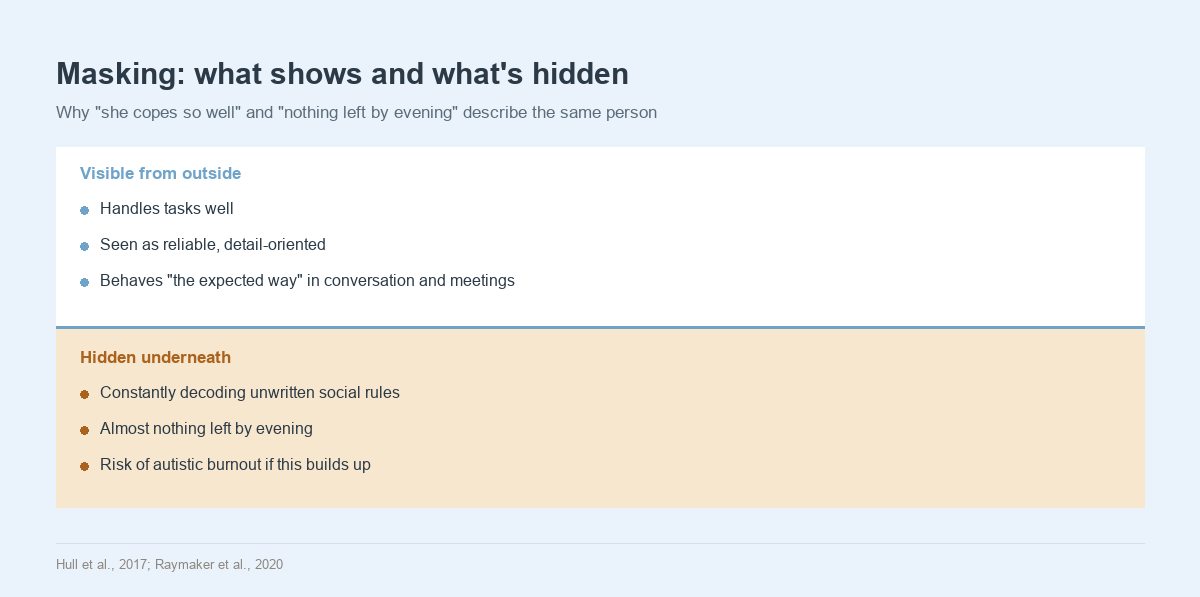
That's why signs of autism in adults are often hidden: on the outside you're coping well, and by evening there's almost nothing left inside.
If that strain goes on for years, it can build into a state the interview-study authors called autistic burnout: prolonged exhaustion, loss of skills that used to come easily, and reduced tolerance for stimulation (Raymaker et al., 2020). If this sounds familiar, we've written a separate piece on how masking works and why it's so draining: masking and burnout in autism.
The picture often looks different in women and gets noticed even later, which is why there's a separate article for them: autism in adult women.
What Autism Can Be Mistaken For, and What Often Comes Along With It
Some signs of autism in adults look similar to other conditions. Exhaustion from socializing shows up with social anxiety, difficulty planning and paying attention shows up with ADHD, and low energy shows up with burnout and depression. Sometimes all of this overlaps, which makes the picture complicated: for example, autism and ADHD can both be present in the same person. Only a specialist can tell similar conditions apart and work out what's contributing what. If you're mainly wondering how autism differs from ADHD and what to do if both seem to fit, we have a separate piece on that: autism or ADHD in adults: how to tell them apart.
Questions People Ask Most Often
Could this just be my personality? Individual traits, like loving quiet or planning conversations in advance, show up in plenty of people. ASD comes up when such traits have been present since early life and noticeably complicate important areas of life: work, relationships, well-being. The thing to weigh here is the cost you pay for an ordinary day.
Is it too late to look into this at my age? No. NICE guidance on diagnosing and supporting autism covers people aged 18 and over, with no upper age limit.
What if there's no diagnosis? That's a result too. Not getting confirmation doesn't erase the fact that things are hard, and it doesn't stop you from looking for ways to make life easier. You can look for support without a diagnosis.
How to Tell If an Adult Has Autism
If you want to check how much of this applies to you, it helps to remember: you can't know for certain on your own, and that's not your fault. A self-check can show which patterns described in research resonate more strongly, while a diagnosis is made by a specialist after an assessment that takes your whole life history into account. If you'd like to start with a self-check, here's a look at the kinds of autism tests for adults and what they actually show.
To make your own observations useful, including at a consultation if you decide to have one:
- for a week or two, note down which situations leave you with little energy and what helps you recover;
- think back to your childhood and school years: how you played, who you were friends with, what was hard, and ask people close to you what they remember;
- mark which of the traits above have been there all along, and which showed up later.
Notes like these help you see the signs of autism in adults in the context of your own life, not just as a general list.
What You Can Do Right Now
You don't really need to wait for a diagnosis to start changing things. You can plan for downtime after demanding days, mask less where it's safe to do so, choose quieter settings, and tell the people you trust about your traits. Even a few people around whom you don't have to play a role make a real difference to how you feel.
If you'd like to talk to specialists who work with requests like this, take a look at how our support is set up: from the first test to everyday support. You can start without a diagnosis and without any commitment. If you recognized yourself in any of this, it's simply an explanation, one that makes it easier to build a life on your own terms.
Sources
- Lai M.-C., Baron-Cohen S. (2015). Identifying the lost generation of adults with autism spectrum conditions. The Lancet Psychiatry, 2(11), 1013–1027.
- Hull L. et al. (2017). "Putting on My Best Normal": Social Camouflaging in Adults with Autism Spectrum Conditions. Journal of Autism and Developmental Disorders, 47(8), 2519–2534.
- Raymaker D. M. et al. (2020). Defining Autistic Burnout. Autism in Adulthood, 2(2), 132–143.
- Tavassoli T. et al. (2014). Sensory over-responsivity in adults with autism spectrum conditions. Autism, 18(4), 428–432.
- American Psychiatric Association. DSM-5-TR diagnostic criteria for autism spectrum disorder (via StatPearls, 2025).
- NICE (CG142). Autism spectrum disorder in adults: diagnosis and management.
This material is for informational purposes only and does not replace a consultation with a specialist.