Autism and ADHD in Adults: Differences, Similarities, and What AuDHD Is

You read a description of autism and recognize yourself, then a description of ADHD and recognize yourself even more. If you searched for "autism and ADHD in adults differences," you are probably at exactly this fork and don't know where to start. The short answer: the signs partly overlap, the history from childhood and an assessment by a specialist help tell them apart, and some people have both.
Below is a practical walk-through: how the two conditions are alike, how they differ, what AuDHD is, and where to start if both seem to fit. The article helps you get your bearings and diagnoses no one, and only a specialist can make a diagnosis.
How Autism and ADHD in Adults Are Alike
They are alike above all in their effects on everyday life because both begin in childhood and affect attention, organization, communication, and emotions. This is where confusion arises most often:
- Difficulties with attention and organization. Tasks don't start, time slips away, and thoughts drift, and from the outside this is easy to take for the same thing.
- Fatigue from socializing. After meetings you need time to recover, in both autism and ADHD.
- Strong emotions. Irritation and overload hit quickly and are slow to ease.
- Late recognition. Adults often notice either condition only after years of difficulty, and before that are treated for anxiety or depression.
How Autism and ADHD in Adults Differ
The differences are clearest in what causes a difficulty and not in the difficulty itself. At the core of autism, according to NICE, are lasting difficulties in social interaction and communication, repetitive rigid behavior, resistance to change or narrow interests, and differences in sensitivity (NICE, 2012). At the core of ADHD, by DSM-5 criteria, are inattention and hyperactivity with impulsivity (Volkow & Swanson, 2013). This gives pointers that do not replace an assessment:
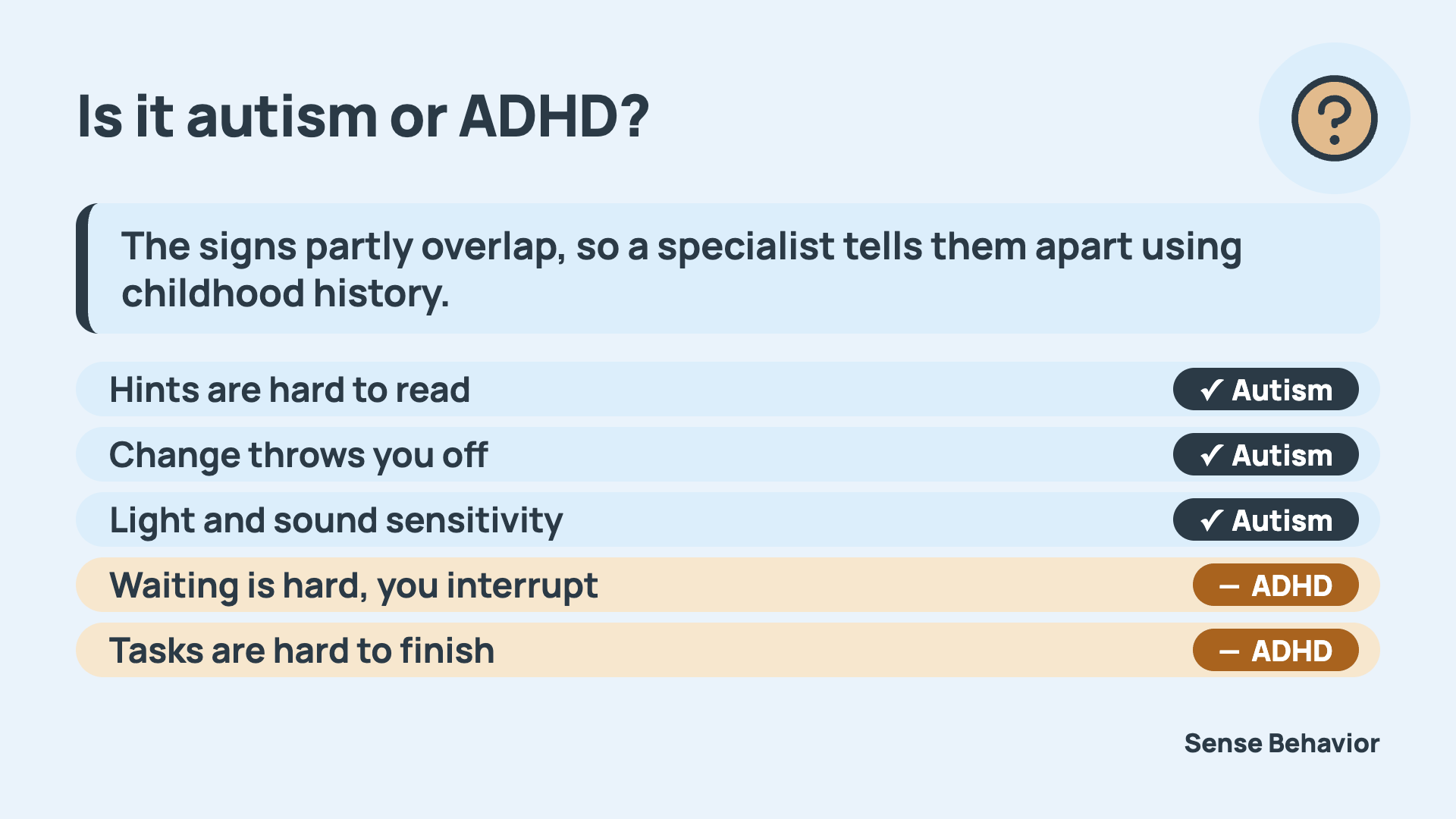
- Communication. In autism it is hard to read hints and unwritten rules, and conversations have to be thought through in advance. In ADHD the thread is lost more often and you want to interrupt or answer before the other person finishes, because waiting is hard.
- Change and order. In autism change throws you off and familiar order calms. In ADHD order is usually wanted but hard to keep up and to carry through to the end.
- Attention. In autism it often goes deep into a chosen interest. In ADHD it is hard to hold on anything boring or demanding sustained effort.
- Sensitivity to surroundings. Heightened or reduced sensitivity to light, sound, and touch is part of the picture of autism, and it is not part of the ADHD criteria.
Can a Person Have Both Autism and ADHD
Yes, and it is not rare. In the meta-analysis by Lai and colleagues, pooling 96 studies, ADHD occurred in about 28% of autistic people (Lai et al., 2019). The NICE autism guideline lists ADHD among the reasons to consider an autism assessment (NICE, 2012), and the ADHD guideline advises against refusing a diagnosis only because an autism spectrum disorder is present (NICE, 2018).
For this combination, communities use the informal word AuDHD, from autism and ADHD. It is not a separate diagnosis but a convenient name for the case where a person has both conditions, and officially both diagnoses are made separately.
How to Tell Autism From ADHD in Adults
It is hard to do on your own, because the difference is built on developmental history and a conversation with a specialist and not on a single questionnaire. In an autism assessment, according to NICE, other neurodevelopmental conditions are also assessed (NICE, 2012), and in an ADHD assessment the criteria and coexisting conditions are checked (NICE, 2018). You can start preparing today:
- write down separately the situations that drain you because of surroundings, change, and communication, and the situations where you lose the thread, put things off, and don't finish;
- recall your school years and ask your parents what you were like as a child, because both diagnoses rest on childhood;
- tell the doctor you recognize yourself in both descriptions and ask them to assess both conditions;
- take the screeners separately and remember that each shows only a reason for an assessment.
What to Read Next About Autism and ADHD in Adults
If the description of autism fits you better, begin with the piece on what autism in adults is, in simple words and the breakdown of autism tests for adults, and if ADHD, with the explanation of what adult ADHD is and the breakdown of ADHD tests for adults. How an assessment goes and who to see is in the pieces on autism diagnosis and ADHD diagnosis.
You can work out where to start in your own situation with no commitment, through the bot, which asks a few questions and suggests a next step, and how the center's work with adults is set up in general is on the For Adults page.
Sources
- Lai M.-C. et al. (2019). Prevalence of co-occurring mental health diagnoses in the autism population: a systematic review and meta-analysis. The Lancet Psychiatry, 6(10), 819–829.
- NICE (CG142, 2012, updated 2021). Autism spectrum disorder in adults: diagnosis and management.
- NICE (NG87, 2018, updated 2019). Attention deficit hyperactivity disorder: diagnosis and management.
- Volkow N. D., Swanson J. M. (2013). Adult Attention Deficit–Hyperactivity Disorder. New England Journal of Medicine, 369(20), 1935–1944.
This material is for informational purposes only and does not replace a consultation with a specialist.