Alexithymia in Adults: Why It Is Hard to Name What You Feel and What Helps

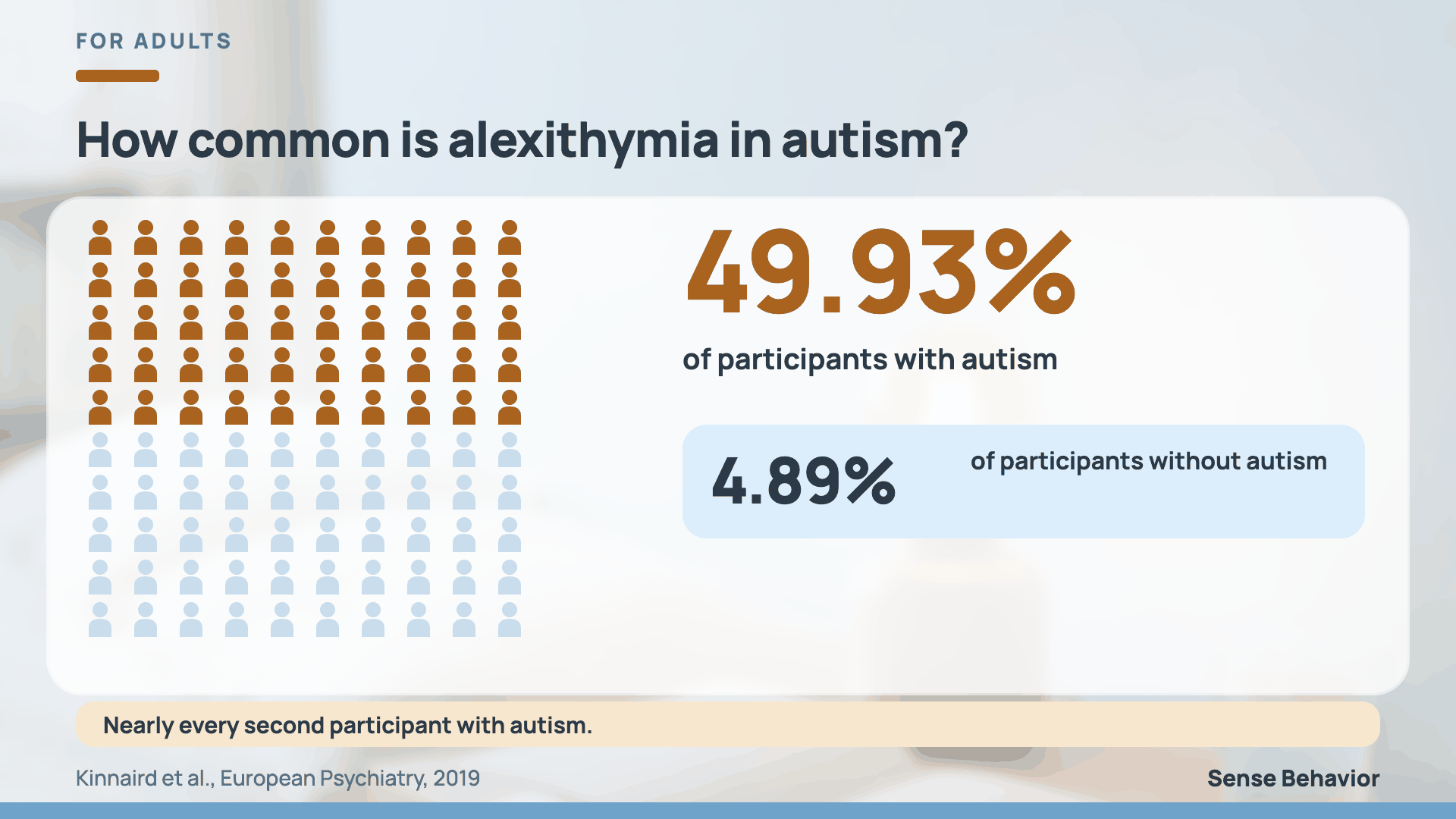
Alexithymia in adults means difficulty noticing and naming your own feelings. You know something is off but cannot say what it is: anger, tiredness, hurt or plain hunger. It is a trait that shows up in many ways, and on its own it does not count as a diagnosis. It is discussed most often in relation to autism: in the 2019 meta-analysis by Kinnaird and colleagues, signs of alexithymia were found in 49.93% of autistic people versus 4.89% in comparison groups.
If you have gotten used to answering "how are you?" with "fine" while everything inside hums, you are far from alone. Below we look at how this feels, what research says and where you can begin.
What is alexithymia in adults and how does it show up
The word comes from 1970s psychology and describes trouble identifying and describing feelings. People tend to describe it in similar ways. Here are the common ones.
- Only "good", "bad" or "nothing" come to mind for your feelings.
- You notice an emotion through your body: a lump in the throat, a heavy chest, a headache.
- Feelings hit suddenly, as if from nowhere.
- When you recount your day, you list facts rather than experiences.
- When asked "what do you feel?", the reply that comes up is often "I don't know".
These descriptions help you recognise yourself and prove nothing. Self-observation does not replace an assessment by a specialist, and questionnaires such as the Toronto Alexithymia Scale (TAS-20) are used as part of an evaluation, with the score alone not amounting to a diagnosis.
Alexithymia and autism: what research shows
In the systematic review and meta-analysis by Kinnaird, Stewart and Tchanturia (European Psychiatry, 2019), fifteen studies of autistic and non-autistic participants were compared. Alexithymia was clearly more common in the first group, 49.93% against 4.89%. The authors stress that it is frequent but not universal, so its absence proves nothing. It is described outside autism too, but this article leans on the data about autism.
When trouble with feelings comes with exhaustion from constant self-monitoring, take a look at the piece on masking and burnout in autistic adults, which explains where that depletion comes from.
How to understand what I feel: simple steps for alexithymia
These are general approaches you can try on your own. Few studies have tested them specifically in autistic adults, so treat them as ways to try things and see what suits you.
- Start with the body and ask where the tension is right now: jaw, shoulders, stomach.
- Describe the sensation in plain words: heaviness, heat, emptiness, trembling.
- Take a list or wheel of emotions and pick the nearest word, even an imperfect one.
- Write one line three times a day: time, situation, sensation, word.
- If a word does not fit, swap it for another and see whether it resonates.
- Ask someone close to suggest a word if you are comfortable with that.
For tonight, pick one moment of your day and describe the bodily sensation in three words. That is enough for a first step.
Body signals are often tied to sensory overload, and if you notice that noise, light or crowds knock you off balance, the article on sensory overload in adults may help.
Who to see if trouble with feelings gets in the way of life
If unclear emotions are straining your relationships, work or sleep, it makes sense to talk to a psychologist or psychotherapist who works with adults with autism and ADHD. They can help you find words and notice body signals. When strong anxiety or low mood is present, a psychiatrist joins the conversation. We do not diagnose from a description, that is done by a specialist after an in-person assessment. For how the overall picture of signs forms, see the piece on signs of autism in adults.
If you would like to talk through your situation, write to us using the link at the bottom of the page.
This material is for informational purposes only and does not replace a consultation with a specialist.