Masking and Burnout in Autistic Adults
The day was completely ordinary: nothing happened, no visible stress from outside. And by evening there was nothing left, not even enough to answer a message or decide what to make for dinner. If this sounds familiar, the problem might not be that the day was hard — it might be what it took to get through it "the right way." Autistic adults call this masking, and it isn't one habit. It's several strategies, each with a different cost.
Masking is not one strategy, but several
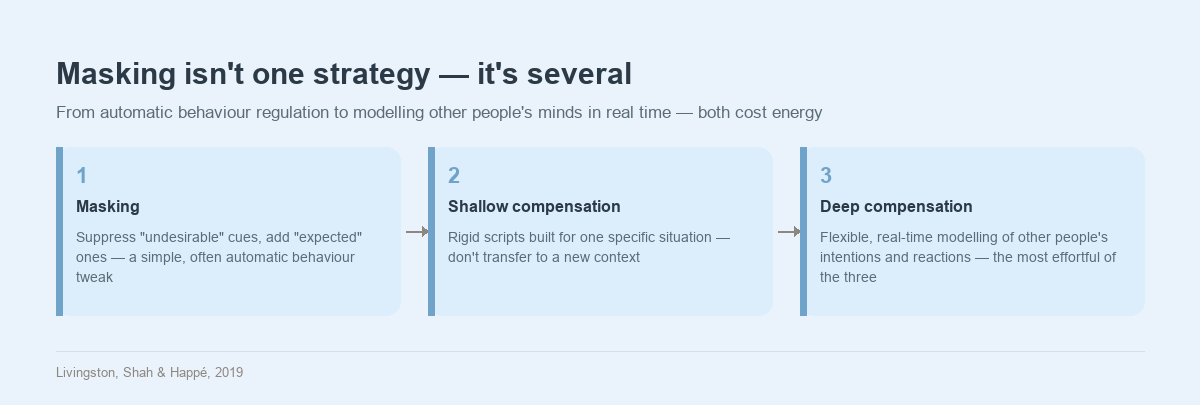
Researchers Livingston, Shah, and Happé surveyed 136 adults (58 diagnosed with autism, 19 self-identified as autistic, and 59 without a diagnosis but reporting similar difficulties) and identified several strategies of different complexity for hiding autistic traits (Livingston, Shah & Happé, 2019). Masking, in the narrow sense, is the simplest part: suppressing what's seen as undesirable, adding what's seen as expected, often almost automatically. Next comes shallow compensation — rigid scripts built for one specific situation that don't transfer to a new context. Deep compensation is the most demanding: flexible, real-time modelling of other people's intentions and reactions.
In participants' own words
Participants in that same study described it like this:
Study participant, non-diagnosed (Livingston et al., 2019).
Study participant, diagnosed at age 51–60 (Livingston et al., 2019).
The cost that doesn't show from outside
When masking and compensation become a way of life rather than a rare exception, the accumulated exhaustion can tip into what researchers call autistic burnout: prolonged exhaustion, loss of skills that used to come easily, and reduced tolerance for stimulation (Raymaker et al., 2020). This isn't ordinary tiredness that clears up over a weekend — it's a deeper, longer-lasting state.
Anxiety often goes hand in hand with this — not as a separate problem that happens to show up at the same time, but as one of the direct consequences of constantly monitoring yourself. In the same study, participants linked compensatory strategies to anxiety and depression: among those with an autism diagnosis, 36% had an anxiety disorder and 22% had a depressive disorder. Masking and compensation were described as exhausting and stressful in their own right, separate from whatever else was going on that day.
Why ordinary rest doesn't help
Autistic burnout is easy to mistake for ordinary tiredness or depression, but it recovers differently. By Raymaker and colleagues' account, this state can last three months or longer, and approaches usually recommended for depression often don't work here. What helps instead: meaningfully cutting demands and sensory load for a while, allowing yourself not to mask where it's safe to do so, and leaning on people who don't require you to constantly be "on" (Raymaker et al., 2020). Taking a week off and going back to the same routine usually isn't enough — this calls for seriously rethinking the load for a while.
What you can do about it
Removing masking from your life entirely probably isn't possible, and it isn't always necessary — sometimes it's a deliberate choice in a specific situation. But if it's become the backdrop of nearly every day rather than the exception, it helps to start small: notice which situations cost the most, and deliberately leave room in your week where you don't have to perform anything. This doesn't solve the whole thing, but it hands back a bit of choice where right now there may not feel like any at all.
Questions people ask most often
How do I know if this is burnout and not just a tiring week? Ordinary tiredness usually clears up over a weekend or a holiday. Autistic burnout lasts weeks and months, often alongside losing skills that used to come easily and a heightened sensitivity to stimulation that wasn't there before to that degree.
Do I need an official diagnosis for this to apply to me? No. The mechanism of masking and its cost are just as real whether you already have a diagnosis or you're only starting to work this out.
Where to go from here
If you'd like the wider picture of how autism shows up in adults generally, not just the masking mechanism, here's a general overview: signs of autism in adults: what they look like and why they're often missed. If this exhaustion is tied mainly to the role of "she copes so well" at work and at home, here's a piece specifically about that: autism in adult women: why it gets missed so often. And if it's long felt like you're "not the way autism gets described," here's a plain explanation: what autism in adults means, in plain words.
You can talk to a specialist with no commitment — through the bot, which asks a few questions and suggests a next step, and how the center's work with adults is set up in general is on the For Adults page.
Sources
This material is for informational purposes only and does not replace a consultation with a specialist.