What Is ADHD in Adults in Simple Words: Signs, Causes, and What to Do

"I spend more energy looking organized than on the actual work." You can hear a phrase like this from many adults who suspect they have ADHD. If you searched for what adult ADHD is in simple words, you have probably already met the word in connection with yourself and want to understand, without medical language, what it is about, where it comes from, and what is done about it.
This article serves as the main overview: it gives the general picture, and the details are moved into separate pieces linked throughout the text. It helps you get your bearings, and only a specialist can make a diagnosis.
What Is ADHD in Simple Words
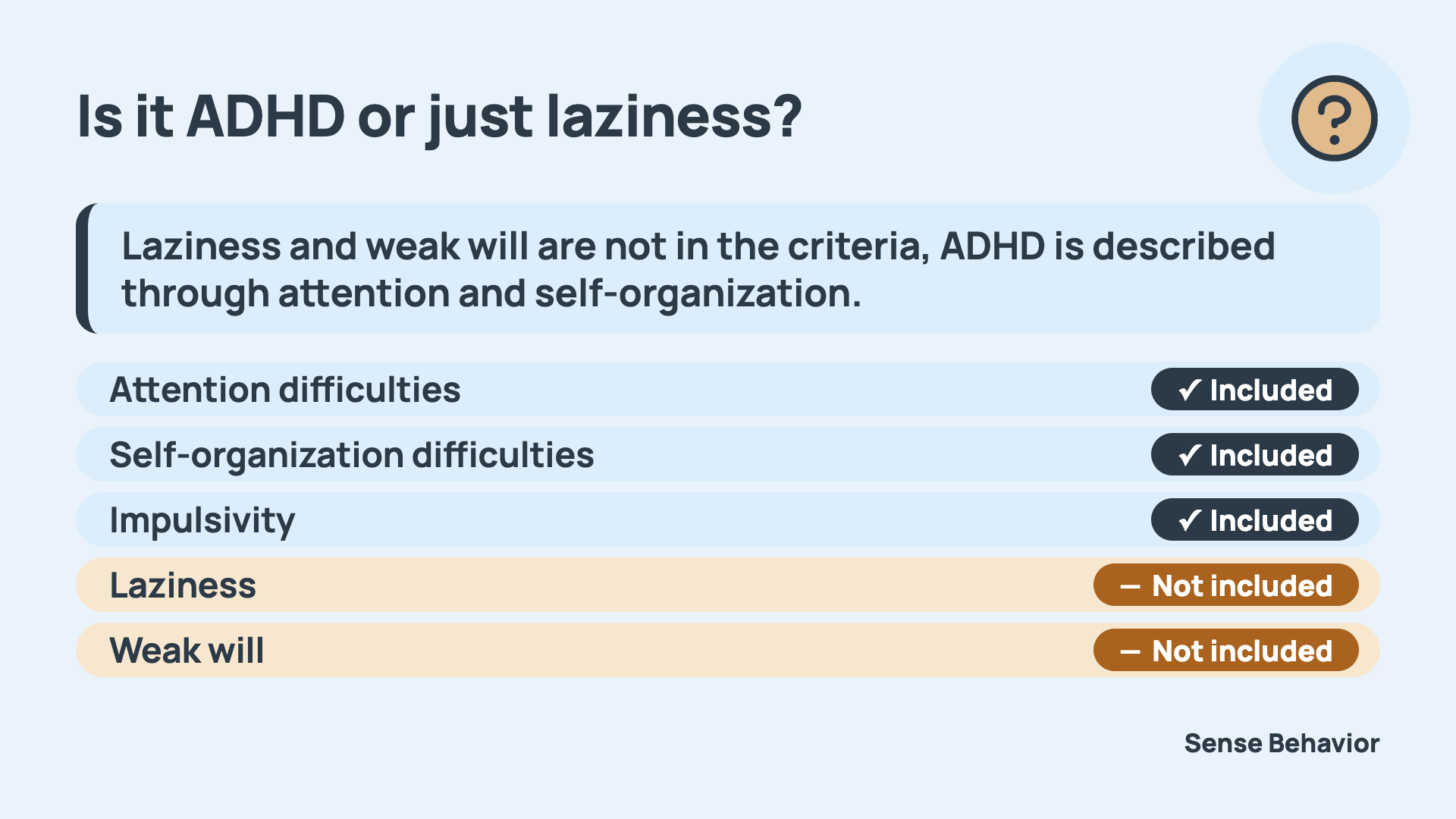
ADHD (attention-deficit/hyperactivity disorder) is a difference in the development of the nervous system in which attention, self-organization, and impulse control work differently than in most people, and it begins in childhood. Attention is not absent, it is harder to steer: it sticks to the interesting, slips away from the boring, and starting a needed task without an outside push is harder. Laziness and weak will are not in the diagnostic criteria.
In the DSM-5 classification, symptoms are split into two groups, inattention and hyperactivity with impulsivity, with nine signs in each. For an adult, five of nine in either group is enough, they must last at least six months, appear before age 12, and show up in at least two areas of life (Volkow & Swanson, 2013).
What Does the Abbreviation ADHD Mean in Adults
The abbreviation stands for attention-deficit/hyperactivity disorder, and the name misleads in two places at once. Attention is not "deficient" but poorly steered, and hyperactivity in adults rarely looks like running around and more often becomes inner tension, difficulty relaxing, and talkativeness (Kooij et al., 2010).
What Types of ADHD Exist in Adults
Three presentations are distinguished, and over time one can give way to another. According to expert guidance, with age inattention and difficulties with self-organization come to the front while visible motor activity recedes (Kooij et al., 2010). The presentations are:
- Predominantly inattentive. It is hard to start and finish tasks, things and the thread of a conversation are easily lost, and thoughts wander off.
- Predominantly hyperactive-impulsive. It is hard to wait and to relax, you want to be doing something all the time, and decisions are made quickly and on the fly.
- Combined. Signs of both groups are present.
Where Does ADHD Come From
ADHD runs in families, and the reason is not parenting or a lack of willpower. Studies of families, twins, and adoptees show high heritability, around 74%, while the influence of individual gene variants is very small, and no single gene "is responsible" for ADHD (Faraone & Larsson, 2019).
How Common Is ADHD in Adults
According to a global meta-analysis, ADHD with a childhood onset persists in about 2.6% of adults, and counting those who have symptoms without a confirmed childhood start, the estimate rises to 6.8% (Song et al., 2021). These shares decrease with age, and the difference between men and women in the pooled estimates is not statistically significant.
What Adult ADHD Looks Like in Everyday Life
Most often it is not one vivid trait but a combination of everyday difficulties that repeat for years: a task won't start without a deadline, what is begun stays unfinished, time slips away, small things get lost, and more energy goes into looking organized than into the work itself. A detailed breakdown by the criteria is in the piece on ADHD symptoms in adults, why the diagnosis comes later in women is in the piece on ADHD in adult women, and the mechanism of why only a deadline switches on focus is described in the breakdown of executive function.
Men with ADHD often see a doctor only after a crisis at work or in a relationship, and the article on ADHD in adult men explains why that happens.
What to Do If You Recognize Yourself in the Description of ADHD
Gather material for a doctor: a specialist makes the diagnosis and the feeling that the description is about you is worth checking. You can start today: write down three situations from the past month where you got stuck at the start, and recall how it was at school. Separate pieces will help next:
- ADHD tests for adults, to understand what a screener shows and where its limits are;
- adult ADHD diagnosis, to find out which doctor to see;
- how to cope with ADHD without medication and ADHD treatment in adults, to understand what the doctor decides and what you can do yourself;
- does ADHD go away with age, if you were waiting for it to pass on its own.
If you would like to go deeper at a pace that suits you, a selection of books is gathered in books about ADHD in adults.
You can work out where to start in your own situation with no commitment, through the bot, which asks a few questions and suggests a next step, and how the center's work with adults is set up in general is on the For Adults page.
Sources
- Volkow N. D., Swanson J. M. (2013). Adult Attention Deficit–Hyperactivity Disorder. New England Journal of Medicine, 369(20), 1935–1944.
- Kooij S. J. J. et al. (2010). European consensus statement on diagnosis and treatment of adult ADHD: The European Network Adult ADHD. BMC Psychiatry, 10, 67.
- Faraone S. V., Larsson H. (2019). Genetics of attention deficit hyperactivity disorder. Molecular Psychiatry, 24(4), 562–575.
- Song P. et al. (2021). The prevalence of adult attention-deficit hyperactivity disorder: A global systematic review and meta-analysis. Journal of Global Health, 11, 04009.
This material is for informational purposes only and does not replace a consultation with a specialist.