How to Cope With Adult ADHD Without Medication: CBT, Coaching, and Working Strategies

You have probably already tried timers, planners, and task apps, dropped them after a couple of weeks, and then blamed yourself for weak willpower for a long time. If you are looking for how to cope with adult ADHD without medication, it helps to start with a simple fact: such tools most often fail because they rely on the very inner signal to start that is weaker in ADHD, and not because something is wrong with you.
Below is what helps without pills, what research says about it, and where to start today. It helps you get your bearings, and treatment decisions are made by a doctor.
What Helps With Adult ADHD Without Medication
Without medication, people rely on cognitive behavioral therapy (CBT) tailored to ADHD, on external structure in daily life, and on regular support. According to the UK's NICE guideline, this kind of treatment is worth considering when a person has made an informed choice not to take medication, has difficulty taking it, or finds it ineffective or not tolerated (NICE, 2018). This is what it usually consists of:
- CBT focused on ADHD. This is training in planning, organization, and time management skills, and work with thoughts that get in the way of starting. NICE names as the minimum a structured supportive psychological intervention focused on ADHD, with regular follow-up in person or by phone, and allows either elements of CBT or a full course (NICE, 2018).
- Changes to the environment. The NICE guideline suggests first making and reviewing changes to surroundings, and only then deciding on medication if symptoms still get in the way significantly (NICE, 2018). These are reminders where you will certainly see them, order in the places where you lose things, and splitting big tasks into steps.
- Regular support. Meetings where you and a specialist look at what worked and what to change give what an app doesn't: a person who holds the thread.
- Sleep, movement, and food. NICE calls a balanced diet and regular exercise valuable for all people with ADHD (NICE, 2018).
Why Apps and Planners So Often Don't Stick in ADHD
Because an app you have to open and keep up yourself relies on the same inner signal to start that is weaker in ADHD. This is a logical consequence of how executive function works and not a separate research finding, and the mechanism is described in detail in the breakdown of executive function in adult ADHD. So it is more useful not to look for the perfect tool but to build a support that doesn't require you to remember it: a reminder tied to a specific place and time, a person you tell when you start, a short weekly review.
What Research Shows About CBT for Adult ADHD
CBT reduces symptoms and improves daily life although the effect compared with control groups is more modest than before and after treatment. A meta-analysis by Knouse and colleagues, pooling 32 studies and up to 896 participants, showed large changes in self-reported symptoms before and after therapy (g = 1.00) and medium-to-large changes in self-reported functioning (g = 0.73), while against control groups the effect was small to medium (g = 0.65 for symptoms and 0.51 for functioning). In studies with active control groups the effect was smaller, and the length of the course and its format did not affect the result (Knouse et al., 2017). The authors compare the effect to behavioral methods for children with ADHD, which are considered well established. An important caveat is that the main results in this work come from participants' self-report.
Where to Start With Adult ADHD Without Medication Today
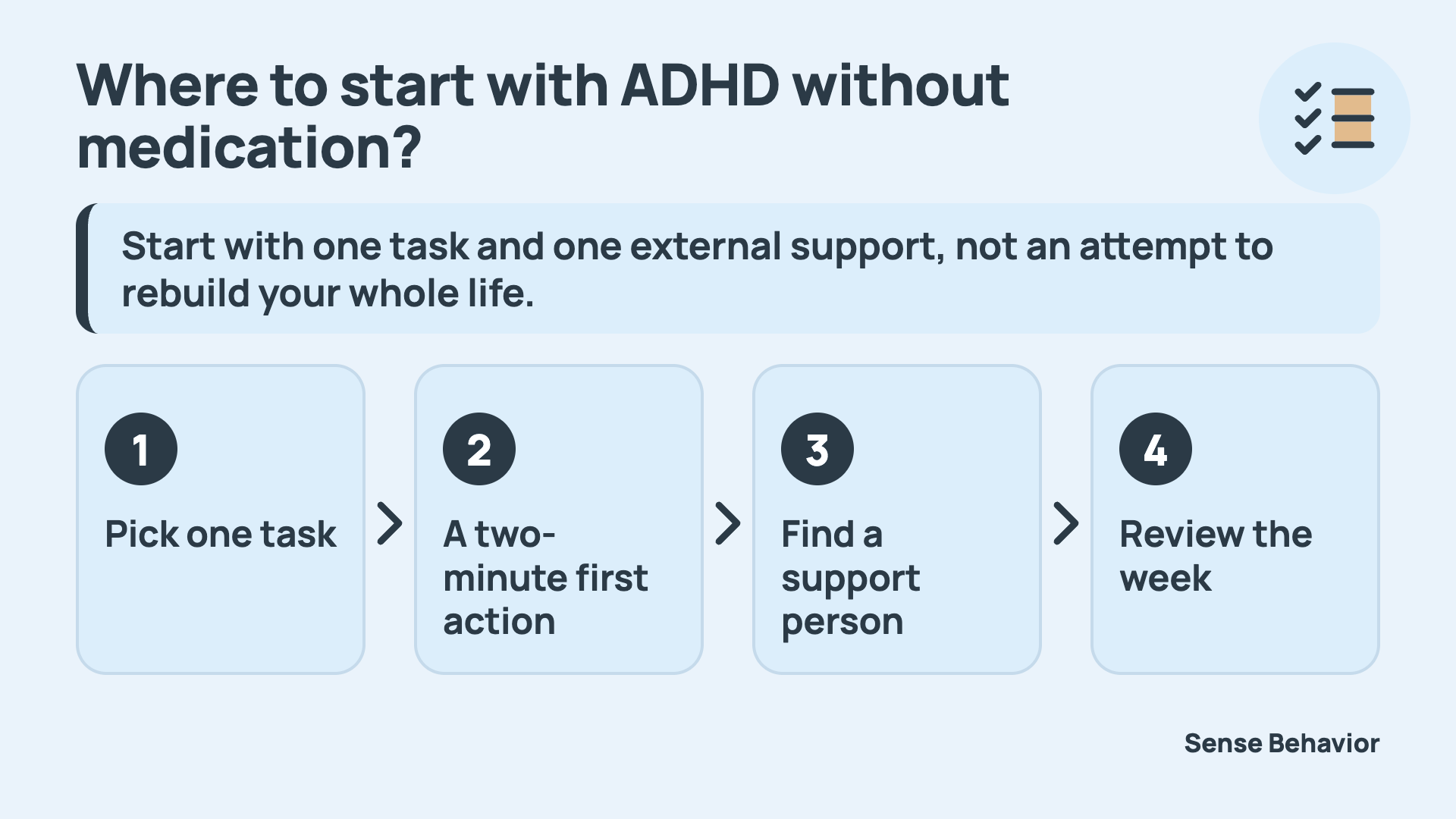
This is not treatment but a first set of supports, and you can start with one recurring task without trying to rebuild everything at once:
- pick one task that regularly stalls and decide at what time and in which place you begin it;
- define a first two-minute action, for example opening the file and writing a heading, and aim to do only that;
- agree with a person you message "started" and "finished";
- set aside ten minutes at the end of the week to look at what worked and drop what didn't stick;
- if you can, anchor your wake-up and bedtime, because lack of sleep amplifies attention difficulties.
Some people find it easier to start with reading, and the books worth opening first are listed in books about ADHD in adults.
When Going Without Medication Is Not Enough
If after changing the environment and working on skills symptoms still get in the way of life noticeably, the NICE guideline suggests discussing medication with a doctor and, where needed, combining it with psychological support (NICE, 2018). The choice here is made by the doctor together with you, and declining medication is as acceptable as agreeing to it. What a psychiatrist decides and what you can do yourself we cover in the piece on ADHD treatment in adults, and how an assessment works if you haven't sought one yet in the piece on adult ADHD diagnosis.
If strategies are easier to work through together with someone, you can start with no commitment through the bot, which asks a few questions and suggests a next step, and how the center's work with adults is set up in general is on the For Adults page.
Sources
This material is for informational purposes only and does not replace a consultation with a specialist.