Does ADHD Go Away With Age: What Changes and What Stays

As a child you were called restless or absent-minded, and adults assured you it would pass with age. You grew up, the fidgeting calmed down, and the difficulties stayed, only now they look different. If you searched for "does ADHD go away with age," you are probably trying to figure out whether to wait for it to disappear on its own or to take a closer look at yourself.
Below is what research knows: for whom symptoms persist, how the picture changes over the years, and what to do if you recognize yourself in the descriptions. The article helps you get your bearings, and only a specialist can make a diagnosis.
Does ADHD Go Away With Age
Most often it does not disappear completely but changes shape, and in some people symptoms do become weaker. It all depends on what counts as "gone." In the meta-analysis by Faraone and colleagues, only about 15% of people still met full ADHD criteria by age 25, but counting those who keep some impairing symptoms, the share rose to about 65% (Faraone et al., 2006). The authors stress that estimates depend heavily on the definition, and that it is still unclear whether the decline reflects true remission or the fact that the criteria were built for children and fit adults less well.
What Changes in ADHD With Age
Over the years visible motor activity usually recedes, while inattention, difficulties with self-organization, and inner tension come to the front. The European expert group on adult ADHD describes this as an age-related shift in the picture (Kooij et al., 2010). This is what most often happens:
- Running around turns into inner busyness. Outwardly you sit calmly, while inside a motor seems to be running, and it is hard to relax in the evening.
- Organization and planning come to the front. In childhood parents and school held much of it for you, and in adult life you have to create the structure yourself.
- Impulsivity changes form. It is no longer shouting out in class but hasty decisions, impatience, and flashes of irritation.
- The cost of difficulties grows. Work, money, household, and relationships demand just what is hardest to manage.
Why It Seems That ADHD Has Gone Away
Because the most visible part fades and because many learn to compensate over the years. Motor restlessness calms and from outside the person looks calmer, while inside the tension is the same. In addition, adults with ADHD often build around themselves a system of reminders and workarounds that hides the difficulties for as long as it has the energy, and under stress, a change of job, or the birth of a child they show up again. Why such techniques use up energy we wrote about in the piece on executive function in ADHD.
How Often ADHD Persists Into Adulthood
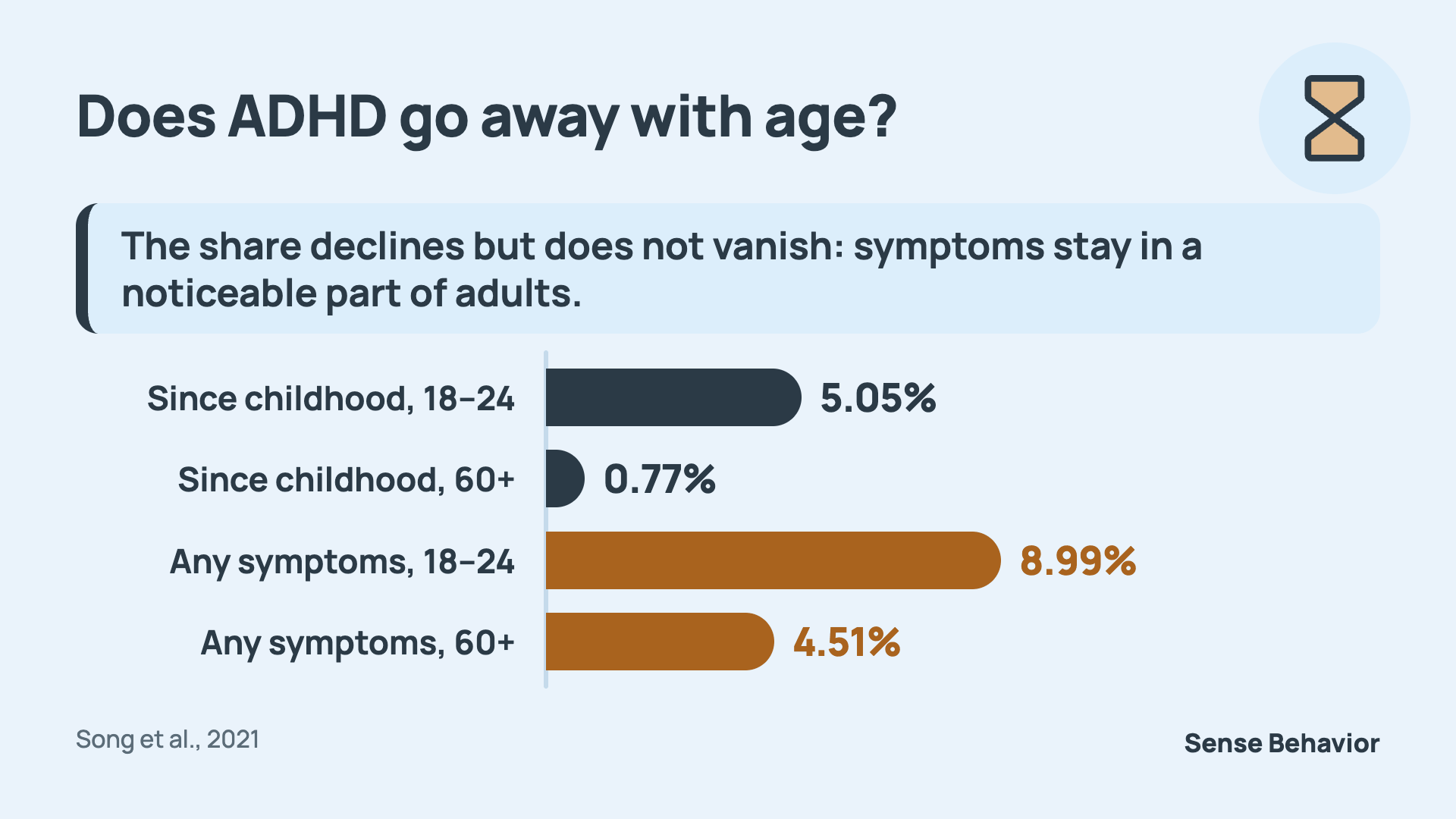
According to a global meta-analysis, the share of adults with ADHD that began in childhood fell from 5.05% at ages 18 to 24 to 0.77% after 60, and the share of those with symptoms regardless of childhood onset from 8.99% to 4.51% (Song et al., 2021). These are estimates of the share within different age groups, and they show a decline and not disappearance: symptoms remain in a noticeable part of adults of any age.
What to Do If You Were Restless as a Child and Things Are Different Now
Don't wait for it to pass on its own but check what is going on with you now. You can start today:
- write down situations from the past month where you got stuck at the start, lost the thread, or didn't finish, and note in which areas of life it repeats;
- recall what was said about you at school and ask your parents, because for an adult diagnosis it matters that the signs were there in childhood;
- read what the symptoms of ADHD in adults look like and compare with what is going on with you now;
- if you recognize yourself, find out how an adult ADHD diagnosis goes.
If you are still looking for the general picture, begin with the piece on what ADHD in adults is in simple words, and if you feel you were overlooked for a long time, see the breakdown of ADHD in adult women.
You can work out where to start in your own situation with no commitment, through the bot, which asks a few questions and suggests a next step, and how the center's work with adults is set up in general is on the For Adults page.
Sources
- Faraone S. V., Biederman J., Mick E. (2006). The age-dependent decline of attention deficit hyperactivity disorder: a meta-analysis of follow-up studies. Psychological Medicine, 36(2), 159–165.
- Kooij S. J. J. et al. (2010). European consensus statement on diagnosis and treatment of adult ADHD: The European Network Adult ADHD. BMC Psychiatry, 10, 67.
- Song P. et al. (2021). The prevalence of adult attention-deficit hyperactivity disorder: A global systematic review and meta-analysis. Journal of Global Health, 11, 04009.
This material is for informational purposes only and does not replace a consultation with a specialist.