ADHD in Adult Women: Why It Goes Unnoticed for So Long

"I read about ADHD and it felt like it was written about me. But maybe I just talked myself into it?" Many women ask this when they first read about the symptoms and recognize their own life in them. If you searched for "ADHD in adult women," you are probably somewhere here too, between recognition and doubt about your own sense of things.
The doubt is understandable, and it has an explanation. ADHD in women goes unnoticed for years for reasons that have been studied and described. Below are those reasons, what the symptoms look like, and what you can do without waiting for the doubt to settle on its own. The article helps you get your bearings, and only a specialist can make a diagnosis.
Why ADHD in Adult Women Goes Unnoticed for So Long
The picture of ADHD was shaped for a long time by the behavior of boys: loud, visible, and disruptive to others. In girls and women it is more often quiet and tucked behind diligence, so it reaches a doctor later. According to the expert consensus by Young and colleagues, children's clinics see anywhere from three to sixteen boys for every girl, while in the general population the ratio is about three to one, and among adults the difference in samples is modest or absent altogether (Young et al., 2020). The authors link the gap in clinics, in part, to ADHD in girls being overlooked and girls being referred for assessment less often.
It shows in experiments with one and the same case description, too. Teachers referred the child named as a boy for assessment more often (Young et al., 2020), and parents and teachers were less likely to recommend seeking help when the child was described as a girl (Quinn & Madhoo, 2014). How many women end up without a diagnosis is not yet known, and the consensus authors note this, but the mechanisms of being missed are described in detail. Here is what most often gets in the way of noticing ADHD:
- Inattention instead of hyperactivity. In the general population the inattentive presentation is more common in girls than in boys, and inattention disturbs others less, so it comes into view less often (Young et al., 2020).
- Skill at compensating. Many girls and women learn techniques that cover for difficulties, and these techniques mask the signs and delay the visit to a doctor (Young et al., 2020).
- Good grades. Diligence and decent marks do not rule out ADHD (Quinn & Madhoo, 2014).
- Anxiety and low mood in the foreground. They are reported more often in women with ADHD, and treatment frequently starts with them.
What Does ADHD Look Like in Adult Women
The diagnostic criteria for women are the same as for everyone but outwardly the picture is often calmer, and most of the load falls on inner tension and exhaustion from constant compensating. These are the things described most often:
- Inner busyness. Outwardly you seem collected, while inside there are many thoughts, and in the evening it is hard to switch your head off.
- Hidden chaos. Lists, time buffers, bags packed in advance, and other people's reminders keep life afloat for as long as your energy lasts.
- Self-criticism. In women with ADHD, low self-esteem is more pronounced than in men with ADHD (Quinn & Madhoo, 2014).
- Anxiety and mood dips as a background. The expert consensus calls this combination especially common in women (Young et al., 2020).
A detailed walk-through of the signs by DSM-5 criteria is in our piece on ADHD symptoms in adults and how to tell them from fatigue and anxiety, and if the "nothing moves until the deadline is on fire" pattern describes you best, take a look at the breakdown of how executive function ties into it.
Do Hormones Affect ADHD in Women
Possibly, but data are still scarce. The expert consensus says symptoms may get worse with hormonal changes during the menstrual cycle, in pregnancy, and at menopause, but the evidence is not enough to change treatment according to the phase of the cycle (Young et al., 2020). The practical takeaway is simple: if you notice your state changing over the month, write it down, because that picture is useful to a doctor. Decisions about medication, including during pregnancy and menopause, are made by a doctor.
Why ADHD in Women Is Often Mistaken for Anxiety or Depression
Because anxiety and depression often come alongside ADHD in women, and they are the ones that stand out. Emotional difficulties and anxiety are reported more often in women, and women may more often be given a primary diagnosis of an internalizing or personality disorder, which delays ADHD treatment (Young et al., 2020). In the review by Quinn and Madhoo, among girls aged 6 to 18 with ADHD, major depression occurred in 17% versus 1% in the control group, and several anxiety disorders at once in 34% versus 5%. The same review notes that women diagnosed with ADHD only in adulthood more often have a past of depression and anxiety (Quinn & Madhoo, 2014).
This does not make the anxiety imaginary, and it still needs treatment. But if ADHD stands behind it too, the question of why it is so hard to get organized and finish things stays unanswered, however many years the treatment goes on. How ADHD and anxiety are connected and how to tell them apart we cover in the piece on ADHD and anxiety.
What to Do If You Recognize Yourself in the Description of ADHD in a Woman
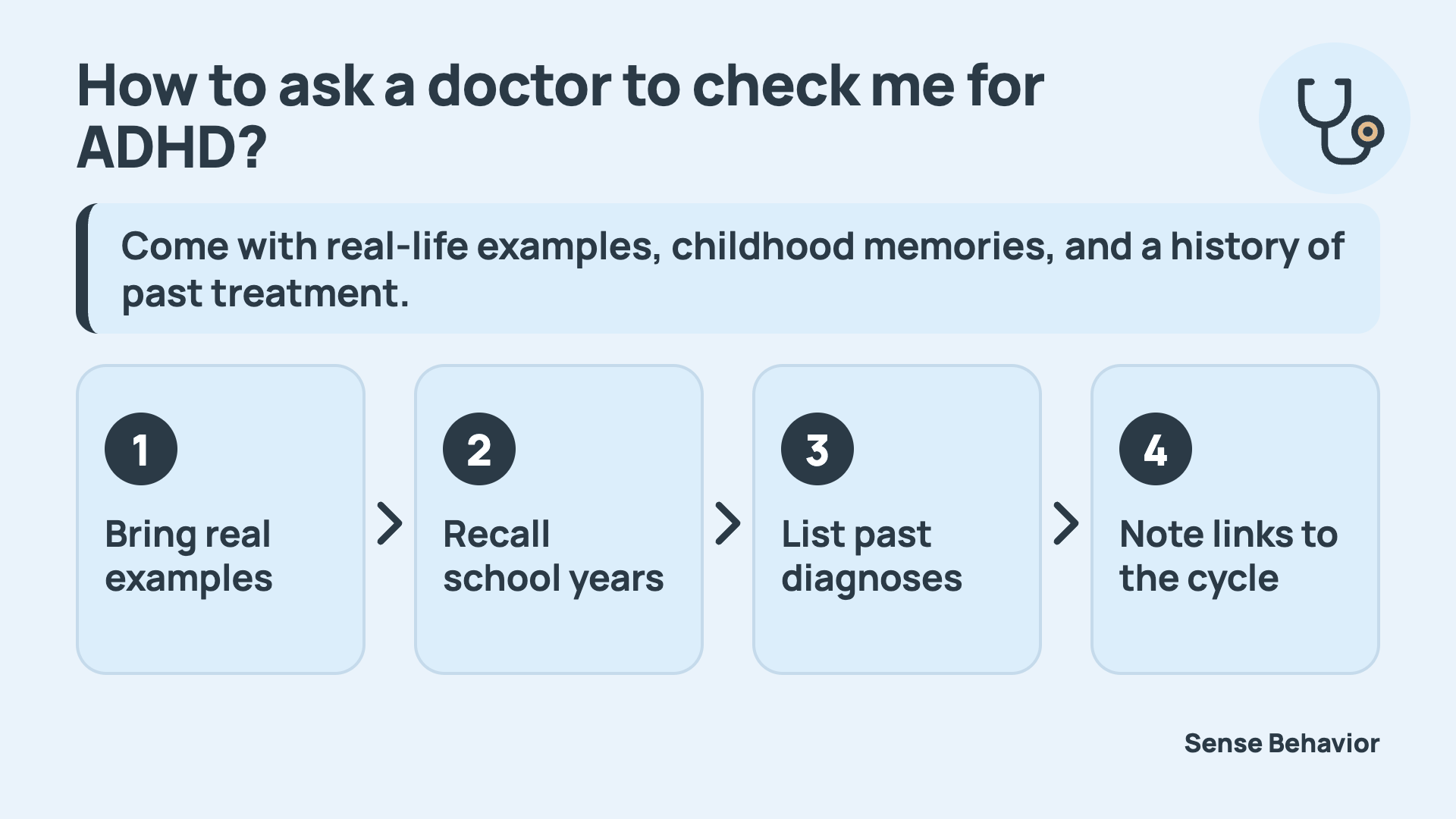
First, the main fear, "what if I made it up." It is familiar to many and proves nothing in either direction. It is settled by an assessment and not by how you feel about it, and your part of the work is to come to the doctor with material. You can start today:
- write down examples of situations where you got stuck or lost the thread, and note in which areas of life they repeat;
- recall your school years, teachers' remarks, and how you did homework, and if you can, ask your parents;
- list past diagnoses and treatment for anxiety or depression, and note what helped and what did not;
- keep notes on how your state changes over the month;
- choose a doctor who works with adults and with ADHD.
Screening questionnaires can also be part of the preparation, but they are only a reference point. Which ADHD tests exist and what they show we cover in the piece on ADHD tests for adults, and where to go and what an assessment includes in the piece on adult ADHD diagnosis.
The same symptoms can look different in men, and the article on ADHD in adult men is useful for comparison.
You can work out where to start in your own situation with no commitment, through the bot, which asks a few questions and suggests a next step, and how the center's work with adults is set up in general is on the For Adults page.
Sources
- Young S. et al. (2020). Females with ADHD: An expert consensus statement taking a lifespan approach providing guidance for the identification and treatment of attention-deficit/hyperactivity disorder in girls and women. BMC Psychiatry, 20, 404.
- Quinn P. O., Madhoo M. (2014). A review of attention-deficit/hyperactivity disorder in women and girls: uncovering this hidden diagnosis. The Primary Care Companion for CNS Disorders, 16(3), PCC.13r01596.
This material is for informational purposes only and does not replace a consultation with a specialist.