ADHD Test for Adults: What Tests Exist and What They Show

If you searched for "ADHD test for adults," you have probably already taken one or more online questionnaires and are now comparing the number with how you feel. The short answer is this: a test shows how similar your answers are to the answers of people with ADHD and works as a reason to seek an assessment, but it is not a diagnosis.
Below is a practical walk-through: which tests exist, what accuracy studies have shown, why they should not be trusted as a diagnosis, and what to do with the result. It helps you get your bearings, and only a specialist can make a diagnosis.
What ADHD Tests Exist for Adults
The best known self-completed questionnaire for adults is the ASRS (Adult ADHD Self-Report Scale), developed with the involvement of the World Health Organization. These are the ones met most often:
- ASRS v1.1. An 18-question version with a short six-question screener inside it, chosen to match clinical assessment as closely as possible (Kessler et al., 2005).
- The ASRS for DSM-5. A six-question version updated for the broader DSM-5 criteria (Ustun et al., 2017).
- Other self-rating scales. There are many, and the quality varies widely: some have accuracy studies behind them and some do not.
- Structured clinical interviews. For example, the DIVA-5. This is not a test for home but a conversation along a set outline led by a trained specialist.
How Accurate Are ADHD Tests for Adults
The accuracy of screeners is usually described with two numbers: sensitivity, the share of people with ADHD whom the test caught, and specificity, the share of people without ADHD whom the test correctly screened out. In the study by Kessler and colleagues, the six-question ASRS screener showed a sensitivity of 68.7% and a specificity of 99.5%, meaning it rarely raised a false alarm but missed roughly one in three people with ADHD. It was tested on 154 participants (Kessler et al., 2005).
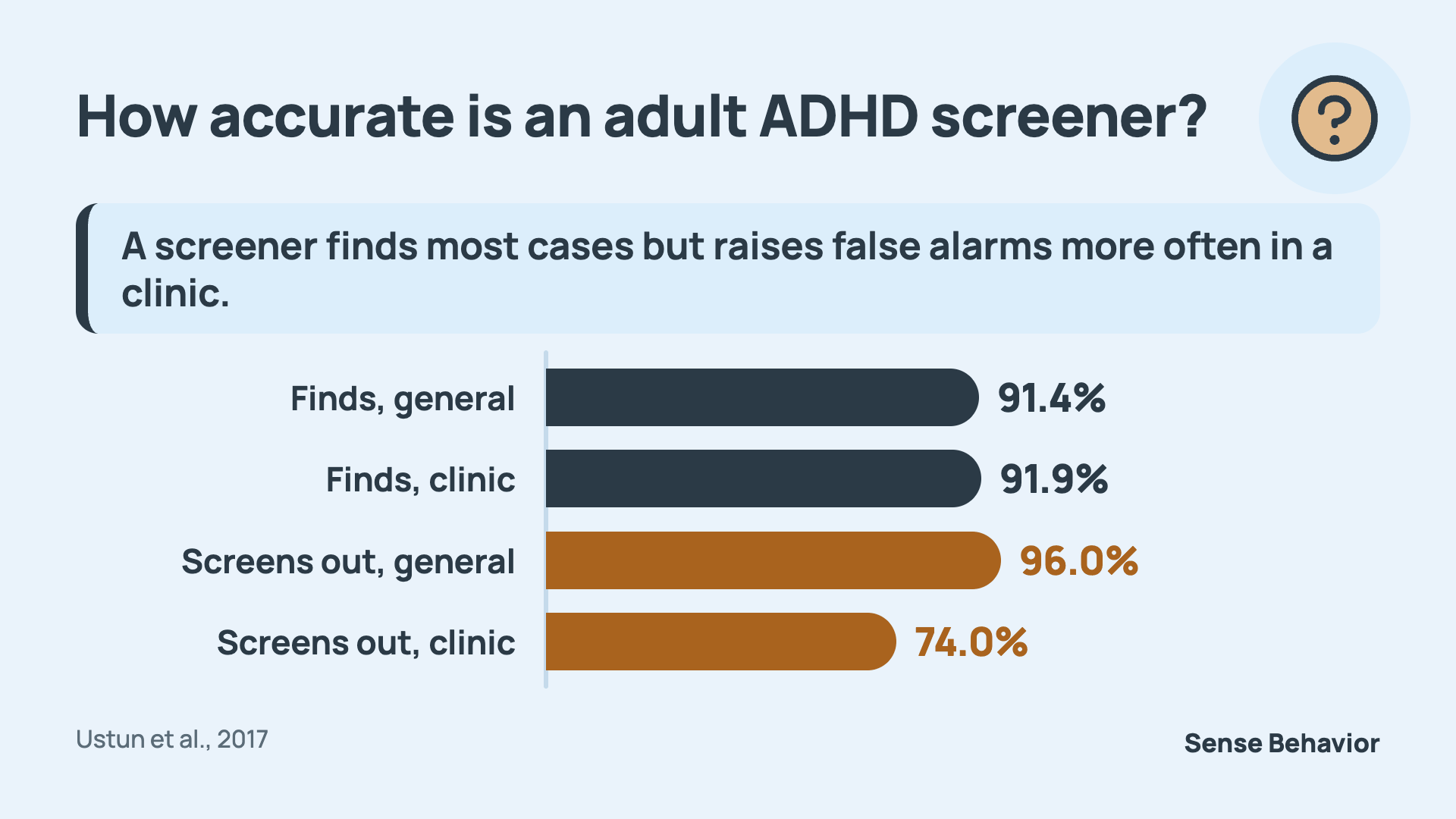
The updated DSM-5 version showed, in the general population, a sensitivity of 91.4%, a specificity of 96.0%, and a share of correct positive results of 67.3%, and in a clinical sample, where ADHD is much more common, a sensitivity of 91.9% but a specificity of only 74.0% (Ustun et al., 2017). In other words, the new version catches most cases but in a clinic it gives a positive result noticeably more often to people who do not have ADHD.
Why an ADHD Test for Adults Is Not a Diagnosis
Because a screener gives a probability, while a diagnosis requires a history and a clinical assessment. The NICE guideline states plainly that an ADHD diagnosis should not be made on rating scales alone, although the scales are useful as an addition (NICE, 2018). Inattention, absent-mindedness, and trouble with organization also occur with lack of sleep, anxiety, depression, and stress, and only the full picture of your life tells them apart, including how things were in childhood. What the symptoms of ADHD in adults look like and by what criteria they are assessed we cover separately.
If traits of autism ring true alongside ADHD, the differences and overlap are covered in autism and ADHD in adults.
What to Do With an ADHD Test Result
Use it as a reason to take a closer look at yourself and talk to a doctor, whatever the result. You can start today:
- write down the result, the date, and five situations from recent months where you got stuck at the start or lost the thread;
- if the result is positive, discuss it with a doctor who works with adults and tell them about your childhood;
- if the result is negative but you recognize yourself in the descriptions, don't close the subject, because a screener can miss some cases;
- don't make treatment decisions based on a questionnaire result, because that is the doctor's job.
A test result is easier to make sense of when you have something to compare your own experience with, and the selection in books about ADHD in adults can serve that purpose.
Can You Trust Online ADHD Tests
Only those with a clear source that do not promise a diagnosis. Before filling in a questionnaire, it is worth checking:
- whether it says who created the scale and where it was published;
- whether the page calls the result a diagnosis or charges a fee for a "report";
- whether it says clearly that this is only a screening and that a doctor's consultation is needed;
- whether you are asked for excess personal data in exchange for the result.
What comes next if the result made you think is described in the piece on adult ADHD diagnosis.
You can work out where to start in your own situation with no commitment, through the bot, which asks a few questions and suggests a next step, and how the center's work with adults is set up in general is on the For Adults page.
Sources
- Kessler R. C. et al. (2005). The World Health Organization Adult ADHD Self-Report Scale (ASRS): a short screening scale for use in the general population. Psychological Medicine, 35(2), 245–256.
- Ustun B. et al. (2017). The World Health Organization Adult Attention-Deficit/Hyperactivity Disorder Self-Report Screening Scale for DSM-5. JAMA Psychiatry, 74(5), 520–527.
- NICE (NG87, 2018, updated 2019). Attention deficit hyperactivity disorder: diagnosis and management.
This material is for informational purposes only and does not replace a consultation with a specialist.