Adult ADHD Symptoms and Signs: How to Recognize Them

"I'm not lazy, I just can't get started." "I can do the hard things but not the simple ones." That is often how the first thoughts sound for an adult who begins to suspect ADHD, usually after years of trying to pull themselves together through willpower alone. If you typed "adult ADHD symptoms" into a search bar, you probably recognize yourself in something similar and want to know where ordinary absent-mindedness ends and a reason to look closer begins.
Below is a practical walk-through: which signs doctors describe, how to tell them from fatigue and anxiety, how to check yourself, and who to see next. It helps you get your bearings, and only a specialist can make a diagnosis.
What Are the Symptoms of ADHD in Adults
ADHD (attention-deficit/hyperactivity disorder) is described through two groups of signs, inattention and hyperactivity with impulsivity, nine symptoms in each. In adult life they rarely look like a schoolchild who can't stay in a seat, and more often show up at home, at work, and in relationships. Here is how it often looks:
- The task won't start. You know what to do but seem not to get the inner go-ahead, and the job sits for days until a deadline or anxiety arrives.
- Things stay half done. A dozen open tabs, three projects underway, and the last step keeps getting postponed because it's boring.
- Time runs its own way. You're regularly late, underestimate how long something takes, and lose an hour where you planned ten minutes.
- Small things slip away. Keys, documents, paying a bill, a reply to a message you've already read and mentally answered.
- Attention jumps. In a meeting or a conversation you suddenly notice you've spent the last few minutes in your own thoughts and have to ask people to repeat themselves.
- Inside, it doesn't settle. Outwardly you sit calmly while inside a motor seems to be running, relaxing is hard, and you want to get up and do something else. Talkativeness often comes with it.
- Emotions flare quickly. Irritation or excitement hits sharply and passes just as sharply, and decisions get made on the fly, before there's time to think.
Almost everyone recognizes each of these now and then. With ADHD they last for months and years, repeat across different areas of life, and noticeably get in the way of work, study, or relationships. If the first item hits closest, take a look at our piece on why a task won't start without an outside push and why a deadline suddenly switches on focus, which describes the mechanism itself and what can be done about it.
How to Tell ADHD From Ordinary Distraction, Fatigue, and Anxiety
The verdict rests on the combination of signs, and what counts is how many there are, when they began, where they appear, and what they cost in everyday life. In the DSM-5 classification that doctors rely on, this looks as follows for adults (Volkow & Swanson, 2013):
- From age 17, five symptoms out of nine in either of the two groups are enough, while for children the threshold is higher, at six.
- The symptoms last at least six months.
- Some of them appeared before age 12.
- They show up in at least two areas of life, for example at home and at work.
- They noticeably interfere with study, work, or relationships.
Lack of sleep, anxiety, depression, prolonged stress, and burnout produce a similar picture of attention and memory. What marks ADHD is that the difficulties were there earlier, in school years, and don't go away after a vacation or a few nights of good sleep. Often several conditions sit side by side, anxiety or autism for instance, and then the picture only comes together during an assessment. How to tell autism from ADHD in adults, and what AuDHD is, we cover in the piece on autism and ADHD in adults.
How to Check Yourself for ADHD
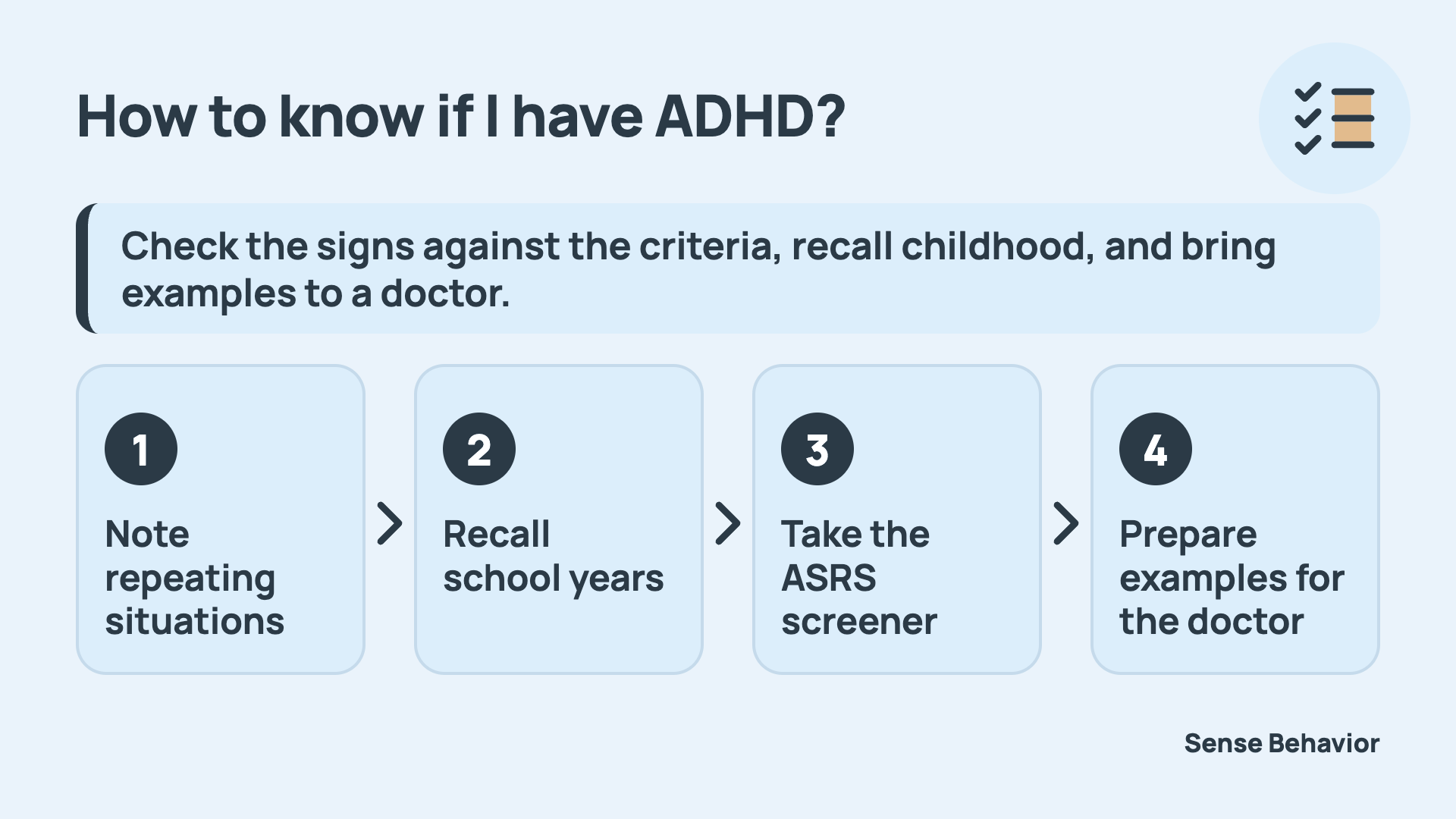
A self-check gives you only a reference point. It helps you decide whether to see a doctor and what to tell them. You can start today, and one evening is enough:
- write down three situations from the past month where you got stuck at the start or lost the thread, and note which areas of life it repeats in;
- recall your school years, what was written in your planner, what teachers said, how you did homework, and if you can, ask your parents;
- take a screener, for example the six-question ASRS v1.1, created with the involvement of the WHO, and which ADHD tests exist and what they show we cover in the piece on ADHD tests for adults;
- write down questions for the doctor and specific examples, because real-life situations carry more weight than general words.
A screener shouldn't be given more weight than it can bear. In a study by Kessler and colleagues, the six-question version showed a sensitivity of 68.7% and a specificity of 99.5%. That means it gives few false alarms, but misses roughly one in three people who have ADHD (Kessler et al., 2005). It was tested on 154 participants, so both a positive and a negative result remain a reason to talk to a doctor.
How Adult ADHD Differs From Childhood ADHD
With age, visible motor activity usually fades, and difficulties with self-organization, attention, and inner tension come to the front. The European expert group on adult ADHD describes this as an age-related shift in the picture: adults more often feel inner restlessness, can't relax, and talk a lot, while inattention shows up as distractibility and disorganization (Kooij et al., 2010).
Because of this shift, adult ADHD stays unnoticed for so long. Among the reasons, the same guidance names age-related changes in symptoms, co-occurring conditions that get taken for the main diagnosis, and too little awareness among doctors who work with adults. Co-occurring disorders are closer to the rule: at least one more is present in 75% of clinical patients (Kooij et al., 2010). So a person often seeks help for years over anxiety or low mood, while the question of why organizing is so hard goes unanswered.
Whether the picture changes over the years and what stays for the long run is covered in does ADHD go away with age.
How Common Is ADHD in Adults
According to a global meta-analysis, ADHD with a childhood onset persists in about 2.6% of adults, and counting those who have symptoms without a confirmed childhood start, the estimate rises to 6.8% (Song et al., 2021). The analysis included 40 publications from 30 countries.
These shares decrease with age, and the difference between men and women in the pooled estimates is not statistically significant. For a reader, that means adult ADHD is fairly common. How it looks in women, and why it goes unnoticed for so long, we cover in the piece on ADHD in adult women.
Who to See If You Recognize ADHD Symptoms in Yourself
The assessment is done by a doctor, usually a psychiatrist, based on an interview, developmental history, and criteria, and not on the result of a single test. It is worth checking in advance whether the specialist works with adults and ADHD specifically, because the approach to assessment differs from that for children. Bring your notes and examples from childhood, and tell the doctor about sleep, anxiety, and any medication you take. Where to go and what an assessment includes we cover in detail in the piece on adult ADHD diagnosis.
If you are a man hesitating over whether to see a doctor, the article on ADHD in adult men looks at why so many put that step off for years.
You can work out where to start in your own situation with no commitment, through the bot, which asks a few questions and suggests a next step, and how the center's work with adults is set up in general is on the For Adults page.
Sources
- Volkow N. D., Swanson J. M. (2013). Adult Attention Deficit–Hyperactivity Disorder. New England Journal of Medicine, 369(20), 1935–1944.
- Kooij S. J. J. et al. (2010). European consensus statement on diagnosis and treatment of adult ADHD: The European Network Adult ADHD. BMC Psychiatry, 10, 67.
- Song P. et al. (2021). The prevalence of adult attention-deficit hyperactivity disorder: A global systematic review and meta-analysis. Journal of Global Health, 11, 04009.
- Kessler R. C. et al. (2005). The World Health Organization Adult ADHD Self-Report Scale (ASRS): a short screening scale for use in the general population. Psychological Medicine, 35(2), 245–256.
This material is for informational purposes only and does not replace a consultation with a specialist.