Adult ADHD Diagnosis: Who to See and What the Assessment Includes

If you searched for "adult ADHD diagnosis," you have probably recognized some of the symptoms in yourself and are now finding out who makes this diagnosis and what it takes. The short answer is that a doctor makes the diagnosis based on a detailed conversation and your life history, and the result of a single test does not replace it.
Below is a practical walk-through: who to see, what the assessment includes, why one questionnaire is not enough, and what to prepare in advance. It helps you get your bearings, and only a specialist can make a diagnosis.
Who to See If You Suspect ADHD as an Adult
According to the UK's NICE guideline, ADHD should be diagnosed by a specialist psychiatrist or another qualified clinician trained specifically in diagnosing ADHD (NICE, 2018). Job titles and the booking route depend on the country: in some places you need a family doctor and a referral first, in others you can book directly. Before the visit, it is worth asking:
- whether the specialist works with adults and with ADHD, and not only with children;
- whether there will be a full conversation about your life history or it all comes down to a questionnaire;
- whether they will ask about childhood and whether a close person can be involved;
- in what form the report is issued and what to do with it next.
What an Adult ADHD Assessment Includes
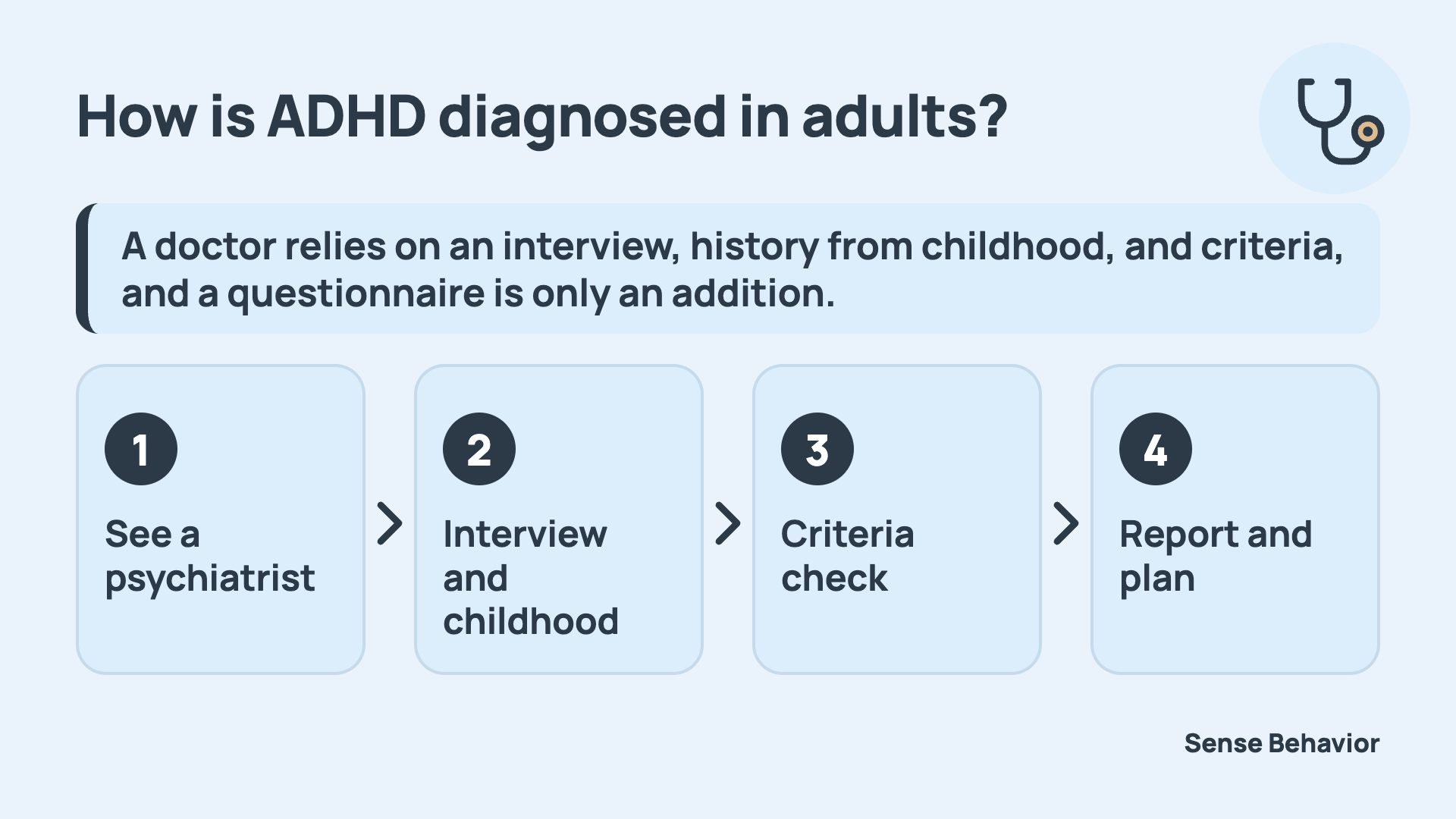
The assessment consists of a detailed conversation, a developmental history, and a check against the criteria, and questionnaires serve only as an addition. According to NICE, it includes:
- A clinical and psychosocial assessment. The doctor discusses behavior and symptoms across different areas of everyday life and assesses your mental state.
- A developmental and psychiatric history. For an adult diagnosis it matters that the signs appeared in childhood, so the doctor asks about your school years.
- Information from other people. Where possible, the account of a close person who has known you for a long time is taken into account.
- A check against the criteria. Symptoms must meet DSM-5 or ICD-11 criteria, noticeably affect life, and appear in at least two important areas, for example at home and at work.
- An assessment of coexisting conditions and circumstances. The doctor looks for anxiety, depression, and other conditions, and takes into account your circumstances and physical health (NICE, 2018).
A clinician may also look at autism, since the two conditions often occur together, and autism and ADHD in adults explains how they are told apart.
Why One ADHD Test Is Not Enough
Because a questionnaire shows a probability while a diagnosis requires a history and a clinical assessment. The NICE guideline states plainly that a diagnosis should not be made on rating scales alone, although they are useful as an addition (NICE, 2018). The recent DSM-5 version of the popular ASRS screener detected 91.4% of cases in the general population and correctly screened out 96.0% of those without ADHD, but in a clinical sample, where the diagnosis is far more common, specificity dropped to 74.0% (Ustun et al., 2017). So a positive result remains a reason for an assessment. Which tests exist and what they show we cover in a separate article: ADHD tests for adults.
What to Prepare for an Adult ADHD Assessment
The more specific material you bring, the more accurate the picture. You can start today, and one evening is enough:
- write down five situations from recent months where you got stuck at the start or lost the thread, and note in which areas of life it repeats;
- find school planners and report cards, recall teachers' remarks, and ask your parents what you were like as a child;
- agree with a close person who has known you for a long time and find out whether they will come or answer the doctor's questions;
- list past diagnoses and treatment, as well as your sleep, medication, and substances you take, because they affect attention.
What to Do If ADHD Is Mistaken for Anxiety or Depression
Tell the doctor everything that is going on with you and ask them to assess all the possible causes at once. Coexisting conditions in adult ADHD are closer to the rule: at least one more is present in 75% of clinical patients (Kooij et al., 2010), and they often come to the foreground. So the doctor should assess them together with ADHD, and you can ask directly how they tell these conditions apart. How such a picture looks in women we covered separately: ADHD in adult women.
Should You Worry About Registration After an ADHD Diagnosis
The rules differ between countries, so it is better to check in advance by asking the doctor yourself. What happens when an adult sees a psychiatrist and what is and isn't worth fearing we covered in detail in the piece on psychiatric registration in adults.
If you are only starting to look at your symptoms, begin with the breakdown of adult ADHD symptoms, where it also describes how to check yourself before the visit.
You can work out where to start in your own situation with no commitment, through the bot, which asks a few questions and suggests a next step, and how the center's work with adults is set up in general is on the For Adults page.
Sources
- NICE (NG87, 2018, updated 2019). Attention deficit hyperactivity disorder: diagnosis and management.
- Ustun B. et al. (2017). The World Health Organization Adult Attention-Deficit/Hyperactivity Disorder Self-Report Screening Scale for DSM-5. JAMA Psychiatry, 74(5), 520–527.
- Kooij S. J. J. et al. (2010). European consensus statement on diagnosis and treatment of adult ADHD: The European Network Adult ADHD. BMC Psychiatry, 10, 67.
- Kooij J. J. S. et al. (2019). Updated European Consensus Statement on diagnosis and treatment of adult ADHD. European Psychiatry, 56, 14–34.
This material is for informational purposes only and does not replace a consultation with a specialist.