ADHD in Adult Men: How It Shows Up and Why Men Seek Help Late

If you searched for "ADHD in adult men," you have probably recognized absent-mindedness, impatience, or chronic disorganization in yourself or in a man close to you and want to understand whether it is ADHD. The diagnostic criteria for men and women are the same, but the picture changes over the years, and many seek help only when the consequences have piled up.
Below is how ADHD shows up in adult men, how common it is, and why people come to a doctor late. The article helps you get your bearings, and only a specialist can make a diagnosis.
What ADHD Looks Like in Adult Men
The core is the same as for everyone: inattention and hyperactivity with impulsivity. In adulthood, according to the European expert consensus, visible motor activity usually fades and inner restlessness, difficulty relaxing, talkativeness, impatience, hasty decisions, distractibility, and disorganization come to the front. Many adults also describe sharp mood swings and a short temper (Kooij et al., 2010). This is how it often looks in life:
- Tasks don't start and don't end. You know what to do but put it off until the deadline, and what is begun stays unfinished.
- Inside, it doesn't settle. Outwardly you are calm, while inside it is as if a motor is running, and relaxing in the evening is hard.
- Decisions are made on the fly. You act before you have time to think and then deal with the consequences.
- Irritation flares fast. The outbursts pass quickly but manage to spoil a conversation or a day.
- Small things slip away. Lateness, lost items, forgotten payments and promises.
A detailed breakdown by DSM-5 criteria is in the piece on ADHD symptoms in adults, and the mechanism of why only a deadline switches on focus is in the breakdown of executive function.
How Common Is ADHD in Adult Men
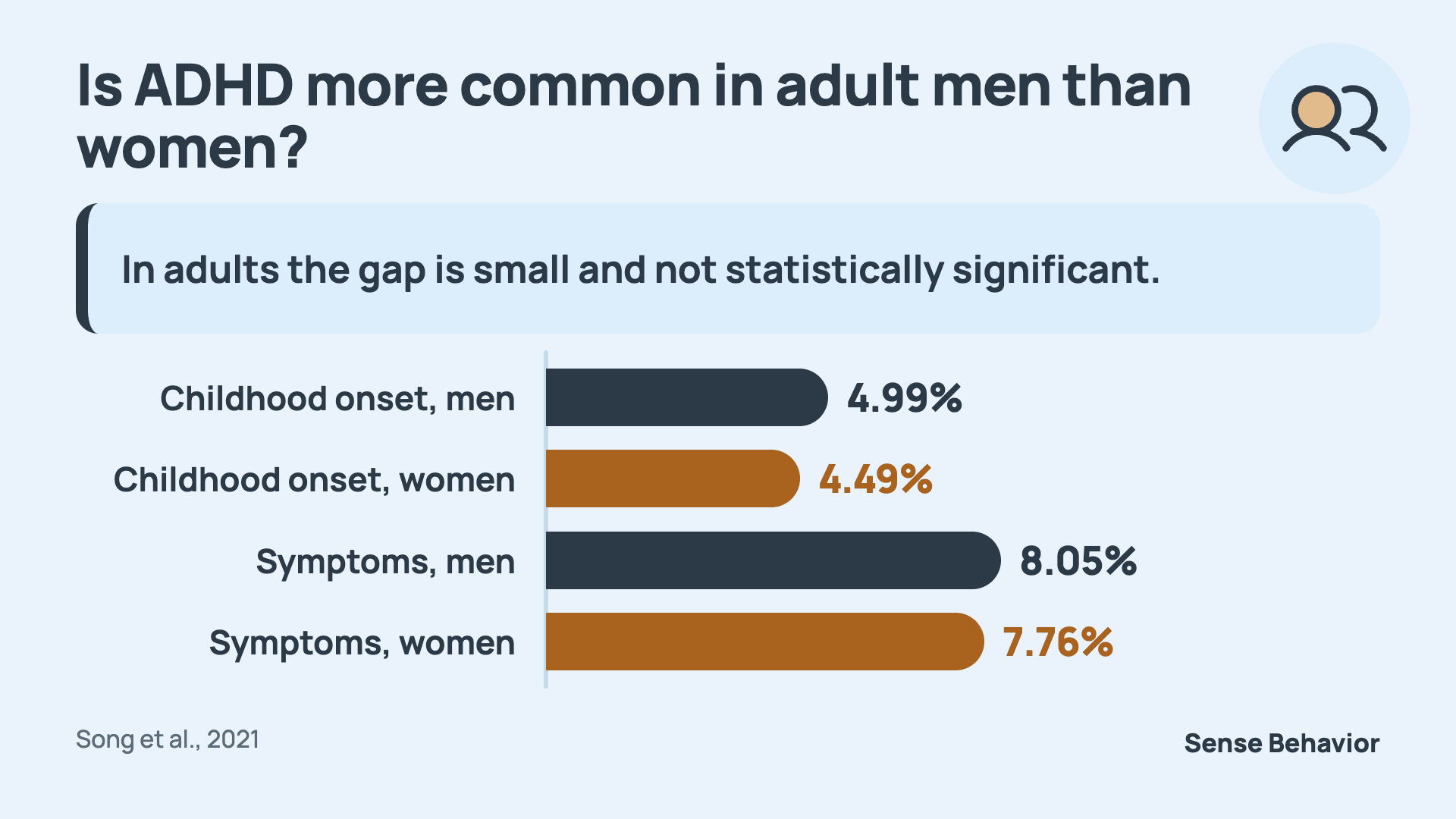
It occurs almost equally often in adult men and women. According to a global meta-analysis, ADHD with a childhood onset persists in 4.99% of men and 4.49% of women, and counting symptoms without a confirmed childhood start, in 8.05% and 7.76%, and these differences are not statistically significant (Song et al., 2021). In children's clinics the picture is different: there are three to sixteen boys for every girl, and by adulthood the difference in samples becomes modest or disappears (Young et al., 2020). In a national survey in the US, the prevalence of ADHD among adults aged 18 to 44 was estimated at 4.4%, and male sex was among the factors linked to it (Kessler et al., 2006).
How ADHD changes with age and in whom it persists into adult life is covered in does ADHD go away with age.
Why Men With ADHD See a Doctor Late
Because the symptoms can be explained by character for a long time, and help is sought when the consequences have piled up. Among the reasons ADHD in adults goes underdiagnosed, the European consensus names the change in the picture with age, coexisting conditions mistaken for the main diagnosis, stigma, and too little awareness among doctors who work with adults (Kooij et al., 2010). Coexisting disorders are closer to the rule: at least one more is present in 75% of clinical patients (Kooij et al., 2010). So a person often first comes about anxiety, mood, or problems at work, while the question of the cause goes unanswered.
What a Man Should Do If He Recognizes Himself in the Description of ADHD
Gather material for a doctor and don't diagnose yourself. You can start today:
- write down five situations from recent months where you got stuck at the start, blew up, or lost the thread, and note in which areas of life it repeats;
- recall your school years and ask your parents, because for an adult diagnosis it matters that the signs were there in childhood;
- find out what an ADHD test for adults shows and where its limits are;
- see how adult ADHD diagnosis goes, and what the doctor decides in ADHD treatment in adults.
For comparison, you can also read the breakdown of how ADHD looks in adult women and why it is noticed there even later.
If other traits besides ADHD ring true for you, the article on autism in adult men is worth a read, since the two conditions often occur together.
You can work out where to start in your own situation with no commitment, through the bot, which asks a few questions and suggests a next step, and how the center's work with adults is set up in general is on the For Adults page.
Sources
- Song P. et al. (2021). The prevalence of adult attention-deficit hyperactivity disorder: A global systematic review and meta-analysis. Journal of Global Health, 11, 04009.
- Young S. et al. (2020). Females with ADHD: An expert consensus statement taking a lifespan approach. BMC Psychiatry, 20, 404.
- Kessler R. C. et al. (2006). The prevalence and correlates of adult ADHD in the United States: results from the National Comorbidity Survey Replication. American Journal of Psychiatry, 163(4), 716–723.
- Kooij S. J. J. et al. (2010). European consensus statement on diagnosis and treatment of adult ADHD: The European Network Adult ADHD. BMC Psychiatry, 10, 67.
This material is for informational purposes only and does not replace a consultation with a specialist.