Anxiety in Adults: What It Is, When It Is Normal, and When to See a Specialist

"Anxiety doesn't explain everything." You often hear this from people who have been treated for anxiety for years and are left with a sense that it isn't only about that. If you are looking for what anxiety in adults is and how it differs from the norm, this article gives a general picture, and the details are moved into separate pieces.
It serves as the main overview for the anxiety section and helps you get your bearings, and only a specialist can make a diagnosis.
What Is Anxiety
Anxiety is a state of worry and expecting something unpleasant that everyone knows and that in its ordinary form helps you prepare for something important. It becomes a problem when it is strong, long and gets in the way of life. According to the UK's NICE guideline, in assessing such a state they look not only at the number, severity, and duration of symptoms but also at the degree of distress and the effect on everyday life (NICE, 2011).
Anxiety in Adults: When It Is Normal and When It Is a Disorder
The line runs by how long the worry lasts and what it does to life. These are the pointers:
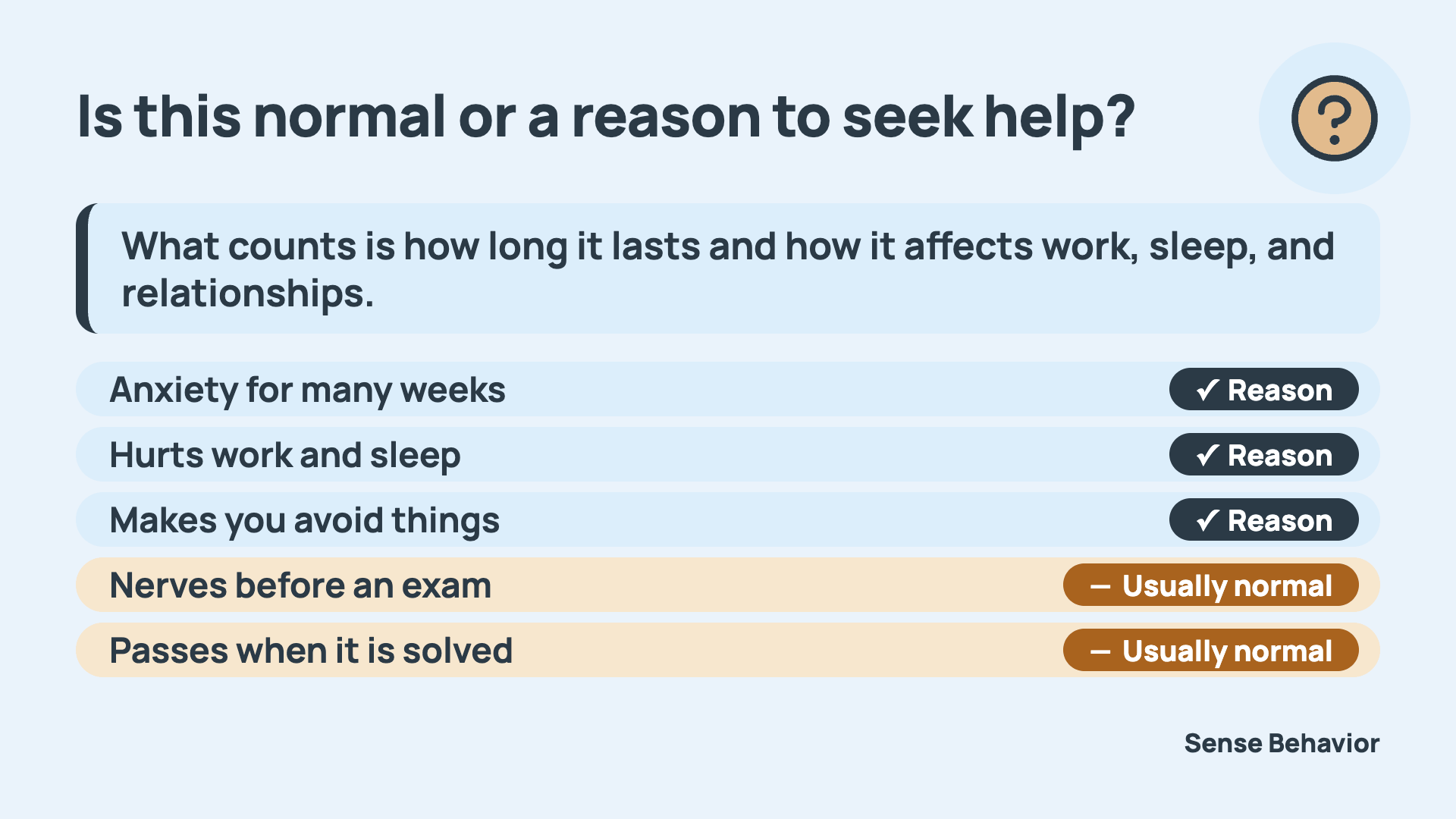
- Usually normal. Nerves before an important event or an exam, anxiety about a problem that passes when the problem is solved.
- A reason to look closer. The worry lasts many weeks, moves from one subject to another, and is hard to control.
- A reason to seek help. Anxiety interferes with work, sleep, or relationships, makes you avoid situations, or comes with physical symptoms that make you seek reassurance again and again that all is well.
Anxiety disorders are common. According to the systematic review by Baxter and colleagues, covering 87 studies from 44 countries, the global prevalence of anxiety disorders adjusted for methods was 7.3% and ranged from 5.3% in African cultures to 10.4% in European and English-speaking ones (Baxter et al., 2013).
What Anxiety Disorders Exist
Several forms are mentioned most often, and each has its own breakdown:
- Generalized anxiety disorder. Constant worry about a wide range of issues. NICE suggests considering it in people who often come to primary care with anxiety or significant worry, seek reassurance about physical symptoms, or worry repeatedly about many different things (NICE, 2011).
- Panic disorder. Repeated attacks of intense anxiety, which the NICE guideline on anxiety addresses separately (NICE, 2011).
- Social anxiety. Fear of evaluation in communication and avoidance, covered in more detail in the piece on social anxiety.
When to See a Specialist About Anxiety
When it lasts for weeks and months, gets in the way of work, sleep, or relationships, makes you avoid what you need, or comes with physical symptoms that a doctor does not explain. If you are thinking about harming yourself, seek urgent help from a doctor or your country's emergency service. What helps in practice is described in the piece on how to cope with anxiety, and what questionnaires show in the piece on the anxiety test.
When anxiety gets in the way of daily life, the question of medication often comes up, and anxiety pills explains who prescribes it and why choosing it yourself is a bad idea.
If Anxiety Doesn't Explain Everything
Coexisting conditions are common with anxiety, and sometimes something else stands behind years of treatment for anxiety. Anxiety often goes together with ADHD and with autism, and we cover this in the pieces on ADHD and anxiety and autism and anxiety in adults. You can start today: write down three situations where anxiety was strongest and note what came before them and how long it has been repeating.
You can work out where to start in your own situation with no commitment, through the bot, which asks a few questions and suggests a next step, and how the center's work with adults is set up in general is on the For Adults page.
Sources
This material is for informational purposes only and does not replace a consultation with a specialist.