Autism and Anxiety in Adults: Why They So Often Go Together

"I can't keep pretending to be normal at work and at home anymore." You can hear a phrase like this from many adults with autism who have no energy left by the end of the day and feel anxious. If you searched for "autism and anxiety," you probably want to understand why they so often go together. The short answer: anxiety in autism makes sense given the conditions a person lives in, and it can be reduced.
Below is how often these conditions combine, what stands behind it, and what helps. The article helps you get your bearings and diagnoses no one, and only a specialist can make a diagnosis.
How Often Autism and Anxiety Go Together
Very often. In the meta-analysis by Lai and colleagues, anxiety disorders occurred in about 20% of autistic people (Lai et al., 2019). According to the review by Hollocks and colleagues, covering 35 studies, the pooled prevalence of anxiety disorders in adults with autism was 27% at the current time and 42% over a lifetime, although the authors note a high degree of heterogeneity in methods and an overreliance on clinical samples (Hollocks et al., 2019).
Why Autism and Anxiety Go Together
Because many features of autism themselves create conditions for anxiety. This is what most often stands behind it:
- Overload from surroundings. Light, noise and smells can drain more than they do others. In a survey of 221 adults with autism and 181 without, people with autism reported heightened sensitivity noticeably more often (Tavassoli et al., 2014).
- Unpredictability. Changed plans and unclear expectations keep you tense, while predictability and order calm. The NICE guideline names clarity, structure, and routine as important for autistic people and notes an increased propensity for anxiety about decision-making (NICE, 2012).
- Masking. Constantly hiding differences takes energy and is linked with anxiety. In a systematic review of nine studies with more than 1500 autistic women, masking was consistently linked with anxiety and depression (Cuni & Cantero-García, 2026).
- Burnout. In a qualitative study, burnout was described as chronic exhaustion, loss of skills, and reduced tolerance to stimuli against a background of accumulated stress (Raymaker et al., 2020).
How hiding differences works and what it costs we cover in more detail in the piece on masking and burnout in autism.
Anxiety around other people can occur with or without autism, and the article on social anxiety explains how it differs from shyness.
What Helps With Autism and Anxiety
What helps are an adjusted setting and psychological help adapted for autism. According to NICE, autistic people with a coexisting disorder are offered the same psychological approaches as for that disorder in others, but adapted: more concrete and structured, with written and visual materials, with an emphasis on changing behavior, clear rules, plain language, and use of your interests (NICE, 2012). The setting is adjusted like this: less fluorescent light, quiet or earplugs, personal space, and visual supports. The doctor also takes into account that autistic people can have greater sensitivity to side effects and an unpredictable response to medication (NICE, 2012).
A broader look at what helps adults with autism is in can autism be treated in adults.
What to Do If You Have Autism and Anxiety
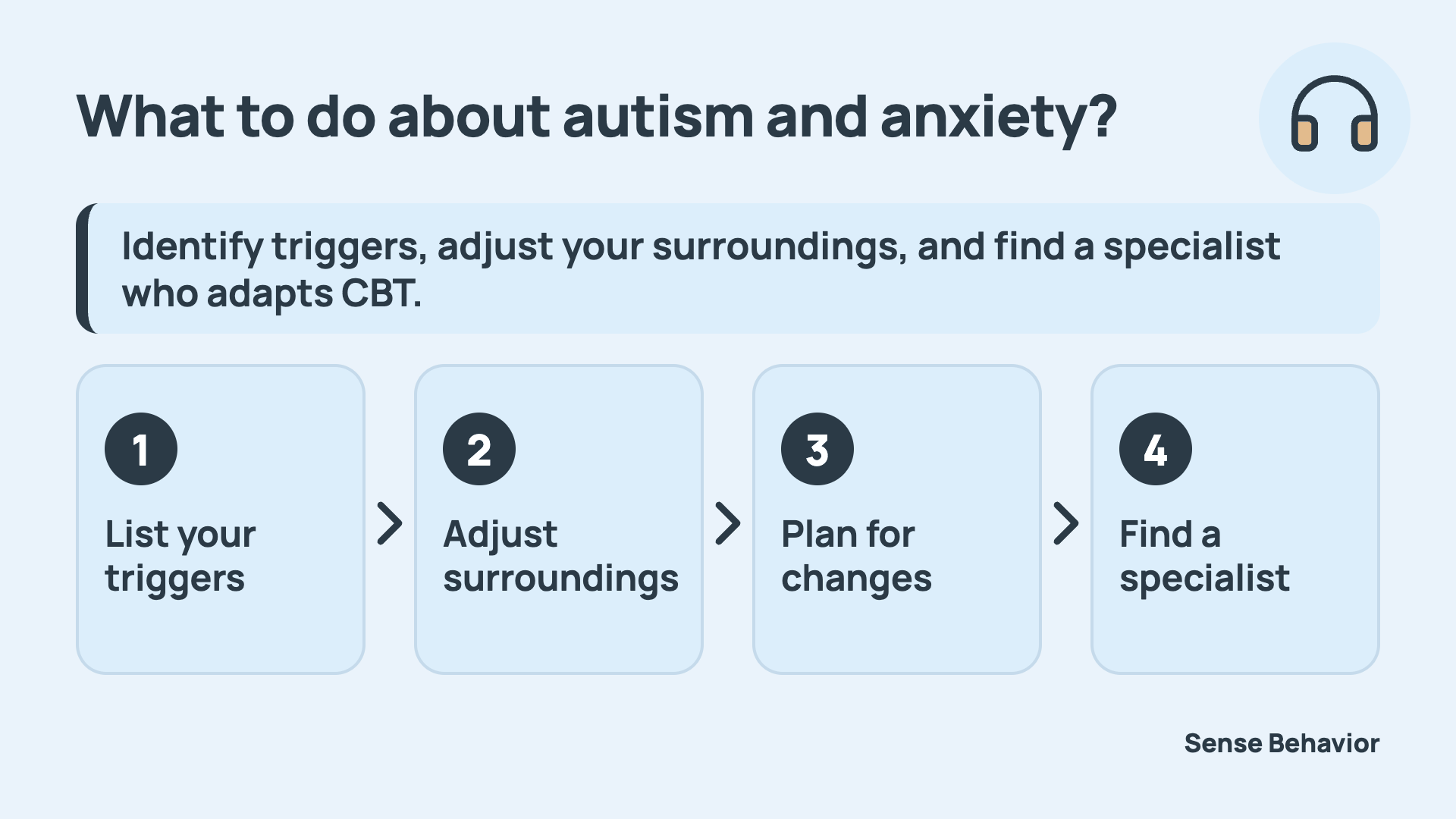
Collect your triggers, adjust your setting, and find a specialist who knows autism. You can start today:
- write down situations after which anxiety grows and note what was in them: noise, change, communication, or having to hide;
- pick one setting you can adjust right now, for example lighting or your workspace;
- plan changes in advance and ask to be warned about them early;
- look for a specialist who works with autism in adults and knows how to adapt CBT.
The general picture of anxiety is described in the piece on anxiety in adults, practice in the piece on how to cope with anxiety, and autism itself in the pieces on signs of autism in adults and autism in adult women.
Anxiety at work is often tied to the question of whether to open up to a manager, and should you tell your employer about autism walks through how to decide.
You can work out where to start in your own situation with no commitment, through the bot, which asks a few questions and suggests a next step, and how the center's work with adults is set up in general is on the For Adults page.
Sources
- Hollocks M. J. et al. (2019). Anxiety and depression in adults with autism spectrum disorder: a systematic review and meta-analysis. Psychological Medicine, 49(4), 559–572.
- Lai M.-C. et al. (2019). Prevalence of co-occurring mental health diagnoses in the autism population: a systematic review and meta-analysis. The Lancet Psychiatry, 6(10), 819–829.
- Cuni E., Cantero-García M. (2026). Autistic Masking and Mental Health Outcomes in Autistic Women: A Systematic Review (2015-2025). Journal of Autism and Developmental Disorders (online ahead of print).
- Raymaker D. M. et al. (2020). Defining Autistic Burnout. Autism in Adulthood, 2(2), 132–143.
- Tavassoli T. et al. (2014). Sensory over-responsivity in adults with autism spectrum conditions. Autism, 18(4), 428–432.
- NICE (CG142, 2012, updated 2021). Autism spectrum disorder in adults: diagnosis and management.
This material is for informational purposes only and does not replace a consultation with a specialist.