Anxiety Test: What Scales Exist and What They Show

If you searched for an "anxiety test," you have probably already noticed that anxiety takes up too much room and want a number or an answer. The short answer: a test shows how pronounced your anxiety symptoms are and how likely an anxiety disorder is, and works as a reason to talk to a doctor, but it is not a diagnosis.
Below are the scales that exist, what accuracy research has shown for them, and what to do with the result. The article helps you get your bearings, and only a specialist can make a diagnosis.
What Anxiety Tests Exist
For adults, short self-completed questionnaires are used most often. These are the main ones:
- The GAD-7. Seven questions about recent symptoms of generalized anxiety disorder. The short two-question version is called the GAD-2, and the UK's NICE guideline suggests using it when identifying anxiety disorders (NICE, 2011).
- The HADS. The Hospital Anxiety and Depression Scale, which has a separate anxiety subscale, the HADS-A.
- Other scales. The Beck scale and the Spielberger-Hanin scale are also met. They measure the level of anxiety by self-rating but they are not among the reviews discussed below, so we say nothing about their accuracy.
How Accurate Are Anxiety Tests
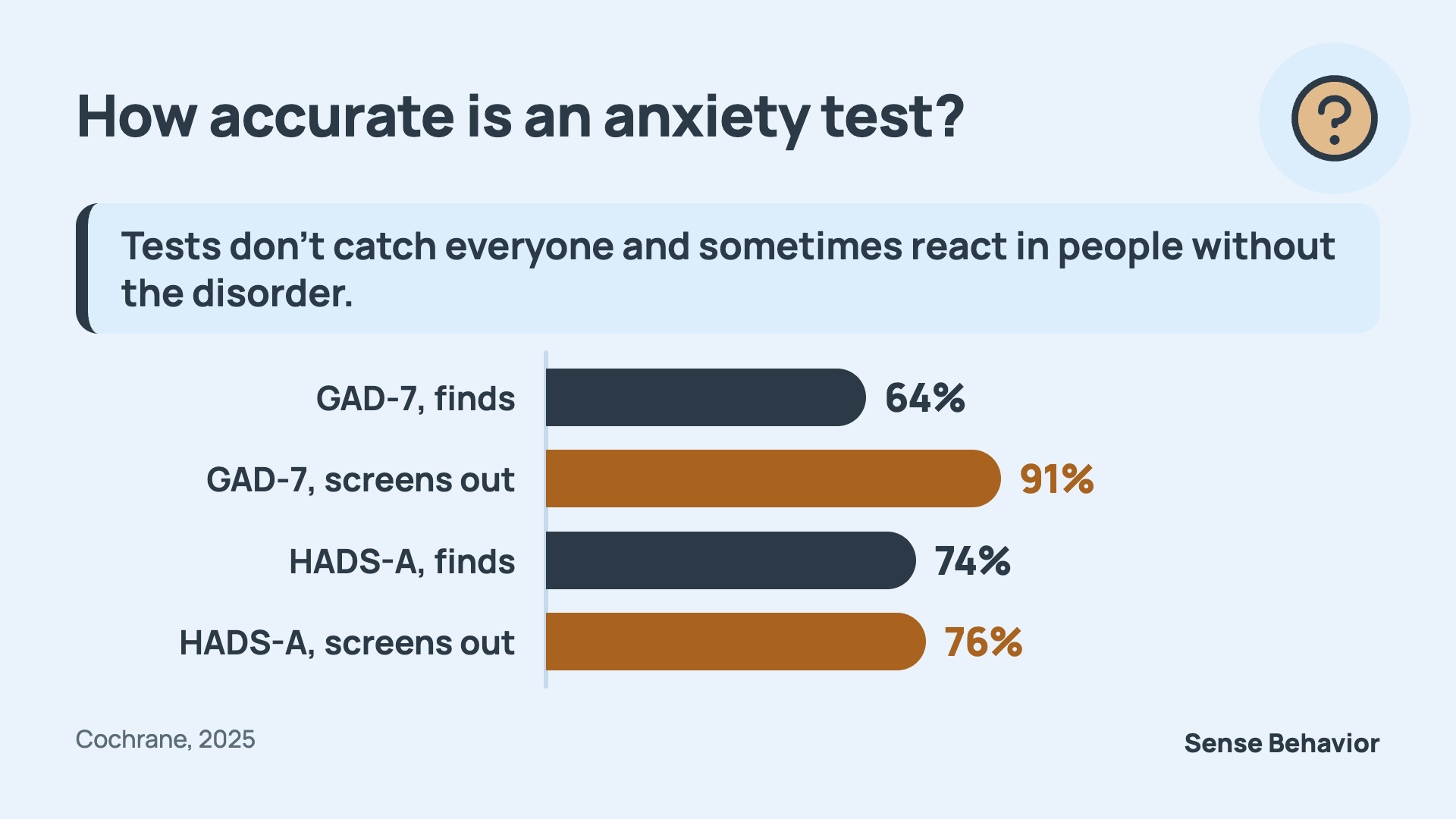
The accuracy of screeners is usually described with two numbers: sensitivity, the share of people with an anxiety disorder whom the test caught, and specificity, the share of people without one whom the test correctly screened out. According to the 2025 Cochrane review, pooling 48 studies and 19,228 participants, at the recommended cut-off of 10 points the GAD-7 caught generalized anxiety disorder in 64% of cases and correctly screened out 91% of those without it, and for any anxiety disorder sensitivity was 48% with a specificity of 91% (Aktürk et al., 2025).
For the HADS-A, a Cochrane review covering 67 studies and 18,467 participants showed, at a cut-off of 8 points, a sensitivity of 74% and a specificity of 76% for any anxiety disorder. The authors give an example: of 1000 people at an anxiety disorder prevalence of 17%, the test would give 199 false positives and 44 false negatives, and they stress that the reliability of the conclusions is limited (Fomenko et al., 2025). Put simply, tests don't catch everyone and sometimes react in people who do not have the disorder.
Why an Anxiety Test Is Not a Diagnosis
Because a diagnosis rests on a full assessment of your state and not on a number of points. The NICE guideline states plainly that an assessment should not rely only on the number, severity, and duration of symptoms but should consider the degree of distress and the effect on everyday life (NICE, 2011). Worry also occurs with lack of sleep, stress, depression, and other conditions, and only a conversation with a specialist tells them apart.
If you notice that anxiety rises mainly during conversation and when others might judge you, take a look at the article on social anxiety.
What to Do With an Anxiety Test Result
Use it as a reason to take a closer look at yourself, whatever the result. You can start today:
- write down the result, the date, and three situations in which anxiety was strongest;
- note how long this has lasted and whether it affects work, sleep, or relationships;
- if the anxiety lasts for months or grows, discuss it with a doctor and bring your notes;
- if anxiety has lasted for years and doesn't explain everything, look at other possible causes too, which we cover in the pieces on ADHD tests for adults and autism tests for adults.
What anxiety is and when it becomes a reason to see a specialist is described in the piece on anxiety in adults, and what helps in practice in the piece on how to cope with anxiety.
You can work out where to start in your own situation with no commitment, through the bot, which asks a few questions and suggests a next step, and how the center's work with adults is set up in general is on the For Adults page.
Sources
- Aktürk Z. et al. (2025). Generalized Anxiety Disorder 7-item (GAD-7) and 2-item (GAD-2) scales for detecting anxiety disorders in adults. Cochrane Database of Systematic Reviews, 3, CD015455.
- Fomenko A. et al. (2025). Hospital Anxiety and Depression Scale Anxiety subscale (HADS-A) for detecting anxiety disorders in adults. Cochrane Database of Systematic Reviews, 7, CD015456.
- NICE (CG113, 2011, updated 2020). Generalised anxiety disorder and panic disorder in adults: management.
This material is for informational purposes only and does not replace a consultation with a specialist.