ADHD and Anxiety: How They Are Connected and How to Tell Them Apart

"I was diagnosed with anxiety, but it isn't only that." This is something adults often say when, after treatment for anxiety, trouble with starting tasks, organization, and attention remains. If you searched for "ADHD and anxiety," you are probably trying to understand how the two conditions are connected and why treating only the anxiety turned out to be not enough.
Below is how they intertwine, how to tell one from the other, and what to do. The article helps you get your bearings and diagnoses no one, and only a specialist can make a diagnosis.
How ADHD and Anxiety Are Connected
They often go together. According to the review by Katzman and Bilkey, among the most frequent comorbid problems in adults with ADHD are mood and anxiety disorders, and the overlap of symptoms complicates diagnosis and treatment (Katzman et al., 2017). The European consensus notes that coexisting disorders are closer to the rule: at least one more is present in 75% of clinical patients (Kooij et al., 2010). In a national survey in the US, adult ADHD was strongly linked with many other disorders, and most cases went untreated even though many people received help for coexisting conditions (Kessler et al., 2006).
Why ADHD Gives Rise to Anxiety
Anxiety can be a disorder of its own, and it can also build up as a layer on top of ADHD. This is a logical explanation and not a finding of a particular study but it is familiar to many from experience. This is how it usually goes:
- Chronically missed deadlines. If tasks are put off until the last moment for years, a reminder that something is undone keeps running in your head.
- Shame and self-criticism. Accumulated failures and reproaches from others add up to an expectation of the next failure, and this expectation is itself worrying.
- Forgetfulness and lateness. Fear of missing something makes you double-check, keep everything in your head, and expect problems in advance.
- Exhaustion from compensating. The effort spent on looking organized drains, and drained people are more anxious.
Why a task doesn't start without a deadline we covered in the breakdown of executive function in ADHD, and how ADHD shows up in the piece on ADHD symptoms in adults.
How to Tell ADHD From Anxiety
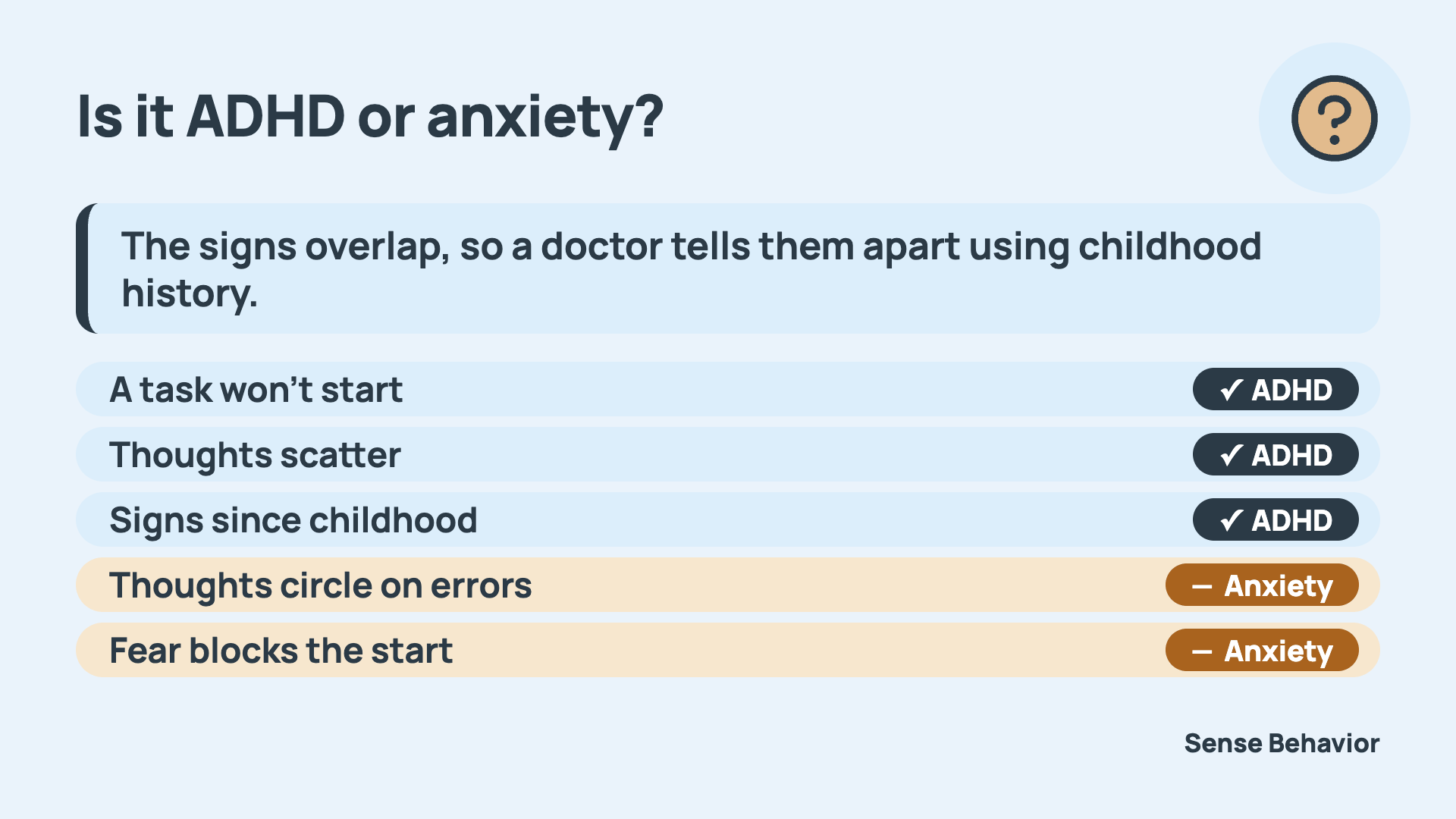
By what stands behind the difficulty: in anxiety, thoughts about possible problems get in the way of acting, while in ADHD the task doesn't start even when there is no anxiety. These are pointers that do not replace an assessment:
- Thoughts. In anxiety they circle around what could go wrong, in ADHD they scatter and drift off.
- Tasks. In anxiety fear blocks the start, in ADHD the starting mechanism doesn't switch on although you want to and know what needs doing.
- History. For an adult ADHD diagnosis it matters that the signs were there in childhood, while anxiety can appear later as well.
- Improvement. If mood evened out after treatment for anxiety and the trouble with organization remained, that is a reason to assess ADHD separately.
What to Do If You Have Both ADHD and Anxiety
Tell the doctor about both conditions and discuss where to begin. The NICE guideline on anxiety says that when it coexists with another disorder, the primary one is treated first, meaning the one that is more severe and whose treatment will improve overall functioning the most (NICE, 2011), and the ADHD guideline offers the same medication options to people with an anxiety disorder as to others (NICE, 2018). You can start today:
- write down separately the situations where anxiety blocks action and the situations where action doesn't start on its own;
- recall your school years and ask your parents, because childhood matters for ADHD;
- find out what ADHD tests for adults and the anxiety test show;
- read how to cope with anxiety, and the general picture in the piece on anxiety in adults.
Only a doctor should choose medication when ADHD and anxiety occur together, and anxiety pills describes why you should not do it yourself.
You can work out where to start in your own situation with no commitment, through the bot, which asks a few questions and suggests a next step, and how the center's work with adults is set up in general is on the For Adults page.
Sources
- Katzman M. A., Bilkey T. S., Chokka P. R., Fallu A., Klassen L. J. (2017). Adult ADHD and comorbid disorders: clinical implications of a dimensional approach. BMC Psychiatry, 17, 302.
- Kooij S. J. J. et al. (2010). European consensus statement on diagnosis and treatment of adult ADHD: The European Network Adult ADHD. BMC Psychiatry, 10, 67.
- Kessler R. C. et al. (2006). The prevalence and correlates of adult ADHD in the United States: results from the National Comorbidity Survey Replication. American Journal of Psychiatry, 163(4), 716–723.
- NICE (CG113, 2011, updated 2020). Generalised anxiety disorder and panic disorder in adults: management.
- NICE (NG87, 2018, updated 2019). Attention deficit hyperactivity disorder: diagnosis and management.
This material is for informational purposes only and does not replace a consultation with a specialist.