Kindergarten and school in Serbia with autism: commission, IEP and support
School in Serbia with autism, and kindergarten for a child who has only just moved, raise two main questions for parents. Will the child be accepted, and how do you get support if the child needs an assistant or an individual learning plan? Under Serbian law a foreign child is educated on the same terms as citizens, and the need for support is assessed by the municipality's interagency commission. This article follows primary sources to describe enrollment dates, rights, steps and questions to ask in kindergarten and school.
School in Serbia with autism: how a child reaches kindergarten, school and the support system
The route has three parts, and it helps to keep them in order. First comes enrollment in kindergarten or in the compulsory preparatory program, then enrollment in first grade, and, where needed, a separate assessment of support needs by the commission and an individual plan.
- Kindergarten or the preparatory program. For the last year before school it is compulsory, and it is free in public institutions.
- Enrollment in first grade. A school admits a child aged between six and a half and seven and a half on 1 September.
- Assessment of support. The municipality's commission assesses the child's needs, and the school draws up an individual education plan (IEP).
The commission's assessment does not delay admission or attendance. This is stated in the rulebook on additional support itself (Pravilnik 80/2018), so a child can be enrolled in kindergarten or school without waiting for the conclusion.
Does a foreign child have the right to attend a Serbian kindergarten and school
Yes. Under the law, a foreign citizen has the right to education on the same terms and in the same manner as citizens of Serbia. This is set out in the Law on the Foundations of the Education System (Official Gazette 88/2017, amended up to 19/2025), articles 3 and 23.
The same law provides support for children of foreign nationals who do not know the language of instruction.
- For children who do not know the language of instruction, the institution organizes learning Serbian as a foreign language.
- A foreign national's child attends the Serbian-as-a-foreign-language program free of charge on condition of reciprocity, or at the parents' expense, in an institution designated by the minister.
- While living in Serbia, the child may attend classes in their mother tongue and culture, free on condition of reciprocity or at the parents' expense, in premises designated by the local authority.
What the "condition of reciprocity" means in practice, and which mother-tongue programs run in your municipality, the law does not specify. Find out at the school, the school administration or the municipal office. We name no specific schools that teach in the family's language, because we found no official pages confirming them.
If the child has already studied abroad, school documents may need to be recognized. Under the Law on Primary Education (article 95a), foreign school documents are recognized by the ENIC/NARIC center, that is, the Qualifications Agency. The welcometoserbia.gov.rs portal describes the procedure for secondary school, and for primary grades you should check the procedure with the school and the agency.
How to enroll a child in kindergarten in Serbia
Serbia has state, private and international kindergartens. Attendance at nursery and kindergarten is optional, while the preparatory program before school is compulsory. State places are sometimes short, so start enrolling early.
What is known from official sources:
- State kindergartens have limited places. Electronic enrollment through the eUprava portal is described on welcometoserbia.gov.rs for cases where at least one parent is a citizen of Serbia.
- If there is no place in a state kindergarten, citizens of Serbia have the right to a private kindergarten at the city's expense. The portal does not state such a right for foreign families, so confirm the procedure with your city's preschool education office.
- The preparatory program lasts at least nine months, four hours a day, and is compulsory for children aged five and a half to six and a half.
- State institutions are required to enroll every child in the preparatory program regardless of the parents' place of residence.
- For a child with developmental difficulties, the commission may recommend a subsidy for the preschool program and a place in a developmental group.
Before enrolling, it helps to ask the kindergarten a few questions.
- Are there free places and how does the queue work, including for foreign families?
- Which documents are needed: passport, proof of stay, medical certificates, vaccination records?
- Does the group have an assistant to the educator, and how many children are in it?
- How does the kindergarten work with children who need extra support, and does it have an inclusion team?
- Can the child come for several introductory visits before starting?
For how to prepare a child for kindergarten, and what to do if admission is refused, read how to prepare a child for kindergarten: signs of readiness and steps and not accepted to kindergarten: what to do and where to turn.
How to enroll a child in first grade in Serbia: dates and steps
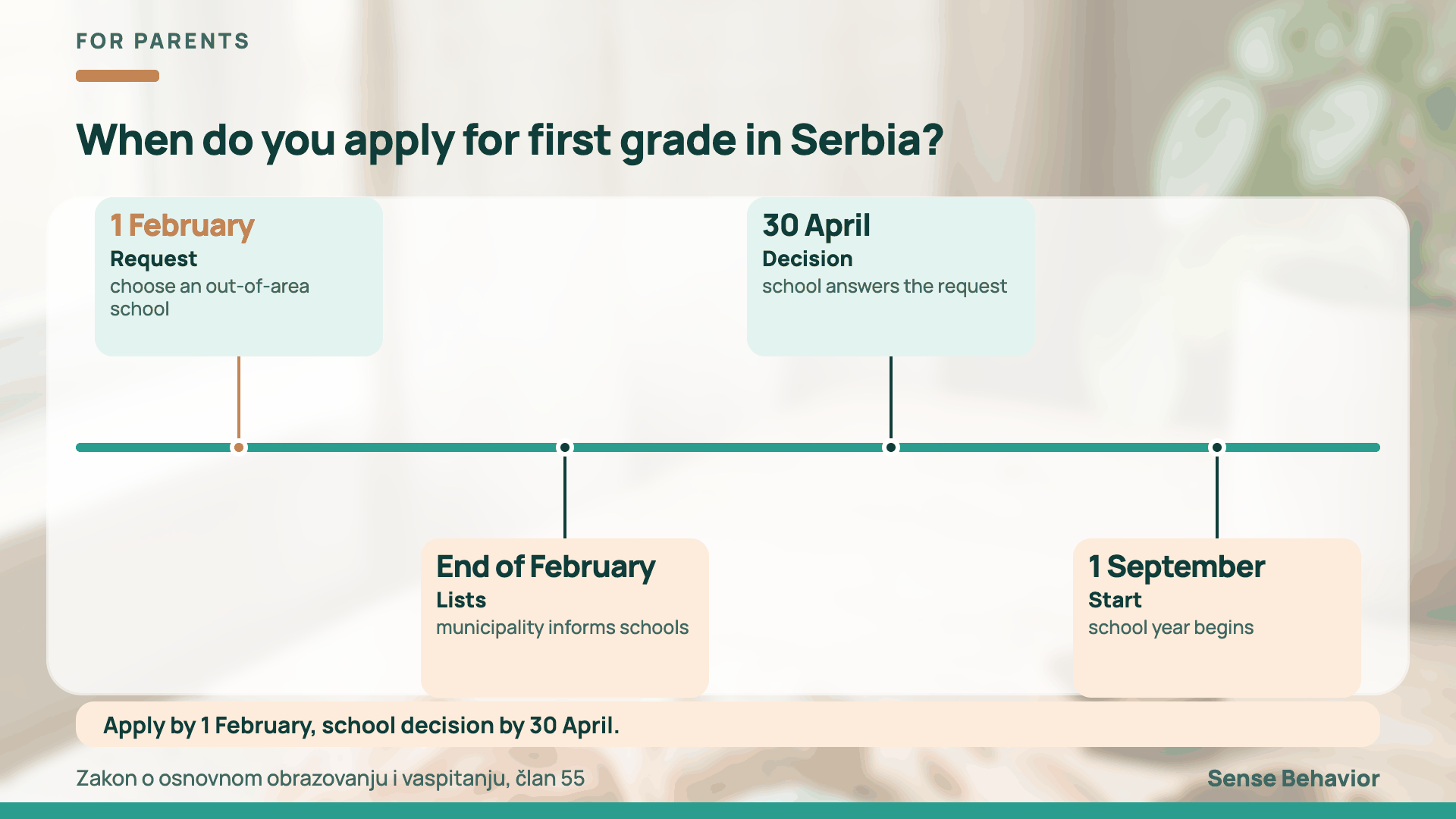
Children who turn between six and a half and seven and a half by 1 September go to first grade. A parent may choose a school by submitting a request no later than 1 February of the enrollment year, and the school announces its decision on an out-of-area school by 30 April.
- By the end of February, the municipality informs schools and parents which children are to start first grade this year.
- No later than 1 February, parents submit a request to the chosen school if they want a school outside their area.
- Proof of the child's medical examination is attached to the enrollment documents.
- The school psychologist or pedagogue assesses the child, by law in the child's mother tongue and with standard instruments.
- By 30 April, the school announces its decision on the request for an out-of-area school.
- The school year begins on 1 September.
The law also covers a few cases that concern children with developmental differences and families who have just arrived. A school must enroll every child from its own area, and a child from another area is admitted on request if capacity allows.
- Children aged six to six and a half take a school readiness check, and the school may recommend starting a year later with the preparatory program.
- If a delay is recommended, parents may within eight days request a repeat check, and the school commission decides within 15 days.
- A one-year delay in enrollment can be granted on the opinion of the interagency commission, if it is in the child's interests.
- A child older than seven and a half who was not enrolled in first grade because of illness or another reason can be enrolled in first or a suitable grade after a knowledge check.
If the psychologist conducts the assessment in a language the child does not know, the law provides for an interpreter proposed by the national council of a national minority. How this works for newly arrived families the law does not describe, so settle the language question with the school before the assessment.
How to prepare a child for school is covered in how to prepare a child for school: a checklist for parents.
What the interagency commission in Serbia is and how to approach it
The interagency commission (interresorna komisija) assesses a child's need for additional educational, health and social support. It is formed by the local authority and has five members.
Under the law and Pravilnik 80/2018, the commission has four permanent members and one occasional member.
- A representative of the health system, a pediatrician.
- A representative of education, an institution psychologist.
- A representative of social protection.
- A defectologist of the relevant profile.
- An occasional member who knows the child well, such as an educator or doctor, proposed or agreed by the parent.
The commission is determined by the child's place of residence (prebivalište) or stay (boravište). How this applies to foreign families on temporary stay the law does not specify, so put the question to the municipality. The process starts at a parent's request, or at the initiative of a kindergarten, school, health or social protection institution with the parent's consent.
How the procedure goes, step by step:
- A parent, or an institution with the parent's consent, submits a request on Obrazac 1 to the commission of their municipality. If there is no Serbian personal number or residence data, the rulebook says the request may be submitted without them.
- Within seven days, the commission meets to consider the request.
- Each member observes the child in a familiar setting, at home, in kindergarten or school, and within 15 days gives a written opinion.
- Within 40 days of the request, the commission issues a joint reasoned opinion with an individual support plan.
- Parents may object to the opinion within 15 days, and the commission replies within 30 days.
- The commission monitors the measures: the provider must report on implementation within six months.
The rulebook protects the family's rights during the assessment. A parent may be present throughout, bring a person they trust, and the assessment is conducted in the language the child understands best. If the child is upset or ill, the procedure is postponed.
The commission is formed by the local authority, and one city may have several. We found no single official pages with addresses and phone numbers, so ask the municipal office, the pedagogue or psychologist at the kindergarten or school, or the center for social work.
What support measures the commission may recommend
The commission recommends measures from three groups, and the list in the rulebook is open, so it may suggest others. Measures tied to its opinion and recommended measures should be told apart.
- Measures based on the opinion: a subsidy for the preschool program, a one-year delay of school, IEP2, a place in a developmental group or school for children with developmental difficulties, specialist support for the school, an increased child allowance.
- Recommended measures: adapted learning materials, training for teachers and parents, help from a specialist, priority for appointments, transport for the child and an escort, payment for trips and other activities.
- Other measures the commission informs the family about: help overcoming a language barrier, a personal companion, an increased allowance for help and care by another person, psychosocial support for the family.
The procedure and amounts of benefits are set by other bodies, first of all the center for social work. We do not cover this topic in detail, because separate verification is needed.
What an IEP is in a Serbian school and who draws it up
An IEP is an individual education plan, a separate document that a school or kindergarten draws up for a child who needs additional support. Its aim is the child's optimal development and the achievement of educational outcomes. It is provided for in article 76 of the Law on the Foundations of the Education System.
The law lists three types of plan.
- IEP1 is an adaptation of working methods and conditions, including learning the language of instruction.
- IEP2 is an adaptation of goals, content and the way the program and outcomes are delivered. It is preceded by IEP1 and requires an opinion of the interagency commission.
- IEP3 is an extension and deepening of content for pupils with exceptional abilities.
The support team draws up the IEP together with the parent, and it takes effect only after the parent's consent. The team includes the teacher, the class teacher, a school specialist, the parent, and, at the parent's proposal, a teaching assistant or personal companion.
- In the first year of work under an IEP it is reviewed every three months, then twice a school year.
- If a parent refuses to take part or give consent without justification, the school must inform the center for social protection.
- A parent must follow the team's recommendations in the part that places obligations on them.
For comparison with other countries, see a guide to inclusive education: how it works in different countries.
Teaching assistant and personal companion for a child in a Serbian school
Serbian law provides two support roles in the classroom. A teaching assistant (pedagoški asistent) helps a group of children and staff, and a personal companion (lični pratilac) helps a specific child.
A personal companion is available to a child with a disability or developmental difficulties who needs support with basic needs. The law lists mobility, personal hygiene, feeding, dressing and communication with others. The condition is that the child is enrolled in an educational institution, and the help lasts until the end of regular schooling, including secondary school.
In the rulebook, the personal companion is among the measures the commission tells the parent about and refers them on for. A parent may propose an assistant or companion for the IEP team. Who pays for such help and how it is arranged in your municipality we could not confirm from a primary source, so put this question to the commission and the school.
If you are thinking about a helper beside the child, the article on tutors: who they are and how to prepare them helps you understand the role and prepare the person for the work.
What a family can do before enrolling in kindergarten or school
Preparation takes a few weeks and consists of simple things, simple and clear ones. The sooner a folder with documents and a description of the child is ready, the easier the conversation with the kindergarten, school and commission.
- Collect documents: passports, proof of stay in Serbia, medical certificates, vaccination data, specialists' reports.
- Prepare a short description of the child: what they understand, how they communicate, what calms them, what is hard.
- Find out from the municipality the address and contacts of your interagency commission.
- Discuss with the kindergarten or school whether the child can be assessed in a language they understand or with an interpreter.
- Start preparing the child in advance: a visual schedule, getting to know the place and people, short practice runs.
A visual schedule for a child helps with preparation, making the day predictable and lowering anxiety.
Our in-person sessions in Belgrade and Novi Sad and preparing for kindergarten and school
At the time of writing (October–November 2026), our specialists hold sessions in Belgrade and Novi Sad. Sessions are in person, at the family's home, and we mostly work with children from one to 10 years old. They help build skills that come in useful in kindergarten and school, for example following a routine, understanding instructions and asking for help.
- Formats: in-person sessions, online support and a hybrid format that combines in-person visits with remote support.
- Sessions are led by Yulia Kozlova and other specialists of the center.
- The session language matches your family's language, and we add Serbian if needed.
- At the time of writing (October–November 2026), about five families in Serbia receive in-person or hybrid support.
- We state the cost at the consultation, and booking is through the website.
- The center's activity is registered in Serbia, and the details are at the bottom of the website.
Support for a child inside kindergarten or school is not among our formats, so turn to the commission and the school for that help. We are ready to align session goals with teachers and other specialists. For the broader picture across the country, see the overview of ABA therapy in Serbia and Montenegro.
Frequently asked questions about kindergarten and school in Serbia with autism
Is a diagnosis needed to enroll a child in kindergarten or school? The law article on enrollment in first grade names only a medical examination document among the papers, and a diagnosis is not mentioned there. The commission's assessment does not delay admission, and doctors' reports are needed for that assessment.
Can we get support at school if the family is on temporary stay? The commission is determined by the child's place of residence or stay, and how this works for foreign families the law does not specify. Put this question to the municipality and the school.
Do we need to know Serbian for the child to be accepted? The law requires the institution to organize learning Serbian as a foreign language for children who do not know the language of instruction. By law the child's assessment is done in their mother tongue.
How long is the wait for the commission's opinion? Under the rulebook, the joint opinion is issued within 40 days of the request. Confirm actual times in your municipality with the commission.
Neighboring topics for Serbia are covered separately, and these articles may help next.
- If you suspect ASD and do not know where to go, the steps are described in autism in a child in Belgrade.
- Questions of insurance and a chosen pediatrician are covered in health insurance in Serbia for a child.
- What is known about benefits and disability for foreigners is in child disability in Serbia for foreigners.
- If you are only planning a move, the checklist moving to Serbia with a child will help.
- Support from other parents and local associations is described in parent communities for autism in Serbia.
The information in this article was checked against the texts of the laws and the rulebook on paragraf.rs and against the welcometoserbia.gov.rs portal as of 28 October 2026. Practice in individual municipalities and schools may differ, so confirm conditions before each step. The article is no substitute for advice from a lawyer or a specialist.
Sources
- Zakon o osnovama sistema obrazovanja i vaspitanja (Sl. glasnik RS 88/2017, 27/2018, 10/2019, 6/2020, 129/2021, 92/2023, 19/2025), Paragraf
- Zakon o osnovnom obrazovanju i vaspitanju (Sl. glasnik RS 55/2013 ... 19/2025), Paragraf
- Pravilnik o dodatnoj obrazovnoj, zdravstvenoj i socijalnoj podršci detetu, učeniku i odraslom (Sl. glasnik RS 80/2018), Paragraf
- Welcome to Serbia, Obrazovanje i upis u školu
- Welcome to Serbia, Briga o deci
- Welcome to Serbia, Priznavanje diploma