Autism in a child in Belgrade: where to go if you suspect ASD

Autism in a child in Belgrade: where do you go when you notice unusual speech, play or behavior and the local system is unfamiliar? Serbia has national autism guidelines, and they lay out the sequence clearly. A chosen pediatrician comes first, then a referral to a developmental counseling service and to a specialist diagnostic team. This article follows official Serbian documents. Where we could not verify something, we say so and turn the question into a list for your phone call to the clinic.
Where to start if you suspect autism in your child in Belgrade
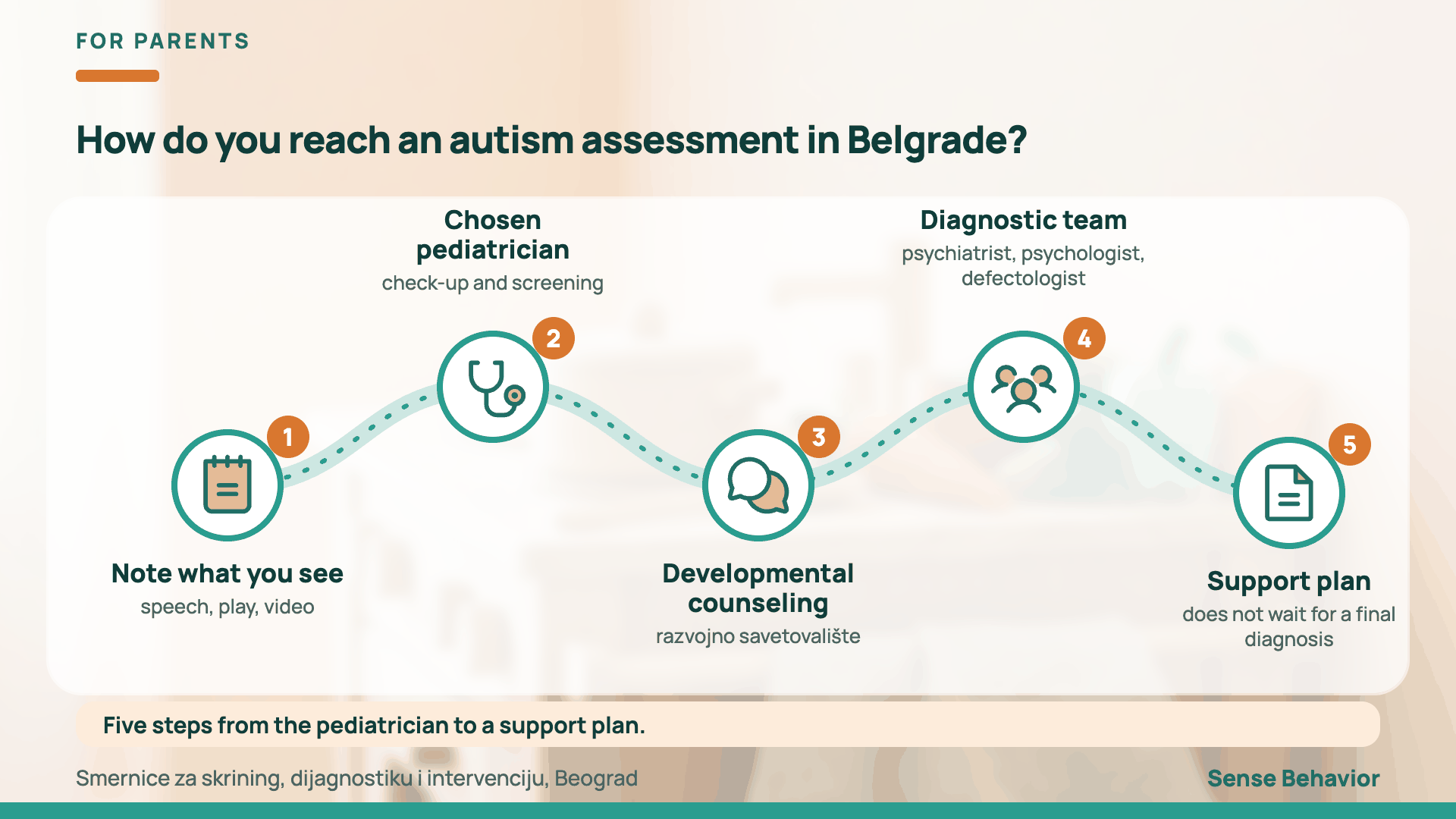
Start by writing down what you see and booking a visit with your chosen pediatrician (izabrani pedijatar) at the health center (dom zdravlja) in your area. Under Serbia's national guidelines, the pediatrician is responsible for early recognition and refers the child onward. No diagnosis is made at this stage, the visit simply starts the route.
Before the visit, note a few things the doctor will not see in a ten-minute appointment.
- When your child said a first word and which words they use now.
- Whether they respond to their name, make eye contact and point to things that interest them.
- How they play and whether they repeat the same actions or movements.
- How they react to noise, light, changes of plan and new places.
- Whether they ever stopped saying words or doing things they could do before.
- Short home videos that show what worries you.
The national guidelines name signs for which autism-specific screening is needed without delay. These are cues to see a doctor, and the diagnosis is made by a specialist.
- By 12 months: no cooing or babbling, no social smile, no response to being called, no joint attention.
- By 16 months: not a single spoken word.
- By 24 months: no spontaneous two-word phrases that are not echoes of an adult.
- At any age: loss of language or social skills the child already had.
The same guidelines say further steps should not be postponed when high-risk signs are present. If a pediatrician advises waiting, ask when exactly to come back and which signs should bring you back sooner. A UNICEF analysis of services for infants and young children in Serbia stresses that a parent's concern should be taken seriously even when screening scores show nothing.
If your child is between one and three, you may find it useful to read about the signs of autism at age one and when to see a specialist. It helps separate normal variation from a reason to book an appointment.
What to ask a pediatrician in Belgrade if you suspect ASD
Ask for three things: developmental screening, a referral to developmental counseling, and a referral to the specialists who carry out diagnosis. These are standard steps from the guidelines, not a special service.
- Standardized developmental screening. The guidelines mention the ASQ and GMCD tools for general developmental monitoring.
- Autism-specific screening with the M-CHAT-R/F. It is designed for ages 16 to 30 months and has 20 questions.
- A referral to a developmental counseling service (razvojno savetovalište) for a closer assessment before specialist diagnosis.
- A referral to an institution with a diagnostic team if the concern remains.
The M-CHAT-R/F is still the most widely used toddler screener, but it only helps decide whether further assessment is needed. A 2023 meta-analysis in JAMA Pediatrics found that its sensitivity and specificity vary noticeably with how and at what age it is used. That is why the Serbian guidelines state that tests do not replace a specialist's clinical assessment.
Which doctor diagnoses autism in Serbia
According to the 2023 national guidelines, a diagnostic team of three specialists makes the diagnosis: a child psychiatrist, a clinical psychologist and a defectologist (defektolog). Formally the child psychiatrist establishes it, but they agree conclusions with colleagues.
The guidelines describe principles worth knowing in advance. They explain why the road to a diagnosis takes more than one visit.
- A diagnosis should be supported by at least two independent opinions based on clinical assessment and standardized methods.
- One meeting is sometimes not enough, so observation and evaluation can take 6 to 12 months, depending on the child's age.
- Clinicians collect information from several sources, including kindergarten and home videos.
- According to the guidelines, ADOS-2, ADI-R and CARS are available in certain tertiary-level institutions in Serbia.
- A diagnosis is not made from a specific test result alone, clinical assessment is required.
Diagnosis can be slow, but starting support does not depend on it. More on that below, in the section on early help before a diagnosis.
Where to go in Belgrade and Novi Sad
We checked against official sources only the institutions about which something definite can be said. The list is short and makes no claim to be complete. Confirm names and opening hours by phone, since they change.
- Institut za mentalno zdravlje (Institute of Mental Health), Milana Kašanina 3, Belgrade. Its official website says the institute works in developmental-age psychiatry, phone +381 11 3307 500. It also published the national autism guidelines.
- Klinika za neurologiju i psihijatriju za decu i omladinu (Clinic of Neurology and Psychiatry for Children and Youth), Belgrade. Its specialists are among the authors of the national guidelines. Check the Clinical Center of Serbia website or call for the address and booking rules.
- A razvojno savetovalište (developmental counseling service) at a health center. UNICEF reported in 2022 that Belgrade has 11 such services. Your pediatrician can tell you which one covers your district.
- Savetovalište razvojne pedijatrije at Dom zdravlja Novi Sad, Zmaj Ognjena Vuka 19. Appointments are by booking, Monday to Friday, 7:00 to 20:00, phone 021/4879-451. It serves children from birth to 6 (10) years, with a speech therapist, a defectologist-re-educator, psychologists and pedagogues on the team.
For Novi Sad we could not confirm from official pages which institution carries out full ASD diagnosis. Begin with the developmental pediatrics service and ask where it refers children when autism is suspected. Private child psychiatry practices exist in both cities, but we do not name them without checking.
The national guidelines acknowledge that the network of developmental counseling services is still being built. Resources are unevenly distributed across the country, so access and quality differ between districts. Keep this in mind when deciding whom to call first.
Do you need a referral, and does insurance cover autism diagnosis
The general order is that a chosen doctor refers you to a specialist, and payment depends on whether the child is insured. For families who arrived recently, both questions need answers before booking, because exceptions are possible.
What the official sources say. Serbia's Law on Health Insurance (Official Gazette 25/2019, 92/2023 and 109/2025) counts family members of an insured person among the insured. The state portal for foreigners, welcometoserbia.gov.rs, states that children under 18 receive insurance as family members, and that working foreigners are insured through an employer or independently as entrepreneurs. Your own status depends on your basis of stay.
A detailed account of what the state fund RFZO covers for foreigners needs separate verification. We give no figures or conditions here without a primary source. Ask these questions at the RFZO branch where you live and at the clinic itself before choosing a date.
What to ask the clinic by phone:
- Whether a referral from the chosen pediatrician is needed and in what form.
- Whether the child will be seen while a Serbian insurance card is still being arranged, and how a paid visit works.
- Which language the appointment is held in and whether you can bring your own interpreter.
- Which documents to bring and whether certified translations of earlier reports are needed.
- How long the wait for a first appointment is and how to learn about the nearest free slot.
How to get an autism assessment in Belgrade if you do not speak Serbian
The national guidelines contain no official rules on assessment language for foreign families, so settle the question with the clinic in advance. The guidelines only note that a diagnosis should be communicated so that the content matches the parents' knowledge of the language and their capacity to understand.
Some practical steps that help you prepare.
- Ask whether you can bring an interpreter and who pays for it.
- Translate earlier reports and discharge summaries if you have them, and bring the originals.
- Write the child's developmental timeline on a single page before the visit.
- Prepare videos that show speech and behavior in ordinary settings.
- Ask for the conclusion in writing and ask separately what its terms mean.
Parents often worry that three languages at home will complicate the assessment or harm speech. Research does not support this. In a study by Hambly and Fombonne (2012), children with ASD from bilingual homes showed no additional language delay compared with children from monolingual homes. Reetzke and colleagues reported a similar finding in 2015. Your home language can stay, and the language plan is worth discussing with a specialist.
How long is the wait for an autism assessment in Belgrade
We found no official data on waiting times for assessment in Belgrade, and we will not quote figures without a source. Waits depend on the institution, the season and the queue, so ask when you book.
What is verified is this. The national guidelines list waiting lists for specialists as one barrier to early diagnosis, alongside a shortage of defectologists, speech therapists and psychologists. The diagnostic process itself, per the same guidelines, can involve 6 to 12 months of observation. It is sensible to plan for several months and to do in parallel what does not depend on the queue.
What to do while you wait for an autism assessment in Belgrade
The Serbian guidelines state that starting early interventions should not wait for a final diagnosis. Any developmental deviation is already a reason for early support. That means the months of waiting can be used.
- Ask the pediatrician to refer your child to developmental counseling to get at least a preliminary assessment and support plan.
- Book a skills assessment. VB-MAPP testing does not require a Serbian diagnosis and shows what your child can already do and what to train first.
- Write a simple behavior plan at home for one or two situations that worry you most.
- Gather a folder of documents, videos and notes so you do not retell everything in every office.
- Look after yourself, because waiting in a foreign country is tiring, and not knowing how long it will last is tiring too. The article on what to do in the first 30 days after a diagnosis has steps that suit the waiting period too.
If you are unsure whether an official diagnosis is needed to begin sessions, read whether you need a diagnosis for therapy and what to do while you wait. It shows how to build the work without losing time.
The scientific picture on behavioral methods is measured. Serbia's national guidelines count ABA-based behavioral interventions among the best-studied approaches. A 2018 Cochrane review rated the evidence for early intensive behavioral intervention as weak and said it may be effective for some children. The Project AIM review in BMJ in 2023 stresses that adverse effects of interventions are poorly monitored. So we describe ABA as one option for support, with no promise of results.
What happens after an autism diagnosis in Belgrade: where to go next
After a diagnosis the route does not end, it moves into a support plan. Under the national guidelines, an individual support plan is drawn up for the child, and parents are helped to understand the diagnosis, the right to education and the choice of therapy.
- An individual support plan prepared by the team together with the family.
- Early interventions where the family lives: at home, in kindergarten and in other places familiar to the child.
- The interagency commission at the municipality, if the child needs additional support in kindergarten or school.
- The center for social work, if you need benefits. The commission may recommend, for example, an increased child allowance (dečji dodatak) or an allowance for help and care by another person, and the center determines the application procedure.
Since 2022 Serbia has been putting into practice a register of children with developmental disabilities. It is used for statistics and service planning. If a doctor mentions entering your child in the register, ask which data are needed and how they are protected.
Which documents to bring to a child psychiatrist in Belgrade
The clinic will give you the exact list when you book, but the basic set is the same for most families. Documents gathered in advance save appointment time and help the specialist see the whole picture of development.
- Passports of the child and parents and documents confirming the basis of stay in Serbia.
- Health insurance documents or information on how a paid visit is arranged.
- All earlier reports, discharge summaries and test results, translated if possible.
- Data on pregnancy, birth and the child's development by month, if you still have it.
- The notes and videos mentioned above.
- A written list of your questions for the doctor, so that none is lost in the tension of the office.
Whether certified translation of documents is required, and in what form, depends on the particular organization. We found no general rule, so confirm this detail before the visit.
Sense Behavior sessions in Belgrade and Novi Sad
At the time of writing (October–November 2026), our specialists hold sessions in Belgrade and Novi Sad. Sessions are in person, at the family's home, and we mostly work with children from one to 10 years old. Diagnosis is done by doctors, and our behavioral skills assessment does not replace it. We help a family understand what the child can already do, where to start and how to fit sessions into daily life.
- Formats: in-person sessions, online support and a hybrid format that combines in-person visits with remote support.
- Sessions are led by Yulia Kozlova and other specialists of the center.
- The session language matches your family's language, and we add Serbian if needed.
- At the time of writing (October–November 2026), about five families in Serbia receive in-person or hybrid support.
- We state the cost at the consultation, and booking is through the website.
- The center's activity is registered in Serbia, and the details are at the bottom of the website.
If you are still in the queue for assessment, that does not prevent you from booking a first consultation. We will discuss what can be done at home right now and tell you whether our format suits you. For the wider picture across the country, see the overview of ABA therapy in Serbia and Montenegro.
Frequently asked questions about autism in a child in Belgrade
Can sessions start before a diagnosis? Yes. Serbia's national guidelines state outright that early interventions should not wait for a final diagnosis. We begin with a behavioral skills assessment.
Is one visit to a child psychiatrist enough? Often it is not. Under the guidelines, a diagnosis is better supported by observation over time and two independent opinions, so several meetings may be scheduled.
How do I know my child needs an assessment? The cues are above, in the list of signs for urgent screening. If you are unsure, book a visit with the pediatrician and bring your notes and videos.
What if the appointment is only several months away? Find out whether there is a waiting list for an earlier slot, and begin in parallel what does not depend on the queue. A skills assessment and a behavior plan can start now.
Neighboring topics for Serbia are covered separately, and these articles may help next.
- Questions of insurance and a chosen pediatrician are covered in health insurance in Serbia for a child.
- What is known about benefits and disability for foreigners is in child disability in Serbia for foreigners.
- If you are thinking about kindergarten or school, a child's rights and the commission's role are explained in kindergarten and school in Serbia with autism.
- If you are only planning a move, the checklist moving to Serbia with a child will help.
The information in this article was checked against the official sources available to us as of 28 October 2026. Institutions change how they work, so confirm conditions by phone before you visit. This article does not replace a doctor's appointment and does not make a diagnosis.
Sources
- Smernice za skrining, dijagnostiku i intervenciju za decu i odrasle sa poremećajem iz spektra autizma (Institut za mentalno zdravlje, Beograd, 2023, pod pokroviteljstvom Ministarstva zdravlja Srbije)
- Institut za mentalno zdravlje, Beograd, službena stranica
- Dom zdravlja Novi Sad, Savetovalište razvojne pedijatrije
- UNICEF Srbija, Situaciona analiza usluga za bebe i malu decu sa smetnjama u razvoju u Srbiji
- UNICEF Srbija, Građani Beograda, UNICEF i JKP Infostan za decu sa teškoćama u razvoju (12. 10. 2022)
- Welcome to Serbia, Zdravstvo i zdravstveno osiguranje
- Zakon o zdravstvenom osiguranju (Sl. glasnik RS 25/2019, 92/2023, 109/2025), Paragraf
- Wieckowski et al. (2023). Sensitivity and specificity of the M-CHAT (original and revised): systematic review and meta-analysis. JAMA Pediatrics
- Hambly & Fombonne (2012). The impact of bilingual environments on language development in children with autism spectrum disorders. J Autism Dev Disord
- Reetzke et al. (2015). Communicative development in bilingually exposed Chinese children with autism spectrum disorders. J Speech Lang Hear Res
- Reichow et al. (2018). Early intensive behavioral intervention (EIBI) for young children with ASD. Cochrane Database Syst Rev
- Sandbank et al. (2023). Project AIM: updated systematic review and secondary analysis. BMJ