Child Disability in Serbia for Foreigners: Which Benefits Apply

Child disability in Serbia for foreigners does not come as one set of benefits. Rights are granted under different laws, and each has its own conditions on citizenship and residence status. Some payments are tied by law to citizenship or to the status of a permanently settled foreigner, and others require a place of residence or stay and an assessment of the child’s need for care. For families on temporary residence the law is silent on many questions, so those questions are put on a list for the social work centre. This guide covers the rules we verified against the texts of the laws.
Which benefits and rights a child with developmental difficulties has in Serbia
The Serbian system rests on several laws. They name different kinds of help and different bodies, so one certificate rarely opens every door at once.
- Care allowance and increased care allowance (dodatak za pomoć i negu drugog lica). The social work centre decides under the law on social protection.
- Child allowance (dečiji dodatak) raised by 50 percent for parents of a child with developmental difficulties when a commission opinion exists. This is under the law on financial support to families with children.
- Reimbursement of preschool costs for children with developmental difficulties.
- Leave for special care of a child with salary compensation for working parents, under the same law.
- The status of a parent-caregiver (roditelj negovatelj) with a monthly payment. The new law applies from 1 October 2026.
- Medical care and rehabilitation under compulsory insurance. We covered this part in the article on a child’s health insurance in Serbia.
Child disability in Serbia for foreigners: are benefits available
In short, benefit by benefit. There is no universal answer, because the laws set different conditions.
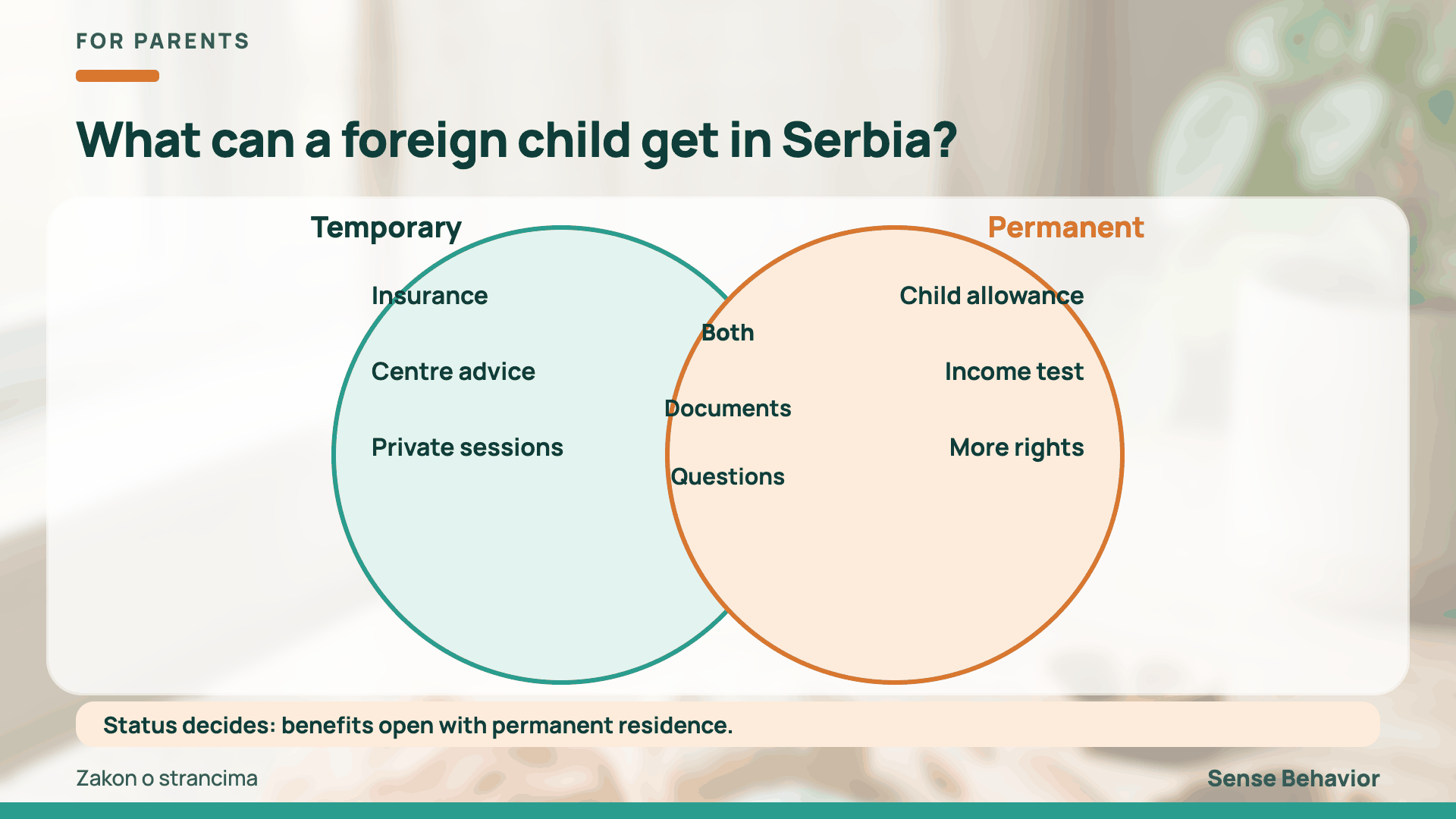
- Social protection. The Law on Social Protection names citizens of Serbia as beneficiaries and adds that foreign citizens and stateless persons can be beneficiaries in accordance with the law and international agreements. Rules for temporary residence are not spelled out separately.
- Child allowance. The law gives the right to one of the parents who is a citizen of Serbia with registered residence in the country, or a foreigner with the status of a permanently settled foreigner (stalno nastanjen stranac). Temporary residence is not named in this provision.
- Parent-caregiver status. The first condition in the law on such parents is Serbian citizenship. Foreign parents do not qualify.
- Preschool costs for children with developmental difficulties. The text of the article names no citizenship condition, but the service is provided by an institution with a ministry decision on verification, and the share of the fee is set by the local government. Ask the local administration.
- Medical insurance and rehabilitation. Here the ground for insurance decides, not citizenship, and the article on insurance covers this in more detail.
The published text of the law on financial support to families with children runs up to the 2024 amendments, and the law on social protection up to 2022. Before applying, check the current text in the Official Gazette or with a specialist at the centre.
Care allowance for a child in Serbia: who is entitled and by what criteria
The care allowance belongs to a person who, because of a physical or sensory impairment, intellectual difficulties or changes in health, needs another person’s help to meet basic life needs. The right applies if it cannot be obtained on another legal ground.
The law describes the need for care very concretely. It concerns a person who cannot get out of bed, move around the flat without aids, eat, undress, dress or keep basic hygiene without another person’s help. The need is established under the rules on pension and disability insurance.
The increased care allowance is granted for more severe impairments. The law names a physical impairment of 100 percent on one ground, a permanent organic disorder of a neurological and psychological type, or several impairments of 70 percent or more on at least two grounds.
What this means for a family. A diagnosis alone does not settle the question. The assessment looks at how much the child depends on help with basic actions, and an authorised body decides. For many children the criteria may not fit, so it helps to hear a centre specialist’s assessment in advance instead of counting on a payment.
The application is considered by the social work centre for the place of residence or temporary stay of the applicant. The law indexes the amounts twice a year, on 1 April and 1 October, and the current sum is best checked on the ministry’s website or at the centre.
Child allowance in Serbia for foreigners: conditions and the increase for children with developmental difficulties
Child allowance goes to one of the parents who directly cares for the child. The parent must be a citizen of Serbia with registered residence in the country or a foreigner with the status of a permanently settled foreigner. Payment runs from the day of the application for the first four children by birth order.
- Income. The family’s total monthly income per person over the three months before the application must not exceed the set threshold. For parents of a child with developmental difficulties for whom a commission opinion exists, the threshold is raised by 20 percent.
- Amount. For such parents the allowance is raised by 50 percent, and the total of all increases cannot exceed 80 percent.
- Income exception. The right does not depend on the family’s means if the child receives the care allowance or its increased form.
- School. The allowance for a child with developmental difficulties for whom a commission opinion exists continues while the child is in an educational programme, and, with extended parental rights, no longer than to age 26.
The threshold and the amount are set by the government, so the figures change. We deliberately do not quote them.
The 2018 bylaw lists the documents in detail. For a foreigner it includes, as a separate line, a certificate of the status of a permanently settled foreigner. For a family on temporary residence this means that the route to the allowance opens only after permanent status is obtained.
How Serbian law defines a child with developmental difficulties and who gives the opinion
Serbian laws use the wording “a child with developmental difficulties and disability” (dete sa smetnjama u razvoju i invaliditetom). For family payments, the opinion on the degree of psychophysical developmental difficulties is given by a commission of the Pension and Disability Insurance Fund, whose work is funded from the state budget.
In practice this is a chain of several steps. The family first collects medical documents, then the body where you apply requests the commission’s opinion. Which examinations and certificates are needed for a particular child we did not find in open texts, so ask a specialist at the centre.
Reimbursement of kindergarten costs for a child with developmental difficulties
Preschool-age children with developmental difficulties have the right to reimbursement of the cost of attending a preschool institution. The law names an institution that holds a ministry of education decision on verification, and gives the reimbursement as a share of the parent’s fee, defined by a local government decision.
- The right does not apply if salary compensation for leave for special child care is already received for this child.
- The right applies if the local government does not finance the same thing.
- For children from low-income families, and for children with developmental difficulties who have not received the right under other articles, partial payment applies depending on family income.
Citizenship is not named in the text of these articles. The conditions in your city, including the certificates needed, have to be clarified at the local administration.
Leave for special child care and working parents in Serbia
The law on financial support to families with children includes among the rights leave for special care of a child and salary compensation. The minister sets detailed conditions for a parent of a child under five who needs special care, and for an unemployed person receiving unemployment benefit.
If you work in Serbia under a contract, ask your employer and the centre how these rules apply to foreign workers. In the articles we checked we saw no separate citizenship restrictions, but the detailed conditions are set by a bylaw.
Parent-caregiver status: what changed on 1 October 2026
The new law on parent-caregivers and caregivers applies from 1 October 2026. It introduces a status and a monthly payment for those who provide constant care to a child who needs another person’s help.
- The child must have the right to the increased care allowance. The law defines the child exactly this way.
- The applicant must be a citizen of Serbia, an adult and have legal capacity. Registered residence at the same address as the child is required.
- The applicant does not work, does not run a business or another professional activity and does not receive a pension.
- The status is recognised up to age 65. The payment under the text of the law is 65,000 dinars a month and is indexed on 1 March.
- The application is filed electronically or at the social work centre for the place of registered residence. The centre decides within 15 days after the documents are complete.
The law separately states that this payment does not cancel the child’s other rights, including the care allowance. For foreigners the citizenship condition closes access completely. We found no exceptions in the text of the law.
How a foreigner can obtain permanent residence status in Serbia
Permanent residence in Serbia (stalno nastanjenje) is allowed by law to a foreigner who has stayed in the country continuously for three years on the basis of temporary residence and meets the conditions of the law. A foreigner with permanent status is equal in rights and duties to citizens, except for rights excluded by the Constitution and the laws.
- The application comes with a passport, proof of means of support, proof of health insurance, evidence of the grounds for the application and proof of paying the fee.
- The foreigner files the application in person. The Ministry of Interior decides within 60 days, and this period includes a security check.
- A stay counts as continuous with absences of up to ten months in total or up to six months at a time within the three years.
- A temporary residence permit must be valid at the time of filing.
- There is a special case for minors where at least one parent is a citizen of Serbia or a foreigner with permanent status.
The law on foreigners requires proof of health insurance for the planned period for the temporary stay itself and its extension. This condition does not apply to family members of a citizen of Serbia or to foreigners who are employed, together with their family members. That is why the question of insurance and the question of benefits are linked, as you will see in the article on a child’s health insurance.
Who assesses disability and the degree of impairment in a child in Serbia, and how
Serbian laws have no single commission for all cases. The assessing body depends on the kind of right, and it matters for a family to understand where exactly the application goes.
- For the care allowance, the need is determined under the rules on pension and disability insurance, and the social work centre decides.
- For child allowance with the increase, the opinion on the degree of psychophysical developmental difficulties is given by a commission of the Pension and Disability Insurance Fund.
- Educational support is determined by an inter-sectoral commission, which we will cover in a separate article on kindergarten and school.
We did not find in open texts a step-by-step procedure for the Fund commission’s in-person assessment of a child, so we do not describe it here. Ask the social work centre which medical documents and opinions are needed, and keep copies of every paper.
What a foreign family in Serbia can do to obtain help for a child
The order of actions depends on the residence status. Below is a general sequence that we assembled from the provisions of the laws.
- Establish your status. Temporary residence, permanent residence and citizenship give different rights.
- Check whether the child has health insurance and a chosen paediatrician. This is the basis for medical documents.
- Collect medical opinions and discharge notes with translations. Ask the centre about translation requirements.
- Book a consultation at the social work centre for your place of stay and ask the questions from the list below.
- File for the right whose conditions you meet. Do not file for what the law closes for your status.
- If the period of continuous stay is approaching three years, prepare documents for permanent residence.
Which documents are needed for benefit applications
The full list depends on the kind of right, so check it at the centre and at the administration. For child allowance, the 2018 bylaw names the following documents.
- birth register extracts for all children in the family
- a certificate of citizenship or of the applicant being a foreigner
- a certificate of residence for all members of the joint household
- a certificate of permanently settled foreigner status for a foreign applicant
- a certificate of owning or not owning real estate
- certificates of income for the three months before filing for all household members
- a certificate of cadastral income for the previous year
- a statement about the educational institution the child attends.
For a medical opinion on the degree of impairment, discharge notes from treating doctors are needed. Foreign documents may require translation and certification, and it is worth asking about the rules in advance.
What to do if benefits for foreigners are not yet available
If a family is on temporary residence, part of the cash payments is closed. Other supports remain, and it is worth pursuing them in parallel.
- Medical care under insurance. For a child, the law covers examinations, treatment and medical rehabilitation in illness and injury in full.
- Educational support in kindergarten and school, which we will cover separately.
- Checking rights with the local government. The law lets cities and provinces introduce additional rights, so in Belgrade and Novi Sad it is worth asking the administration about conditions.
- Private sessions with a skills assessment. They help to build a programme and sit alongside any payments. On budgeting, see the article on the cost of ABA therapy.
- The route to permanent status. Keep your documents in order so that an application can be filed after three years of continuous stay.
Appeals and deadlines: what to do if the centre refuses
Rights under the law on family support and the law on social protection are granted under the general rules of administrative procedure. This means a decision is issued in writing, and you have the right to appeal it.
- Under the law on child payments, the first-instance decision is made by the body for the applicant’s place of registered residence, and the minister hears the appeal.
- Under the law on parent-caregivers, the centre decides within 15 days after the documents are complete, the ministry hears the appeal through the centre, and an administrative dispute is possible after that.
- Changes that affect the right must be reported to the centre within 15 days.
Ask for the decision in writing and, if refused, file the appeal right away. Keep all certificates and receipts.
Common mistakes when applying for benefits for a child in Serbia
- Expecting a diagnosis to give a payment automatically. The law looks at the need for care and at the applicant’s status.
- Applying for a benefit meant for citizens. For foreigners on temporary residence it may be closed.
- Assuming three years of stay in Serbia will count regardless of absences. The law limits the length of absences.
- Not keeping copies of documents and receipts. They help with appeals and renewals.
- Carrying over the rules of Croatia, Montenegro or Republika Srpska. The conditions there are different.
- Not checking which version of the law is in force. Amounts and thresholds change with government decisions.
Questions for the social work centre: what to ask before filing
Write the questions down beforehand and ask for the answer in writing. If another counter says something different, you will still have a document.
- What is our residence status, and which rights under it are open to the child?
- Can the child receive the care allowance on temporary residence?
- Which medical documents are needed, and do they need translation with certification?
- To which commission, and within what period, is the application sent?
- Which benefits are closed for us, and what can be filed now?
- Which additional rights apply in our city?
- How is the right renewed and reviewed?
Sense Behavior in-person sessions in Belgrade and Novi Sad
At the time of writing (October–November 2026) our specialists run sessions in Belgrade and Novi Sad. About five families in Serbia are currently in in-person and hybrid support. That number refers only to the in-person and hybrid format and changes over time.
The sessions are private and do not replace state payments. They run alongside the doctors and documents described here.
- Format. In-person sessions take place at the family’s home. There is also remote support and a hybrid format that combines in-person meetings with video work.
- Age. We mostly work with children from one year to 10 years old.
- Who leads. Sessions are led by Yulia Kozlova and other specialists of the centre.
- Language. Sessions are held in the family’s native language, and Serbian can be added if needed.
- Price. It is discussed at the consultation, and this article gives no figures.
- Booking. You can leave a request on our website. The activity is registered in Serbia, and the registration details are at the bottom of the site.
We do not promise results, and every programme starts with an assessment of the child’s skills. If you are looking for where to start when you suspect developmental differences, read the article on where to go if you suspect autism.
Frequently asked questions about disability and benefits for a child in Serbia
Is the care allowance available to foreigners? The law on social protection names citizens of Serbia as beneficiaries and admits foreigners in accordance with the law and international agreements. For temporary residence there is no direct rule in the text, so ask at the centre.
Can a foreigner receive child allowance? Yes, if the person has permanently settled foreigner status and the conditions on income and property are met.
Do foreign parents qualify for parent-caregiver status? No, the first condition of the law is citizenship of Serbia.
How long must you live in Serbia for permanent residence? Under the law on foreigners, three years of continuous stay on the basis of temporary residence, plus the other conditions.
Where are applications filed? The social work centre for the place of residence or stay considers the care allowance. The body for the applicant’s place of registered residence considers child allowance.
Is insurance needed for permanent residence status? Yes, proof of health insurance is on the list of documents.
Neighboring topics for Serbia are covered separately, and these articles may help next.
- If you are thinking about kindergarten or school, a child's rights and the commission's role are explained in kindergarten and school in Serbia with autism.
- If you suspect ASD and do not know where to go, the steps are described in autism in a child in Belgrade.
- Support from other parents and local associations is described in parent communities for autism in Serbia.
- A general overview of help in the country is in ABA therapy in Serbia.
- If you are only planning a move, the checklist moving to Serbia with a child will help.
If you need help drafting questions for the centre or want to discuss sessions for your child, write to us through the website. We will suggest how to prepare for the conversation.
Sources
- Zakon o socijalnoj zaštiti (Sl. glasnik RS 24/2011, 117/2022 - odluka US)
- Zakon o finansijskoj podršci porodici sa decom (Sl. glasnik RS 113/2017 ... 79/2024)
- Pravilnik o bližim uslovima i načinu ostvarivanja prava na finansijsku podršku porodici sa decom (Sl. glasnik RS 58/2018)
- Zakon o roditeljima negovateljima i negovateljima (Sl. glasnik RS 63/2026)
- Zakon o strancima (Sl. glasnik RS 24/2018, 31/2019, 62/2023)