Preparing a child with autism for daycare: signs of readiness and a checklist
The question of preparing a child with autism for daycare rarely comes from general curiosity. Behind it are usually specific, entirely understandable fears: the child won't let go of your hand at the classroom door, the teacher won't know what a scream or a retreat to a corner means, and a month later the family is searching for a new spot all over again. If that's you, you're not alone. And the good news is that some of that anxiety isn't resolved by patience or by waiting for the child to "grow into it". It's resolved by concrete steps: at home, in preparing the child, and in the conversation with the daycare itself.
How to tell your child is ready for daycare
Readiness for daycare is rarely a matter of calendar age. A specific, observable set of skills is a much better indicator. A study of daycare staff perceptions notes that even in facilities with a genuinely positive attitude toward inclusion, staff knowledge of autism and training in managing challenging behavior are often limited. That means the more stable skills a child already has going in, the less falls on staff who aren't always equipped to close that gap from day one.
- The child tolerates a brief separation from a close adult. Not necessarily calmly, but without an hour-long escalation that doesn't resolve on its own.
- There's at least one reliable way to communicate a basic need: a gesture, a card, a word, or leading an adult by the hand to the object they want.
- The child responds to their own name and generally responds to a familiar adult, even if not immediately.
- The child moving away from an adult doesn't require constant physical monitoring every second. Basic attention redirection already works.
- The child can spend some time in a room with background noise and other children without immediate overload.
Many parents compare their child to the neighbor's and come away discouraged. That comparison is almost always pointless. For children with autism, progress on these skills rarely moves in a straight line. It happens in bursts: a child who couldn't tolerate separation six months ago can close that gap in a few weeks of deliberate practice. Judge your own child against where they were last month, not against someone else's child.
If some of these don't describe your child yet, that isn't a verdict that it's too early. It's a working list for targeted preparation. It's also worth looking at daily self-help skills: dressing, eating, using the toilet. If those are still a struggle, here's a step-by-step starting point: teaching a child to dress independently.
A checklist for getting ready
- Communication a new adult can understand. If your child uses PECS cards, put together a set of five or six essentials for the early days: toilet, drink, eat, hurt, want mom, help. If they use gestures or single words, write them down in plain terms on one page so the teacher isn't guessing what a specific sound or movement means.
- A one-page profile of your child. Not the diagnosis or medical history, but a working cheat sheet: what specifically upsets them (a hair dryer, bright light, a crowd at the door), what specifically helps them calm down (a tight hug, a favorite toy, five quiet minutes), how they signal pain or hunger, and what to do in the middle of a meltdown. For example: don't grab, don't reason with them, clear away anything unsafe and give them space.
- Documents and reports in advance. A specialist's report, environment-adaptation recommendations, and, if needed, arrangements for aide support. Gather these before you need them, not the day before enrollment.
- An anchor object from home. A toy, a piece of fabric that smells like home, or another object the child can bring along for the first few weeks. A small point of stability in an unfamiliar setting works better than it sounds.
- A routine as close to daycare's as possible. Wake-up time, nap, and mealtimes shifted toward the daycare schedule a week or two before the start, not on day one.
- A trial visit without the full program. One or two short visits to the room before the official start, to see the space and meet the teacher. If you can time it for a quiet moment rather than the crowded morning rush, it makes a real difference.
- A specific, not a general, conversation with the teacher. Instead of "he has autism, he's different", give something practical: "he startles at sudden noise, give him a heads-up before anything loud" or "if he pulls at his ear and rocks, he's overloaded and about to lose it, take him somewhere quiet". A concrete behavioral cue is more useful than any diagnosis, because it tells the teacher what to do right now.
Recommendations for the first month
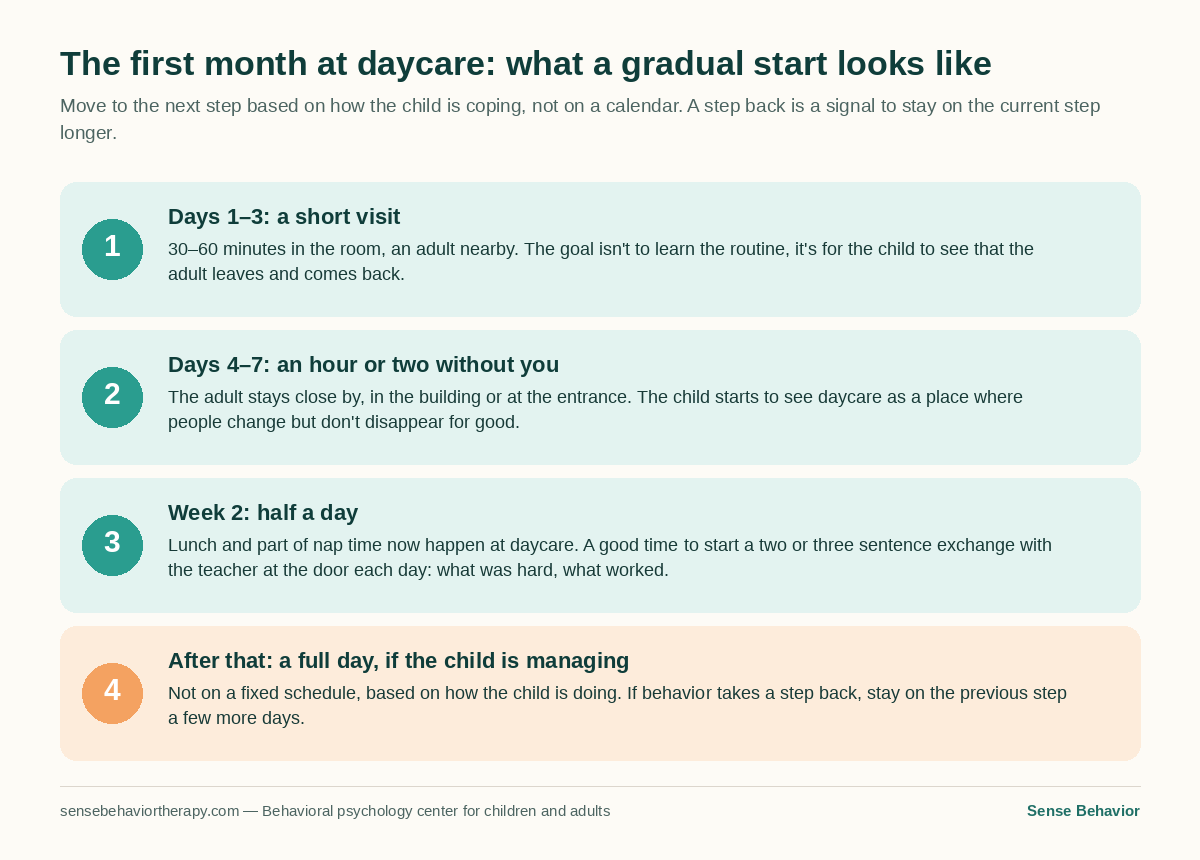
If the daycare allows a gradual start, aim for a pace like this: the first two or three days, a short visit of thirty to sixty minutes with you nearby; the next few days, an hour or two without you, but you're close by, in the building or at the entrance; the second week, half a day; after that, if your child is managing, a full day. If a step back happens somewhere along the way, stay on that step a few more days. If things don't improve, talk to a specialist. Don't wait it out and don't leave your child stuck in that stress for too long.
Set up a visual schedule at home that mirrors the daycare routine. That way the shift between the two settings becomes predictable rather than two unfamiliar worlds. Agree with the teacher on two or three sentences at pickup every day: what was hard, what worked. A short exchange at the door takes under two minutes and gives you more than a summary once a month at a parent meeting.
Watch for signs of overload: worse sleep, more frequent meltdowns at home, refusing food the child used to eat calmly. Treat them not as a signal that daycare isn't a good fit, but as a signal to slow the pace of the transition for now. A small step back in behavior during the first few weeks: a normal reaction to a new load, not a sign preparation failed. In most cases it eases within three or four weeks as the child adjusts.
At Sense Behavior, daycare readiness is part of the program for building independence and communication skills. The specialist assesses which checklist skills the child already has and which are worth practicing in advance, then builds a plan around the specific time remaining before daycare starts. During the adjustment period, we don't leave a family to handle it alone: the specialist is available every day, answers any question, and reacts quickly if something isn't going well.