Parent Communities for Autism in Serbia: Where to Find Support

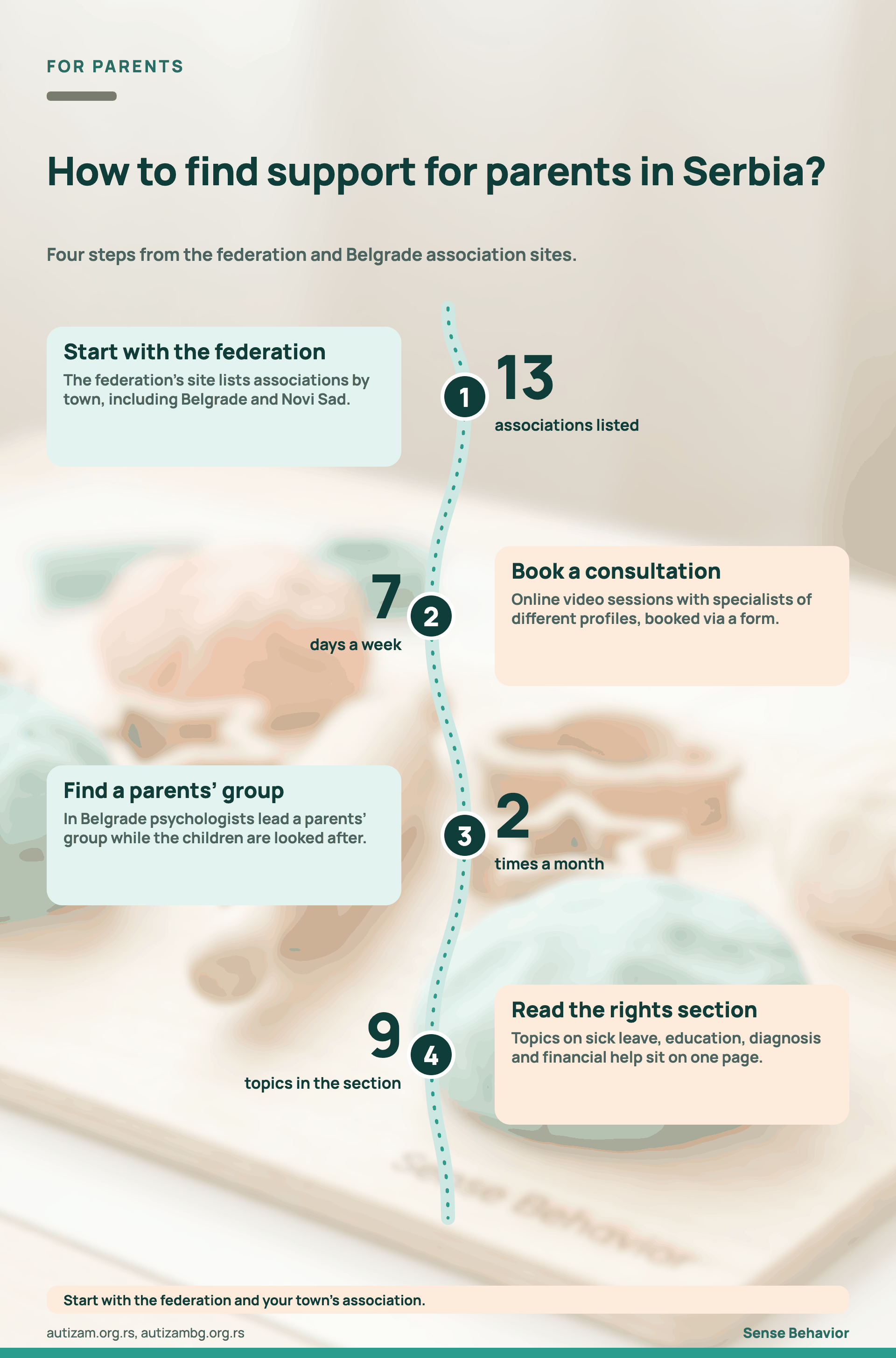
Parent communities for autism in Serbia are built as a network of local associations united by the Association of Serbian Associations for Help to People with Autism. The federation was founded in 1977, and its website names 13 associations in different towns, including Belgrade and Novi Sad. For families who have moved recently this is the most reliable entry point, because the names and details of the organisations can be checked on their official websites. Below is what we confirmed, and separately what we could not confirm.
How parent communities for autism are organised in Serbia
The base is parent associations registered as civil society organisations. Above them stands the federation of associations for help to people with autism, which runs a shared website, projects, a library and online counselling. The federation’s page says its aim is to protect the rights of people with autism and their families.
A list of member associations is on the page on associations and institutions. On the federation’s home page they are named by town. These are Niš, Kraljevo, Vranje, Jagodina, Šabac, Užice, Belgrade, Kruševac, Novi Sad, Sombor, Bela Crkva and Kragujevac. Novi Sad has two organisations listed.
An important caveat. The associations’ websites are in Serbian, and we found no open data on which languages they use with families. This is worth asking at the first contact.
Which autism organisations exist in Belgrade and Novi Sad
Below are the organisations we checked on their own pages or on the federation’s page. We do not give phone numbers or private addresses because they change, so take them from the official websites.
- Association of Serbian Associations for Help to People with Autism, Belgrade. Website autizam.org.rs. Runs online counselling and a section on families’ rights.
- Belgrade Association for Help to People with Autism, New Belgrade. Website autizambg.org.rs. Holds a psychological group for parents and a parallel group on developing communication for children.
- Society for Support of People with Autism of the City of Novi Sad (DPOSA). Named in the federation’s list of member associations. See the federation’s page for its programmes and contacts.
- Association “Prizma Autizma” (Prism of Autism), Novi Sad. Named in the federation’s list of member associations. We found no other open confirmation of its work, so verify the contact through the federation.
- Association “Svoj Svet” (Own World), Novi Sad. Website svoj-svet.rs. This parents’ association, founded on 4 July 2018, works as a non-profit and sets tasks in health, education and social policy.
The federation’s projects and library: what else parents should know
On its home page the federation states its mission as the search for systemic solutions for realising the rights of people with autism. Projects are listed next to it, and they show what the organisation does.
- “Weekend programme”. A support service for people with autism and their families, which runs with the support of Belgrade’s City Secretariat for Social Protection.
- DE-ENIGMA. A project to build a system of therapeutic work with children with the participation of a robot.
- IPA+. A European project to create a curriculum for specialists who work with autistic people of all ages.
- Library. The federation holds a collection of printed and electronic publications by foreign authors and autism specialists, available to parents and specialists.
Participation terms, age and language differ by project, and the home page does not spell them out. Read the project pages and ask the federation whether the format suits your family.
What parent associations work on: the example of Novi Sad
The association “Svoj Svet” describes on its website how it sees parents’ tasks. These are the organisation’s own words, and we give them as its position, not as an assessment of the system.
- The association speaks of three areas of problems, health, education and social policy.
- The organisation names as parents’ main worry the question of who will care for an adult when the parents are no longer there.
- Among its goals it names creating a Centre for Autism, which, in its words, does not yet exist in the country.
- The association stresses that it consists of parents of children on the autism spectrum and parents whose children have similar developmental disorders.
For a family living in Serbia temporarily these topics may seem distant. Yet it is through such associations that parents exchange information about schools, commissions and specialists, and this information is sometimes worth more than any directory.
The federation’s online counselling: what it is and how to book
The federation runs an online counselling service (Savetovalište). Consultations take place as individual video sessions with specialists of different profiles, depending on the area of support needed.
- Consultations are available both to the family and to people with autism themselves.
- According to the website, the team includes psychologists, special educators, doctors, and specialists in social protection and law.
- Booking is through a form on the website. The federation says specialists are available 7 days a week.
- Explaining why the service is needed, the federation notes that most diagnostic centres and support services are located in Belgrade.
We did not find the price of consultations, the language or the booking terms on the page. These points need to be clarified before booking, as does whether an interpreter is needed.
The “Ostvari prava” section on the federation’s site: which topics it covers
The page “Ostvari prava” (Exercise your rights) gathers materials on families’ rights. The section has 9 topics, and their titles show which questions parents in Serbia deal with.
- sick leave for special care of a child
- diagnosis of autism in children and adults
- associations and institutions that protect rights
- laws and rulebooks that concern people with autism
- health care and dental services
- education
- obtaining financial support
- extension of parental rights
- guardianship and the duties of guardians
These topics overlap with our articles on diagnosis when you suspect autism and on rights and benefits for a child in Serbia for foreigners. The federation’s materials are written for citizens of Serbia, so check the conditions for foreign families separately.
A psychological group for parents in Belgrade
According to the description on the Belgrade association’s page, a psychological group for parents meets 2 times a month on the association’s premises. A session on developing communication for children runs in parallel, and the children are looked after.
- Parents discuss how to choose a suitable institution and which kind of help suits the child.
- They go through the rights a family can obtain.
- You can talk about feelings, share experience and ask a psychologist for advice on a child’s behaviour.
- The group is open to parents of people with autism of any age and is led by psychologists.
The page is undated, and the schedule may have changed. Call or write to the association and confirm the dates, format and language before you travel.
Associations in other towns of Serbia
If the family lives outside Belgrade and Novi Sad, start with the list on the federation’s website. It names associations in several towns.
- Niš, Kragujevac, Kraljevo, Kruševac
- Užice, Šabac, Jagodina
- Vranje, Bela Crkva, Sombor
Contact details are in the list on the website. Each association has its own times and terms of admission.
How to write to an association if you do not speak Serbian
Make the first message short and specific. Explain who you are, where you live and what you are looking for. Ask for a reply in English, or simplify your question and use a translator.
An example message in Serbian that you can copy and complete:
- Name the town, the child’s age and the question. Diagnoses and documents are not needed in the first letter.
- Ask which languages the association works in and whether an interpreter is needed.
- Find out whether participation is free and how to book.
- Ask for the schedule and address in writing.
Parent groups in your own language on Telegram and Facebook: how to search and check
Many families in Serbia have moved recently, and many create groups in their own language in messengers. We deliberately name no specific chats. Closed groups cannot be checked, and open ones change rules and membership.
If you find a group yourself, check it against this list:
- who the administrator is and whether you can message them directly
- whether the group has rules and moderation
- whether people are asked to pay money, send a prepayment or buy “courses”
- whether cures are promised. Such promises mean you are better off leaving
- whether members post medical documents and photos of children
Do not publish your child’s medical documents and photos in an open group. For questions about a specific case it is better to write to a specialist or to an association.
Emotional support for parents: what to expect from a community
A community works alongside a doctor and a psychologist and eases the feeling of being alone. The Belgrade association writes directly that the group helps parents see that they are not alone with their problem.
If you have only just learned of a diagnosis or a suspicion, start with the article on how to accept a child’s diagnosis. If relatives do not understand what is happening with the child, the article on how to explain autism to relatives will help. And when a chat recommends diets or supplements, read the article on myths about autism treatment and check with a specialist.
A plan for the first two weeks: how to find support in Serbia
You do not need to do everything at once. A step-by-step plan helps you avoid spreading your energy thin.
- Day 1. Open the federation’s website and find the association for your town in the list.
- Day 2. Write a short message with the questions from the list below and send it to the association.
- Days 3 and 4. Look through the “Ostvari prava” section and note the questions that concern your family.
- Week 2. Book an online consultation with the federation or a parents’ group if the association has confirmed the terms.
- End of week 2. Take stock. What you learned, which contacts proved useful, which questions remain.
How to behave in a parent group and keep your boundaries
A group works better when everyone follows a few simple rules. They help you and the other members.
- Share experience as experience, not as advice for every child. Each child develops in their own way.
- Do not name another person’s child and do not discuss a family without its consent.
- Ask for the source when you hear a promise of a quick result.
- Agree boundaries with yourself. You are entitled to stay silent about a diagnosis or leave a group.
- Thank people for help and return it when you can.
What to do if you do not live in a town with an association
Some families live in small towns with no association. Then there are several options.
- The federation’s online counselling, which is not tied to a town.
- The association in the nearest town on the list on the website.
- A consultation at the social work centre for your place of stay, which we covered in the article on benefits for a child.
- Parent groups in your own language, checked against the list above.
World Autism Awareness Day and other events
World Autism Awareness Day is marked on 2 April. According to Serbian media, associations and parents organise events in different towns on that day. Dates and formats differ each year, so follow the associations’ pages.
State bodies and rights organisations: whom to write to if rights are violated
The federation’s website lists bodies you can turn to if a child’s rights are violated. They are the Commissioner for Protection of Equality, the Protector of Citizens and the Lawyers’ Committee for Human Rights YUCOM. The federation describes YUCOM as an organisation with a free network of legal aid in 16 towns.
Their powers differ. The Commissioner considers complaints about discrimination. The Protector of Citizens accepts appeals when administrative bodies did not apply or wrongly applied the laws. Conditions for foreigners and the language of reception are to be checked on their websites.
Common mistakes when looking for parent communities in Serbia
- Looking only for groups in your own language and not for local associations. Local organisations know how rights are obtained.
- Posting the child’s documents in an open chat.
- Taking advice from a chat as a doctor’s advice.
- Paying for a “guaranteed result”. Serious organisations do not promise results.
- Expecting an association to solve the matter in place of the family. It can advise, and the family files the papers.
- Using outdated contacts. Check the details on the day you reach out.
Questions for the first meeting with an association
- Which languages do you work in with families?
- Do you accept families on temporary residence?
- Which services are free and which are paid?
- How do parent groups run and how do we sign up?
- Can we come with an interpreter?
- Whom should we ask about education and social protection?
- How do you check the information you give families?
Sense Behavior in-person sessions in Belgrade and Novi Sad
At the time of writing (October–November 2026) our specialists run sessions in Belgrade and Novi Sad. About five families in Serbia are currently in in-person and hybrid support. That number refers only to the in-person and hybrid format and changes over time.
We do not replace parent associations. They provide contacts, experience and information about rights, while our sessions are built around the child’s skills.
- Format. In-person sessions take place at the family’s home. There is also remote support and a hybrid format that combines in-person meetings with video work.
- Age. We mostly work with children from one year to 10 years old.
- Who leads. Sessions are led by Yulia Kozlova and other specialists of the centre.
- Language. Sessions are held in the family’s native language, and Serbian can be added if needed.
- Price. It is discussed at the consultation, and this article gives no figures.
- Booking. You can leave a request on our website. The activity is registered in Serbia, and the registration details are at the bottom of the site.
We do not promise results, and every programme starts with an assessment of the child’s skills. On how parent communities work in Bulgaria, see our article on parent communities in Bulgaria, and on parental burnout the article on parent burnout.
Frequently asked questions about parent communities for autism in Serbia
Where to start if we have just arrived? With the website of the federation of associations and the association in your town. You can find counselling and information on rights there.
Does the federation have online counselling? Yes, the service works through video sessions. Check booking terms and language on the website.
Can I attend a parents’ group without Serbian? The website does not say, so ask beforehand. Come with an interpreter if the association agrees.
Are the associations’ services paid? We found no price data on the pages, so ask when you reach out.
Can I trust advice from chats? As ideas, yes. As medical or legal advice, no. Check information with a doctor and official sources.
What if an association does not reply? Write through the federation and to a neighbouring association. Contact details on websites are sometimes outdated.
Neighboring topics for Serbia are covered separately, and these articles may help next.
- If you suspect ASD and do not know where to go, the steps are described in autism in a child in Belgrade.
- If you are thinking about kindergarten or school, a child's rights and the commission's role are explained in kindergarten and school in Serbia with autism.
- If you are only planning a move, the checklist moving to Serbia with a child will help.
- A general overview of help in the country is in ABA therapy in Serbia.
If you need help preparing questions for an association or starting sessions, write to us through the website.
Sources
- Savez udruženja Srbije za pomoć osobama sa autizmom (zvanični sajt)
- Savez: Udruženja i institucije za zaštitu prava dece i odraslih sa autizmom
- Savez: Ostvari prava
- Beogradsko udruženje za pomoć osobama sa autizmom (zvanični sajt)
- Beogradsko udruženje: Savetodavni rad sa roditeljima osoba sa autizmom
- Udruženje Svoj Svet, Novi Sad (zvanični sajt)
- Zaštitnik građana
- Poverenik za zaštitu ravnopravnosti