Health Insurance in Serbia for a Child: What RFZO Covers
Health insurance in Serbia for a child is arranged either through the state fund RFZO, when the family has a ground for compulsory insurance, or through a private policy. The law names children under 18 as family members of an insured person, but an adult has to be insured first. This guide collects the rules of the Law on Health Insurance, the document list, the waiting period and the questions to ask at the fund’s branch. Anything we could not confirm from official sources is marked as such in the text.
How health insurance works in Serbia: RFZO and private policies
Serbia has two kinds of insurance, compulsory and voluntary. The compulsory one is run by the Republic Health Insurance Fund, RFZO for short. Voluntary policies are sold by insurance companies, and the fund itself may offer them too.
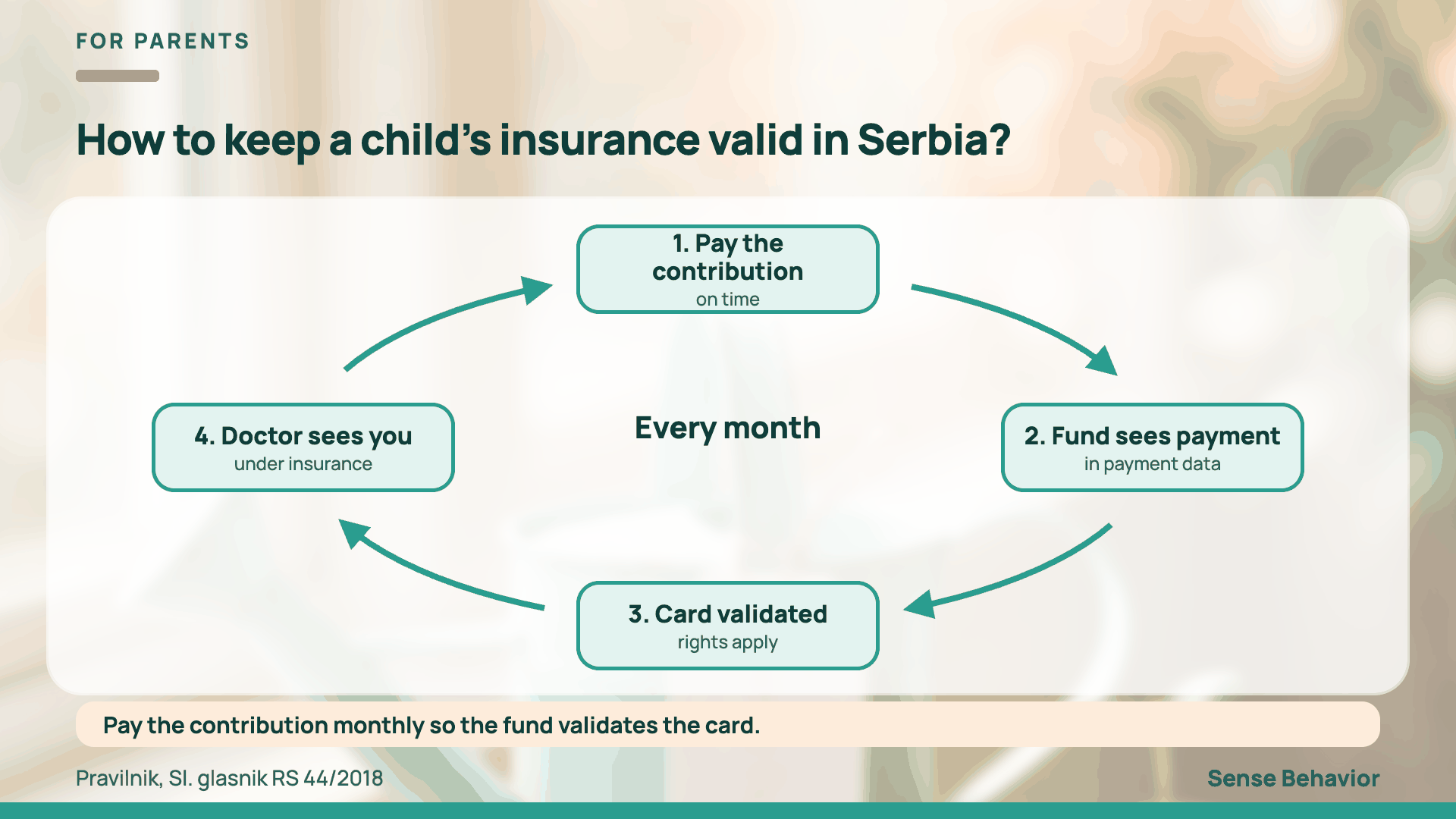
According to the law, compulsory insurance rests on contributions. Insured people and other payers contribute, and those who have an insured event receive care. In practice the question “is there insurance” always becomes “who pays the contributions, and for whom”. The state portal for foreigners says it more simply. Contributions must be paid every month, otherwise the health card will not be validated.
The law describes a voluntary policy as cover for those who are not compulsorily insured and as a way to top up the compulsory package. A private policy cannot replace the state package. The law bars voluntary insurance for the same service that compulsory insurance already provides.
Who can get RFZO insurance when a family has moved to Serbia from another country
A child receives RFZO insurance as a family member when one parent is insured. A foreign parent is compulsorily insured on several grounds, and if none applies, the law lets the person join the system voluntarily and pay the contributions personally.
These are the grounds that fit families who have relocated:
- Employment under a contract. The law names a foreigner employed under the rules on the employment of foreigners, unless an international agreement says otherwise. The employer then pays the contributions.
- Own business. According to the portal for foreigners, an entrepreneur has to pay contributions personally and register with the fund. Founders and members of companies who work in them without an employment contract are also on the law’s list of insured persons.
- Voluntary inclusion. People with no compulsory ground can join compulsory insurance to secure rights for themselves and their close family. They pay the contributions from their own funds.
The last option matters most for families where parents work remotely for a foreign employer or are not working for a while. For them it is one possible route to state insurance, described in the next sections.
Now about children. Article 16 of the law counts as insured the children under 18 who fit no other ground and cannot be insured as family members. The text does not say whether this applies to children of foreigners on temporary stay. We found no official explanation from the fund, so put this question to the branch in writing and keep the answer.
Ways to arrange health insurance for a foreign child in Serbia
There are three routes, and they do not exclude each other. The choice depends on what the parents do and on the family’s residence status.
- Through a parent insured by employment or as an entrepreneur. The child is added to the same fund decision as a family member.
- Through a parent’s voluntary inclusion in compulsory insurance. The adult files the application, and the branch includes close family members in the same decision if they have no other ground.
- Through a private policy. The Serbian portal advises checking first whether your foreign insurer has a representative office in Serbia, and looking for the list of active companies in the register of the National Bank of Serbia.
The register of insurance companies is kept by the National Bank of Serbia.
Health insurance in Serbia for a child: procedure and documents step by step
The application goes to the RFZO branch for the place of residence, and a foreigner files it where they have temporary residence. Insured status begins on the day of the application, and the branch confirms it by a decision. This is set out in the rules on inclusion in compulsory insurance, a bylaw published in 2018.
The procedure looks like this:
- Find your branch. It is the one covering the area where you live or, for a foreigner, where you stay temporarily. The fund calls it the “home” branch.
- File the application for inclusion in compulsory insurance. You can name close family members at once if they have no other ground for insurance.
- Attach the adult’s documents. These are an ID shown for inspection or, for a foreigner, the certificate of temporary residence.
- Attach the child’s documents. You need an extract from the birth register, plus a residence registration, an ID or the foreigner’s temporary residence certificate. For young people aged 18 to 26 in education, a school certificate is added.
- Wait for the decision. It states the start date, the contribution base and the contribution rate.
- Pay the contributions and receive the card. Until the card arrives, or until the prior insurance condition is met, the branch issues a certificate for using health care on the PZK form.
- Keep proving payment. The branch validates the card after checking that the contribution was paid on time.
The rules do not say what to do with a foreign birth certificate. Whether a certified translation, an apostille or legalisation is required needs to be clarified before the visit, otherwise the branch may refuse the papers.
How much RFZO insurance for a child costs and who pays
If a parent works under a contract, the employer pays the contributions and the child is insured as a family member. With voluntary inclusion the adult pays every month. The amount is set by a general RFZO act together with the law on social insurance contributions.
The law has no separate sum “for a child”. Article 17 says the contribution is paid by the person who joined, and it says nothing about a payment for each family member. How this appears in the branch’s decision is something to ask when you apply.
We deliberately do not give an amount in dinars. It changes, and the current figure is published by the fund on its page about inclusion in compulsory insurance on the RFZO website. A number from an unofficial retelling can be out of date within a year.
The waiting period: from which day the child can use insurance
By law, using the rights of compulsory insurance requires prior insurance record. Three months continuously, or six months with breaks within the last 18 months. Family members receive their rights on condition that the insured adult has this record.
The law names the exceptions directly. Emergency medical care is provided without this condition, as is care after a workplace injury. For other visits the waiting period may apply.
The bylaw on inclusion takes this condition into account. Until it is met, the branch issues the PZK form instead of a card. How the period applies to a child entered under a parent’s insurance, the law does not specify. This question goes first on your list for the branch, because it directly affects when you can plan doctor visits.
What RFZO pays for a child: check-ups, treatment, rehabilitation
The law covers examinations, treatment and medical rehabilitation for children in full in cases of illness and injury. This applies to children, school pupils and students until the end of their education, but no longer than age 26.
The general list includes:
- preventive check-ups for children and compulsory immunisation
- examinations and treatment by the chosen doctor and by specialists on referral, and diagnostics
- medical rehabilitation, which the law describes as restoring or improving functions impaired, among other causes, by a developmental disorder, and names kinesitherapy, occupational therapy and voice and speech therapy
- dentistry for children within prevention and treatment
- medicines and medical devices from the fund’s lists
- a companion during inpatient treatment for a child under 15, and for an older person with marked developmental impairments.
Now the limits of cover. The text of the law has no words “autism” or “ABA”, and no behavioural therapy as a separate service. Which kinds of rehabilitation are paid for in practice, in which institutions and in what volume, is defined by bylaws and by the fund’s contracts with institutions. Payment is made when the service is provided by an institution that has a contract with the fund.
For a parent this means a simple rule. Do not count on insurance covering regular sessions of a behavioural programme until you have an answer from the chosen paediatrician and the branch. We wrote about what private sessions cost and how to plan for them in the article on the cost of ABA therapy.
Do you have to pay extra: co-payment and the ban on informal payments
For the child, the law provides no co-payment for the basic services, since examinations, treatment and rehabilitation in illness and injury are paid in full. For adults and for services unrelated to a child’s illness or injury the fund pays a percentage of the price and the patient pays the rest. This is called co-payment, or participation.
- Visits to the chosen doctor and to a specialist outside this rule are paid by the law at no less than 80 percent of the price.
- Complex diagnostics such as magnetic resonance imaging are paid at no less than 95 percent.
- Each year the Minister of Health sets the highest annual sum a patient pays, and anything paid above it is returned.
The law forbids an institution to charge for a service the insured person is entitled to, or to ask for or accept any material or other benefit for it. Every payment must be confirmed by a receipt in the prescribed form. Keep them during the calendar year, since they are needed to reclaim the amount above the annual limit.
The chosen paediatrician and developmental counselling: where help under insurance begins
The main door into the system for a child is the chosen doctor, that is, the paediatrician. The law provides that a child has a chosen paediatrician, and first examinations, referrals and monitoring go through this doctor.
- The chosen doctor is picked at the first visit and a declaration of choice is signed. The choice holds for at least a year, and the doctor can be changed earlier under certain conditions.
- A doctor must accept any insured person unless the doctor already has more patients than the standard allows.
- The paediatrician orders examinations, refers to specialists and other institutions, keeps records and follows the treatment. The same doctor handles mental health measures at the primary level.
What to do when you suspect developmental differences, we covered in the article on where to go if you suspect autism. There is fresh news for Serbia. A UNICEF Serbia piece of 23 September 2026 quotes the Ministry of Health’s state secretary about developmental counselling in health centres (dom zdravlja, the state clinic for your area) in every district. It also says that family-centred early intervention is available in 80 percent of districts. The source does not say who refers a family to such counselling or how to book it, so ask your paediatrician.
Private health insurance for a child in Serbia: when you need it and what to check
A private policy is needed when the family has no ground for compulsory insurance, or when you want to top up the state cover. The state portal describes it as a contract with an insurance company.
Read the policy before signing and ask the insurer these questions:
- whether visits to a paediatrician and specialists, developmental assessments, a speech therapist and an occupational therapist are included
- whether there are exclusions for existing conditions and a waiting period before the first payout
- up to what age the child stays on the policy and whether it can be extended
- how services are paid, directly by the company or by reimbursement against receipts
- whether the police accept your policy if it is needed for a residence permit.
The last point can be checked against the law. The Law on Foreigners requires proof of health insurance for the planned period to be attached to an application for temporary residence and its extension. This duty does not apply to family members of a citizen of Serbia or to employed foreigners with their families. Which document is accepted is set by a bylaw of the Minister of Interior, so confirm the format of the policy with the police.
What to do if you have no policy or card yet: emergency care
Foreign citizens have the right to emergency medical care during a temporary stay in Serbia. The state portal for foreigners says so directly.
How payment works depends on the country of citizenship. Serbia has health insurance agreements with 25 states and one province, and the rules differ between them. The law also takes emergency care out of the waiting period.
- Keep all certificates, discharge papers and receipts, since you may later ask for reimbursement.
- Ask the branch how the agreement of your country of citizenship works, if there is one.
- Do not delay seeking emergency care because of questions about papers.
What to report to the fund and when a child’s insurance ends
An insured person must tell the branch about changes that affect insurance within the period set by the law on the central register of compulsory social insurance. In practice this means a change of address, job, residence status or family composition.
- Insurance by voluntary inclusion ends on the day an application to terminate is filed, or when the person gets another ground, for example work under a contract.
- A child’s right as a family member rests on the adult’s status, so changes for a parent also affect the child.
- The age limit is 18, for pupils and students until the end of their education, but no longer than 26. The right continues beyond that if the person cannot live and work independently and is supported by the insured person.
If the family changes its residence status or the ground for insurance, contact the branch before the previous period ends. This helps avoid a gap, and a gap can bring a new waiting period.
Common mistakes when arranging insurance for a child in Serbia
- Assuming the child is insured automatically. The adult holds the ground, and the child is entered as a family member.
- Filing at the wrong branch. It is determined by the place of residence or, for a foreigner, of temporary stay.
- Stopping the contributions after enrolment. A card without payment will not be validated.
- Not asking about the waiting period and learning about it from a doctor when care is already needed.
- Expecting insurance to pay for therapy that is not in the fund’s contracts. That includes behavioural programmes.
- Carrying over the rules of neighbouring countries. The order in Croatia, Montenegro and Republika Srpska is different, and the closest comparison is a system like the Bulgarian one, covered in our article on NZOK and autism in Bulgaria.
Questions to ask the RFZO branch before filing documents
Write the questions down beforehand and ask for the answers in writing. That makes it easier to go back to them if another counter says something different.
- Which ground fits our family with this kind of residence permit?
- Which documents are needed for the child, and do foreign papers need translation and certification?
- From which day can the child use the rights, and does the waiting period apply?
- What is the contribution now, and how is it paid?
- How do we get the PZK certificate, and for how long is it valid?
- How can we check that the card has been validated?
- How do we choose a paediatrician, and which health centre (dom zdravlja) covers our address?
- Which developmental rehabilitation services does the fund pay for, and in which institutions?
Sense Behavior in-person sessions in Belgrade and Novi Sad
At the time of writing (October–November 2026) our specialists run sessions in Belgrade and Novi Sad. About five families in Serbia are currently in in-person and hybrid support. That number refers only to the in-person and hybrid format and changes over time.
The sessions are private and are not paid from RFZO funds. Insurance is for doctors, diagnostics and state services, and our work runs alongside them.
- Format. In-person sessions take place at the family’s home. There is also remote support and a hybrid format that combines in-person meetings with video work.
- Age. We mostly work with children from one year to 10 years old.
- Who leads. Sessions are led by Yulia Kozlova and other specialists of the centre.
- Language. Sessions are held in the family’s native language, and Serbian can be added if needed.
- Price. It is discussed at the consultation, and this article gives no figures.
- Booking. You can leave a request on our website. The activity is registered in Serbia, and the registration details are at the bottom of the site.
We do not promise results. Every programme starts with an assessment of the child’s skills. How the remote part works is described in the article on remote therapy for children, and the situation with behavioural therapy in the country in the article on ABA therapy in Serbia and Montenegro.
Frequently asked questions about a child’s health insurance in Serbia
Can a child be insured with RFZO without a residence permit? The bylaw names the temporary residence certificate as the foreigner’s document, so this route assumes it exists. Without it, a private policy and emergency care remain.
Until what age is a child insured as a family member? Until 18, and a pupil or student until the end of the prescribed education but no longer than 26. If the child becomes unable to live and work independently, the right continues while that inability lasts.
Does a child need a separate paediatrician? Yes, a chosen paediatrician is needed for most visits. It is chosen at the first visit by signing a declaration.
Does RFZO pay for ABA therapy? The text of the law has no such service, and the list of rehabilitation is defined by the fund’s acts and its contracts with institutions. Ask the branch and the paediatrician which services are paid for your child’s diagnosis.
What if there is no insurance yet and the child falls ill? Seek emergency care and keep every document. Emergency care does not depend on the waiting period.
Is a private policy enough for a residence permit? The law requires proof of insurance for the planned period of stay, and the bylaw determines which policy is accepted. Confirm this with the police before buying.
Neighboring topics for Serbia are covered separately, and these articles may help next.
- If you suspect ASD and do not know where to go, the steps are described in autism in a child in Belgrade.
- If you are thinking about kindergarten or school, a child's rights and the commission's role are explained in kindergarten and school in Serbia with autism.
- If you are only planning a move, the checklist moving to Serbia with a child will help.
- What is known about benefits and disability for foreigners is in child disability in Serbia for foreigners.
If you already live in Serbia and are unsure where to start, write to us through the website. We will suggest which questions to put to doctors and explain how our work is organised.
Sources
- Zakon o zdravstvenom osiguranju (prečišćen tekst, Sl. glasnik RS 25/2019, 92/2023, 109/2025)
- Pravilnik o načinu i postupku uključivanja u obavezno zdravstveno osiguranje lica koja nisu obavezno zdravstveno osigurana (Sl. glasnik RS 44/2018)
- Welcome to Serbia, državni portal za strance: zdravlje i zdravstveno osiguranje
- UNICEF Srbija (23.09.2026): Jača podrška deci sa razvojnim teškoćama i njihovim porodicama širom Srbije
- Narodna banka Srbije: registar društava za osiguranje
- Zakon o strancima (Sl. glasnik RS 24/2018, 31/2019, 62/2023)
- RFZO: Republički fond za zdravstveno osiguranje