How to prepare a child with autism for school: a checklist for parents
The move from daycare or home into school is one of the most noticeable shifts in a child's life. For families where developmental differences are present, the anxiety around this transition is often higher than around schoolwork itself. What worries parents most isn't whether the child will learn their letters, but whether they'll cope with the new pace, new rules, and the new number of people around them. How to prepare a child with autism for school so the first weeks don't become a source of constant crisis is a question with a concrete, step-by-step answer.
How to tell your child is ready for school
Research on the transition of children with autism spectrum disorders from preschool to school settings shows that the key role is played not so much by the amount of academic skill as by behavioral readiness and the ability to cooperate with the teacher. Basic skills like following instructions and joining structured activity turn out to matter more than how early the child started reading. A separate study of parents' perceptions finds the same thing: behavioral readiness and the ability to cooperate with the teacher are what parents name as the most important skills for a successful transition, ahead of specific academic abilities. Full review here: research on the transition of children with ASD from preschool to school.
A more recent 2024 scoping review of research on the transition of children with ASD from preschool to school adds another condition: how well preschool and school staff align expectations with each other in advance and pass along concrete information about the child. Readiness, in other words, isn't only about what the child can already do. It's also about how much the future teacher already knows about that, and about where support will be needed. Source: Chahboun et al., 2024.
- The child responds to a group instruction addressed to everyone at once, not only to being personally called by name.
- Can wait at least a few minutes when told "in a moment", without spiraling into a prolonged crisis.
- Switches between two short activities in a row on a general cue, not only on your personal reminder.
- Can communicate a basic need through some reliable method, it doesn't have to be full speech.
- Can tolerate some time in a room with background noise and other children without immediate overload.
If your child has already been through a similar transition, for example a recent adjustment to daycare, several of these skills are likely already in place, and the move to school will go faster than it feels at the start. If there hasn't been that experience yet, the same readiness-and-checklist approach is covered here: preparing a child with autism for daycare.
If some of these don't describe your child yet, treat that as a working list for targeted preparation rather than a verdict that it's too early. Each item can be practiced deliberately in the time remaining before school.
A checklist for getting ready
- Independence skills. Can the child dress themselves, use the toilet, and eat without constant adult help. School usually won't have the kind of individual help the child is used to at home. If daily self-help skills are still a struggle, there's a step-by-step guide here: teaching a child to dress independently.
- Following group instructions. This differs from an individual instruction like "do this": a group instruction is addressed to everyone at once, and the child needs to understand it applies to them too.
- Waiting and transitions. The ability to calmly wait their turn, wait for the teacher to finish explaining, and switch from one activity to another on a general cue.
- Sitting and engagement during structured time. Not necessarily forty minutes without moving, but the ability to stay within an activity for a gradually increasing amount of time.
- Elements of the school routine at home in advance. A fixed wake-up time, structured blocks of activity with a clear start and end, short transitions between activities on a signal rather than your verbal reminder every time.
- A visit to the building and classroom before the first day. In a calm setting, without the pressure of settling in fast. If you can time it for a quiet moment in the hallways rather than a busy recess, the child will settle into the space more easily.
- A specific, not a general, conversation with the teacher. Instead of "he has autism", give something practical they can use on Monday morning: "if he doesn't respond to a group instruction, repeat it to him personally, by name" or "if he rocks in his seat and stares at one spot, that's overload, give him a couple of minutes in a quiet corner of the room rather than insisting he keep going". While you're at it, ask what support is available in the classroom, how the teacher plans to respond to challenging behavior, and whether a partial day is an option in the first weeks.
Recommendations for the first month
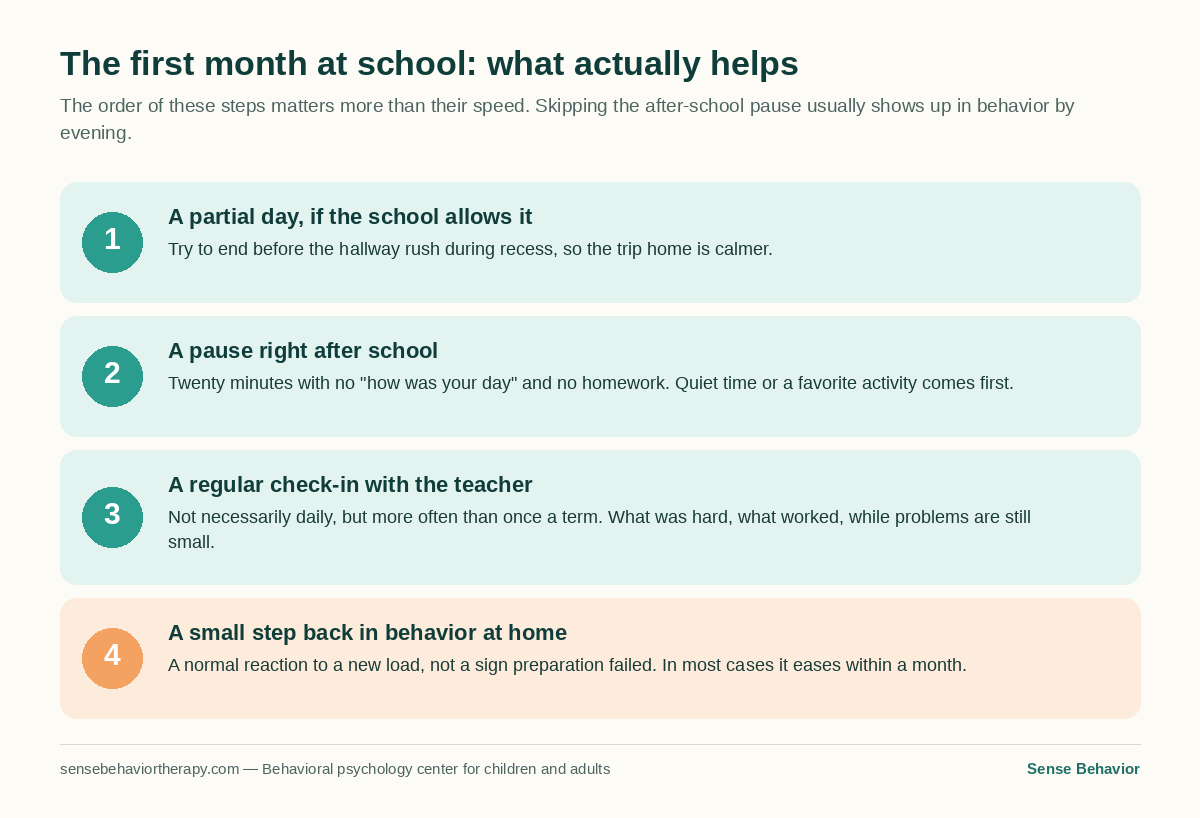
If the school offers a gradual start, begin with a partial day and extend it as your child manages, rather than on a fixed "full schedule after one week" timeline. Set up a visual schedule at home that reflects the structure of the school day, so the shift between home and school stays predictable.
Build in downtime after school before homework or activities. A full day of structured concentration is more tiring than it looks from the outside, and the child needs a pause, not the next demand right away. A simple rule works well: the first twenty minutes after school, no "how was your day", no homework, just quiet time or a favorite activity. Talking about school can wait until the child has had a chance to decompress.
Agree with the teacher on a short, regular check-in: not necessarily daily, but more often than once a term, so you hear about difficulties and wins while they're still small. Worse behavior at home in the first few weeks is a normal reaction to a new load, not a sign preparation didn't work. In most cases it eases over the first month as the child adjusts.
At Sense Behavior, school readiness is a separate track of the program. The specialist assesses which of the listed skills the child already has and which need targeted practice in the time remaining before school, and builds a plan around that specific timeline. During the adjustment period, we don't leave a family to handle it alone: the specialist is available every day, answers any question, and reacts quickly if something isn't going well.
Sources
- Transitions for Young Children with Autism from Preschool to Kindergarten
- Chahboun, Lefstad, Pettersen, Åmot & Thwala (2024). Building Bridges! Children with Autism Spectrum Disorder and Their Transition from Kindergarten to School — A Scoping Review. Neuropsychiatric Disease and Treatment, 20, 1823-1835