Visual schedule for a child: how to make and start one

A visual schedule for a child shows the order of the day: a row of pictures tells what comes first and what comes next. Spoken words vanish the moment they are said, while a picture stays in view. The method is well studied: in the 2015 review by Knight, Sartini and Spriggs, visual activity schedules were judged an evidence-based practice.
If every move from play to washing up ends in tears, you are not alone. Children often struggle to hold the words “now” and “later” in mind. Below we walk through how to build a schedule from things you already have and how to introduce it.
Why a visual schedule for a child helps
A schedule answers three questions a child often cannot ask out loud.
- What is happening now? A card in plain sight shows the current activity.
- What comes next? The next card already lies beside it.
- When does it end? Finished cards go into a “done” pocket.
A schedule does not make the day rigid. You can change it as long as the change is visible in advance: swap two cards before the activity starts and show the new order.
How to make a picture schedule for your child at home
Three cards and a strip of hook-and-loop tape or a magnet are enough to begin. You do not need perfect materials.
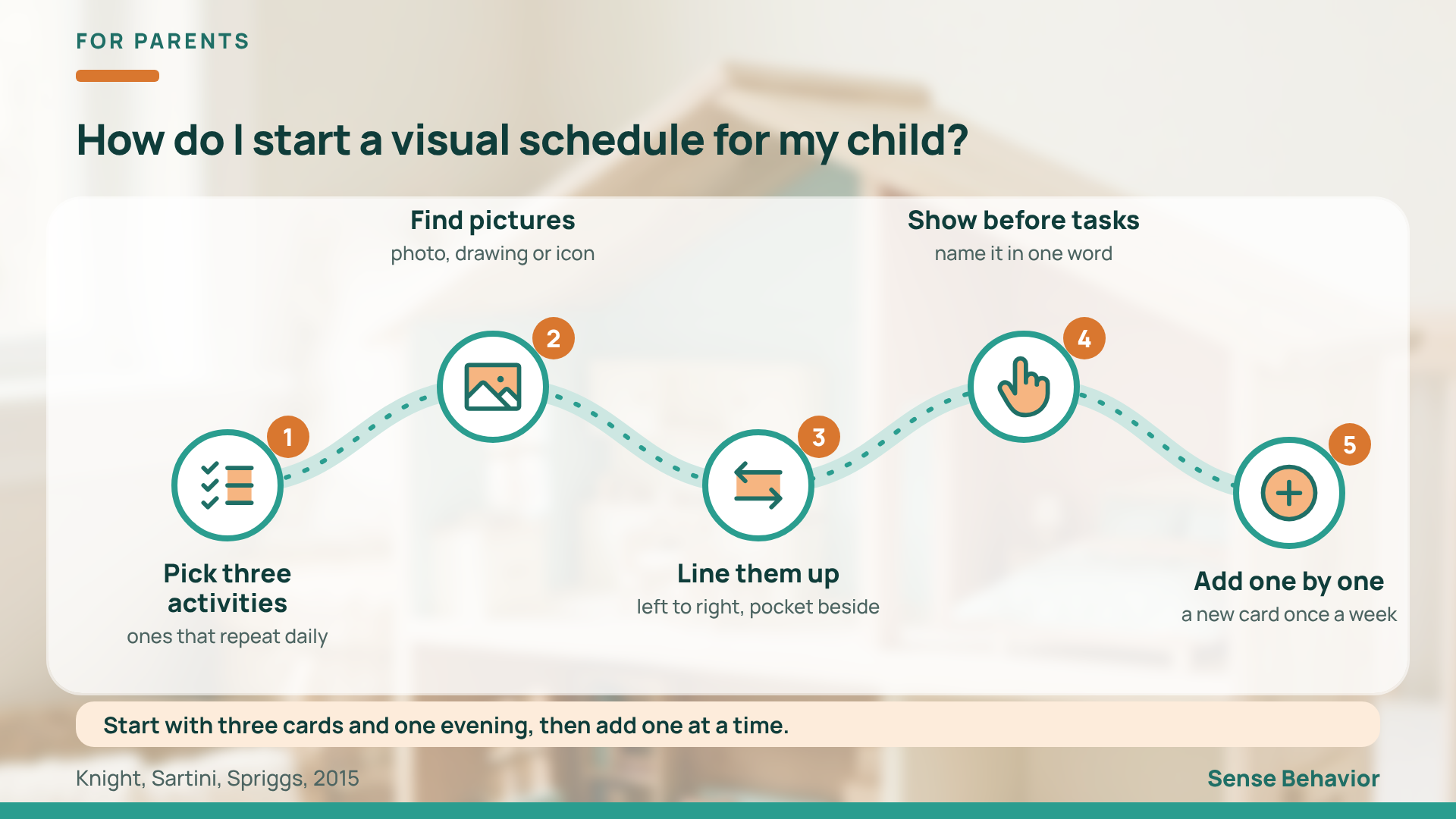
- Pick three activities that repeat every day, such as breakfast, a walk and a bath.
- Find a picture for each: a photo of your own kitchen, a drawing or an icon. A familiar object is easier to read than an abstract symbol.
- Fix the cards in a row, left to right or top to bottom.
- Add a pocket or small box labelled “done” for finished cards.
- Add one new card a week instead of the whole day at once.
The short answer to “where do I start” is three cards and one familiar part of the day, such as the evening. The child sees the benefit quickly, and you do not have to draw a schedule for the entire day.
How to teach your child to use the schedule
A schedule works when it is shown at the right moment, and on the wall unused it does little.
- Walk your child to the schedule before the activity and point to the card, naming it in one word.
- Let your child take off the card or move it into the pocket when the activity is finished.
- Praise your child for glancing at the schedule, speed does not matter here.
- Before switching activities, show the next card first and only then speak.
- If your child refuses, go back a step to two cards.
Many families like a first-then layout: two cards, with something pleasant on the second. It reminds a child that the hard part will end. If your child finds it hard to occupy themselves between activities, read about how to teach a child to play independently. And when a transition still ends in screaming, the guide on tantrums and what to do in the moment will help.
What research says about visual schedules
Knight, Sartini and Spriggs (2015) reviewed studies from 1993 to 2013. Thirty-one studies met the inclusion criteria, and 16 of them were of acceptable quality by the standards of Horner and colleagues (2005). The authors concluded that visual activity schedules can be considered an evidence-based practice, especially when combined with systematic instruction, where an adult teaches the schedule step by step.
The method has limits. Most studies describe small groups and single cases, and results differ from child to child. A schedule helps a child understand the order of the day, but it is not a treatment and does not replace work with a specialist.
When a schedule is not enough and you need a specialist
It is worth discussing the schedule with an ABA specialist if any of these happens.
- Several weeks have passed and your child does not look at the cards.
- Transitions still end in strong meltdowns.
- Your child understands photos but does not respond to drawings or icons.
A specialist can suggest which prompts suit this particular child: objects, photos, icons or words. If evenings fall apart because of sleep, see the article on night sleep, which has bedtime steps too.
How to start a picture schedule this evening
- Choose an evening stretch of three activities, for example dinner, a bath and a book.
- Print or draw one picture for each activity.
- Show the cards to your child and start with the first activity.
If it works the first time, repeat it tomorrow. If it does not, that is a normal part of setting it up: try again with two cards.