RAADS-R test and AQ test: how to take them and what the scores mean

The RAADS-R test and the AQ test are usually found through a link, and people at once want to know what the number at the end means. In short: these are two self-report scales that show how closely your answers resemble those of autistic adults. The result helps decide whether to go for an assessment and is not a diagnosis. Below we look at how the scales differ, how to take them and how to read the scores.
We write the scale names in Latin letters. AQ stands for Autism-Spectrum Quotient, and RAADS-R for Ritvo Autism Asperger Diagnostic Scale-Revised. If you already have a number and feel uneasy, pause for a moment: no single result settles the question.
RAADS-R test and AQ test: what they are
The AQ was created by Baron-Cohen and colleagues, who described it in 2001 as a brief questionnaire for adults of normal intelligence. Scores run from 0 to 50. The RAADS-R was developed by Ritvo and colleagues as an additional tool for clinicians that helps assess autism in adults. It has 80 questions.
The authors of the AQ saw it as a way to quickly place a person on the continuum from autism to normality. This matters for understanding the scale: it describes how strongly traits are expressed and does not sort people into two boxes.
Both scales are filled in by the person. This is screening, a quick check on whether it is worth looking further. At Sense Behavior we do not publish our own diagnostic test: the assessment is done by a specialist, and we help you make sense of your request and choose the next step. An overview of other tests is in the piece on the autism test for adults.
Both scales were created while the earlier system of diagnoses was in force, so Asperger syndrome appears in their names and descriptions. What became of that diagnosis today is covered in the piece on Asperger’s in adults. The RAADS-R was tested at nine centres on three continents, which matters for a scale that is later translated and used in different countries.
How the scales differ
The main differences concern length, content and purpose.
- Length. The AQ has 50 items, and there is a short form, the AQ-10, with ten. In the study by Booth and colleagues (2013) on 149 people with ASD and 134 without, all versions performed similarly, and the short form was almost as good as the full one. The RAADS-R is much longer: 80 questions.
- What they measure. The AQ gives one overall score for traits associated with the autism spectrum. The RAADS-R is divided into four blocks: social relatedness (39 questions), circumscribed interests (14), language (7) and sensory-motor (20).
- How you answer. In the RAADS-R each item has four options: true now and when I was young, true only now, true only when I was young, never true. This lets the scale separate what was always there from what appeared later. 16 questions describe ordinary behaviour and are scored in reverse.
- Who they are for. Both scales are built for adults with average or higher intelligence. The RAADS-R is intended for people aged 18 and over.
The AQ-10 is used as a brief screen to decide whether a person should be referred for a full assessment. The abstract of the original study by Booth and colleagues does not name the threshold for the AQ-10 itself, so look for current guidance on it from a doctor in your country.
How to take the test properly
The result depends on how you answer. A few simple rules help you get a picture that is easy to discuss with a doctor.
- Choose a time when nobody is rushing or interrupting you.
- Answer about yourself on ordinary days, not at your best and not in your hardest period.
- Recall childhood and adolescence, especially for the RAADS-R.
- Do not answer the way you are used to appearing in public. If you have masked your traits for years, answer about what it costs you.
- If a question is unclear reread it later or talk it over with someone close who has known you a long time.
Here is an example of how an answer works in the RAADS-R. Suppose small talk is hard for you. If that was true in childhood and is true now, the first option fits. If the difficulty appeared recently, the second fits. If it was there only in childhood, the third. The difference between the options is the point of the scale.
Masking is described in the study by Hull and colleagues (2017): 92 adults with autistic traits described how they hide them to fit in, and named exhaustion among the consequences. Because of this, a self-report result can understate the picture.
The scales were created in English. Thresholds from the studies belong to the original versions, and translations need to be checked separately, so find out whose translation you are using. The RAADS-R with 80 questions takes noticeably longer than the AQ, so plan a break.
What the scores and thresholds mean
Thresholds belong to the samples on which they were tested, and for you personally they remain a guide.
In the AQ study (Baron-Cohen and colleagues, 2001), 58 adults with Asperger syndrome or high-functioning autism scored 35.8 on average, while randomly selected people without such a diagnosis scored 16.4. A result of 32 or above was found in 80% of the first group and 2% of the second. The authors also note that among students 6% scored 32 or above.
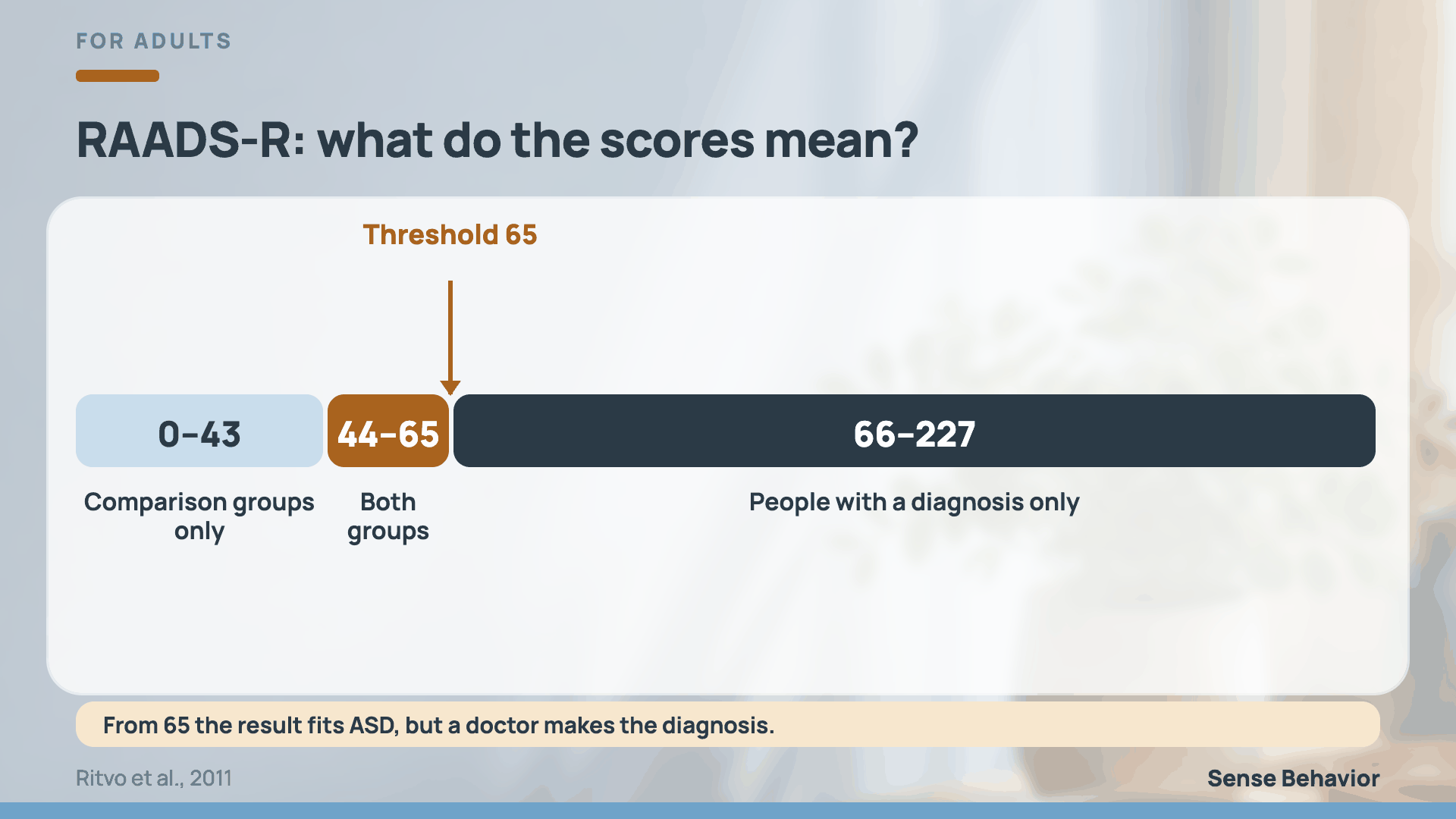
The international validation of the RAADS-R (Ritvo and colleagues, 2011) involved 779 people: 201 with autism and 578 in comparison groups. Total scores ranged from 44 to 227 in the autism group and from 0 to 65 in the comparison groups. The scale’s author writes that a result of 65 or higher is consistent with an ASD diagnosis. At that threshold sensitivity was 97% and specificity 100%. Six people with a diagnosis scored below the threshold, between 52 and 60.
The mean total score was 133.83 in the autism group and 25.95 in the comparison groups. The authors also found thresholds for the separate blocks: social relatedness 31, circumscribed interests 15, sensory-motor 16, language 4. These are supporting figures, and the main guide remains the total score.
An important detail about the comparison groups. They included 276 volunteers and 302 people with other psychiatric diagnoses, and all of them scored no higher than 65. This indicates that in that study the scale distinguished people with autism from people with other conditions.
A simple observation follows from these figures. Up to 43 points only members of the comparison groups appeared, between 44 and 65 both groups, and from 66 points only people with a diagnosis. The middle of the scale remains a grey zone, and that is exactly where a specialist is needed.
Why a high score is not a diagnosis and a low one is not a rule-out
Screening tells you how similar your answers are and says nothing about why. A low score can occur with heavy masking or limited self-observation, and a high one does not explain where the similarity comes from.
- The samples were special. Thresholds were tested on people who already had a diagnosis and on chosen comparison groups. Your surroundings may differ.
- Some people stay below the threshold. According to Baron-Cohen, 80% of adults in the studied group scored 32 or above, so a fifth did not reach it. In the RAADS-R six people with a diagnosis fell below 65.
- Self-report has limits. The RAADS-R authors write that if someone scores 64 or lower but the clinical picture points to autism, clinical judgement takes precedence.
- Some signs overlap with other conditions, for example ADHD, and a specialist helps to tell them apart. More on this is in the pieces on autism or ADHD and the ADHD test.
It helps to read a result in steps.
- Find the total score and compare it with the guide from the scale’s study.
- See which blocks produced the most points and write it down.
- Think about how the answers relate to your life, not only to the number.
- Take questions to the doctor: what surprised you in the result and what remained unclear.
So no number should be read as a verdict. It suggests that a conversation with a specialist makes sense, or that questions remain even with a modest score.
There is one more reason for caution. In the AQ study, men in the control group scored slightly higher than women. Among men 4% scored 34 or above, among women none did. Such differences remind us that the scale may have described women less well, which we covered in the piece on autism in adult women.
What to do after the test
It is useful to turn any result into concrete steps.
- Save the result and the date. If you took several scales, note their names too.
- Write down 5–7 situations where you struggle: contact, noise, changes of plan. A doctor needs examples more than scores.
- Ask yourself what has changed since childhood. For an assessment the developmental history matters.
- If the score is high, book a consultation. If it is low but questions remain, you can book one too.
- Do not draw conclusions about yourself from one result, and do not retake the test many times in a row for a different number.
What is better not to do after the test:
- Look for confirmation or refutation of the result on forums.
- Diagnose yourself or someone close from one number.
- Report the result to an employer or school as a diagnosis.
- Put the question off for years if the result worries you a great deal.
More on the signs adults describe themselves is in the piece on signs of autism in adults.
At the appointment it is enough to say simply which scale you took, what result you got and in which situations you struggle. That is enough for the specialist to see where to begin.
Where to go for an assessment
An assessment is carried out by a psychiatrist or a clinical psychologist experienced in autism in adults. It includes a conversation about development since childhood, observation and sometimes an account from someone close. The screening result is brought to the appointment as one detail among others. The order is described in the piece on autism diagnosis in adults.
If your city has no specialist for adults, ask a family doctor for a referral or look for a psychiatrist with such experience who sees patients remotely. Check beforehand how the assessment works and which documents are needed, so you do not lose time on appointments that turn out to be unsuitable.
If you want to talk through your result and see where to start, write to us using the link at the bottom of the page.
Sources
- Ritvo R. A. et al. (2011). The Ritvo Autism Asperger Diagnostic Scale-Revised (RAADS-R): a scale to assist the diagnosis of autism spectrum disorder in adults: an international validation study. Journal of Autism and Developmental Disorders, 41(8), 1076–1089.
- Baron-Cohen S., Wheelwright S., Skinner R., Martin J., Clubley E. (2001). The autism-spectrum quotient (AQ): evidence from Asperger syndrome/high-functioning autism, males and females, scientists and mathematicians. Journal of Autism and Developmental Disorders, 31(1), 5–17.
- Booth T. et al. (2013). Brief report: an evaluation of the AQ-10 as a brief screening instrument for ASD in adults. Journal of Autism and Developmental Disorders, 43(12), 2997–3000.
- Hull L. et al. (2017). “Putting on my best normal”: social camouflaging in adults with autism spectrum conditions. Journal of Autism and Developmental Disorders, 47(8), 2519–2534.
This material is for informational purposes only and does not replace a consultation with a specialist.