Can Autism Be Treated in Adults: What Helps and What to Expect

"Maybe there is something that can be done about this after all?" Many adults ask this when they learn about autism in themselves. If you searched for "can autism be treated in adults," you probably want the same thing: to understand what is done to make life easier. The short answer: autism stays for life and is not treated in the usual sense, but there are proven supports that make life with it noticeably easier.
Below is a walk-through based on the UK's NICE guideline: what helps, what is not recommended, and where to start. It helps you get your bearings and does not replace a specialist's consultation.
Can Autism Be Cured in Adults
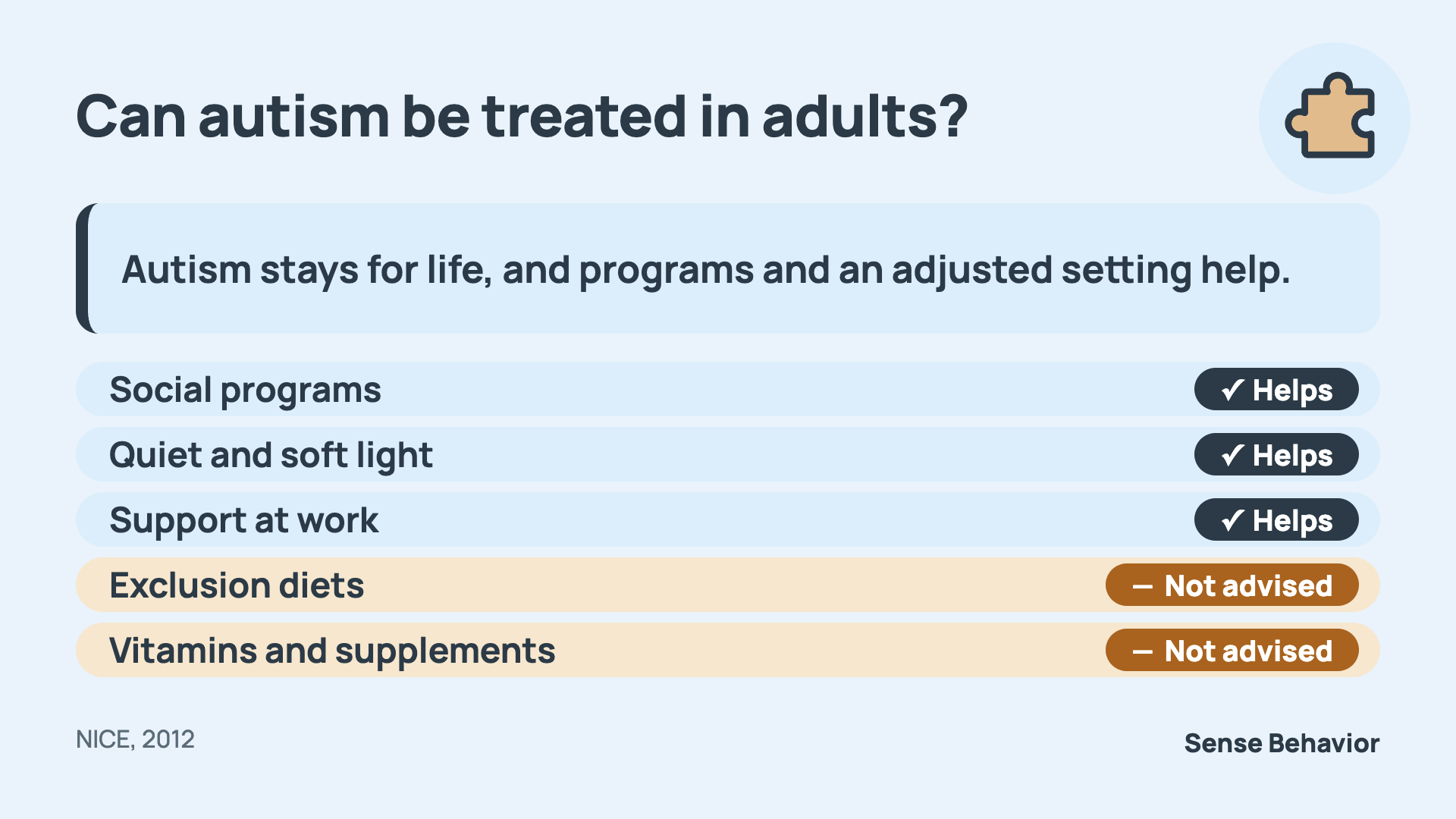
No because it is a difference in the development of the nervous system that lasts for life, and help is aimed at reducing the difficulties that get in the way and supporting what works. The NICE guideline also names approaches that should not be used for the core features of autism in adults: anticonvulsants, chelation, exclusion diets such as gluten-free or ketogenic ones, vitamins and dietary supplements, drugs for improving cognitive functioning, and oxytocin (NICE, 2012). If you come across a promise to "cure autism," treat it with caution.
What Helps an Adult With Autism
What helps are programs that take the person's differences into account and a setting that has been adjusted. The NICE guideline lists the following (NICE, 2012):
- Social learning programs. Group or individual, with feedback, discussion, and explicit rules for difficult social situations, for those who notice difficulties in interaction themselves.
- Structured leisure activities. Regular meetings around an activity you value, if you feel isolated and have little contact.
- Training in daily living skills. A structured and predictable program for those who need help with everyday tasks.
- Support in finding work. An individual program that includes help with a CV and interviews, training for work skills, and advice to employers on reasonable adjustments.
- Self-help and support groups. NICE advises encouraging participation in such groups and one-to-one support.
- Adjusting the surroundings. Less fluorescent light, quiet or earplugs and blackout curtains, personal space of at least an arm's length, and visual supports.
What to Do About Anxiety and Other Conditions in Autism
Coexisting conditions are treated separately, and this is where help often gives the most noticeable result. In the meta-analysis by Lai and colleagues, anxiety disorders occurred in about 20% of autistic people and ADHD in 28% (Lai et al., 2019). NICE recommends offering the same psychological approaches as for these conditions in other people, but adapted: more concrete and structured, with written and visual materials, with an emphasis on changing behavior, with clear rules, plain language, no metaphors, and with your interests built in (NICE, 2012). We cover the link with anxiety in more detail in the piece on autism and anxiety in adults.
Where to Start If You Want to Make Life With Autism Easier
With what drains you the most. You can start today:
- write down five situations from recent months where noise, light, change, or communication threw you off;
- pick one setting you can adjust right now, for example your workspace or the evening lighting at home;
- prepare yourself for change in advance: tell those close to you that you need a plan, and ask them to tell you about changes early;
- find a support group or a person you can talk through your experience with.
If you don't yet know what autism in adults is, begin with the piece on what autism in adults is, in simple words, and for why it goes unnoticed for so long, read the breakdown of masking and burnout and the piece on autism in adult women.
Some adults also find it helps to read the stories of people with similar experience, and we gathered such titles in books about autism in adults.
You can work out where to start in your own situation with no commitment, through the bot, which asks a few questions and suggests a next step, and how the center's work with adults is set up in general is on the For Adults page.
Sources
This material is for informational purposes only and does not replace a consultation with a specialist.