Autism in Adult Men: Signs and Why It Is Noticed Late

If you searched for "autism in adult men," you have probably recognized something from the descriptions in yourself or in a man close to you and want to understand what it looks like and why it wasn't talked about earlier. There are no separate criteria for men, but each person's picture is their own, and adult diagnosis was long built around vivid presentations, which made subtler ones harder to notice.
Below is how autism shows up in adult men, why it is often noticed late, and what to do. The article helps you get your bearings, and only a specialist can make a diagnosis.
What Autism Looks Like in Adult Men
The core features are the same as for everyone. According to the UK's NICE guideline, they are lasting difficulties in social interaction and communication, repetitive rigid behavior, resistance to change, or narrow interests, present in childhood and continuing into adult life (NICE, 2012). In everyday life this often looks like this:
- Communication takes effort. Conversations have to be thought through in advance, hints and unwritten rules have to be decoded and after meetings you need time to recover.
- Change throws you off. Cancelled plans and sudden changes cause tension, while familiar order calms.
- Surroundings drain you. Light, hum, smells, and touch can irritate more than they do others. In a survey of 221 adults with autism and 181 without, people with autism reported heightened sensitivity noticeably more often (Tavassoli et al., 2014).
- Deep interests. One subject can absorb you for weeks, and you know more about it than most of your acquaintances.
- Directness. You say what you mean and expect the same from others.
A fuller breakdown is in the piece on signs of autism in adults, and how to tell them apart from personality traits in the piece on mild autism in adults.
Why Autism in Adult Men Is Noticed Late
Because diagnosis was built for a long time around vivid, easily noticed presentations, and people with a subtler picture were often missed. Researchers Meng-Chuan Lai and Simon Baron-Cohen called them a "lost generation" (Lai & Baron-Cohen, 2015). An adult might not know what was going on, might study and work to the point of exhaustion while adapting to the surroundings, and seek help only when tiredness, anxiety, or conflicts at work and in relationships had piled up. How such hiding of differences works we covered in the piece on masking and burnout in autism.
Many men diagnosed late have to decide whether to say so at work, and should you tell your employer about autism describes how to approach it.
Who Is More Common Among Autistic People, Men or Women
Men are diagnosed more often, but the gap is partly explained by women being left without a diagnosis. The meta-analysis by Loomes and colleagues, pooling 54 studies, showed a male-to-female ratio among autistic people of about 4.2 to 1, but in high-quality studies it was 3.32, and in studies that screened the whole population without waiting for an existing diagnosis it was 3.25. The authors concluded that the true ratio is closer to 3 to 1 and that women are at risk of going without a clinical diagnosis (Loomes et al., 2017). The systematic review by Zeidan and colleagues gives a median ratio of 4.2 (Zeidan et al., 2022). How autism looks in women we cover in the piece on autism in adult women.
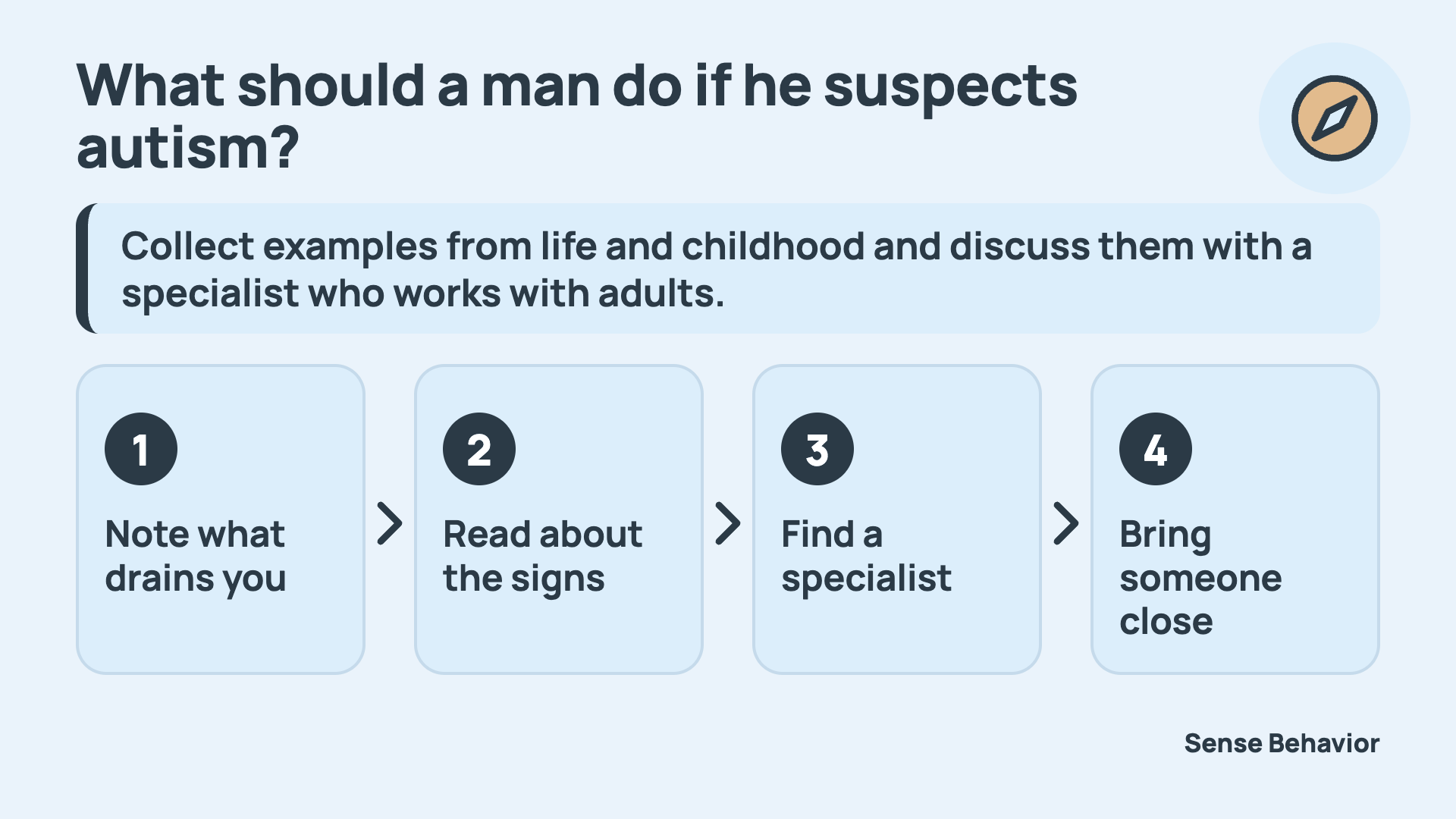
What a Man Should Do If He Recognizes Himself in the Description of Autism
Gather material for a conversation with a specialist who works with adults. You can start today:
- write down five situations from recent months where communication, change, or surroundings threw you off;
- find school reports and planners and ask your parents what you were like as a child;
- take a short screening, what it shows is described in the piece on autism tests for adults;
- find out how autism diagnosis in adults goes and book with a specialist.
Sometimes trouble with attention and organization shows up alongside the autistic traits, and then the article on ADHD in adult men is worth opening.
You can work out where to start in your own situation with no commitment, through the bot, which asks a few questions and suggests a next step, and how the center's work with adults is set up in general is on the For Adults page.
Sources
- NICE (CG142, 2012, updated 2021). Autism spectrum disorder in adults: diagnosis and management.
- Lai M.-C., Baron-Cohen S. (2015). Identifying the lost generation of adults with autism spectrum conditions. The Lancet Psychiatry, 2(11), 1013–1027.
- Loomes R., Hull L., Mandy W. P. L. (2017). What Is the Male-to-Female Ratio in Autism Spectrum Disorder? A Systematic Review and Meta-Analysis. Journal of the American Academy of Child and Adolescent Psychiatry, 56(6), 466–474.
- Zeidan J. et al. (2022). Global prevalence of autism: A systematic review update. Autism Research, 15(5), 778–790.
- Tavassoli T. et al. (2014). Sensory over-responsivity in adults with autism spectrum conditions. Autism, 18(4), 428–432.
This material is for informational purposes only and does not replace a consultation with a specialist.