Do You Need an Official Diagnosis for Therapy? What to Do While You Wait

Short answer: to start working on skills, speech and behavior, an official diagnosis is usually not required. The question "do you need an official diagnosis for therapy" comes up most often in families who have been waiting weeks or months for an appointment and watch each day of waiting slip away. A diagnosis is needed, but for other jobs, and below we go through which ones.
Do you need an official diagnosis for therapy, and where you can't skip it
A doctor's report remains a medical document, and wherever paperwork is required you cannot do without it: disability status and benefits, places in special groups and schools, prescriptions, part of insurance coverage. The rules differ in every country, so check them with the local authority rather than on forums.
Sessions with a parent, a skills assessment, work on difficult behavior, teaching a child to ask and to play are built differently. A behavior analyst relies on what the child does today: which skills are already there, which have not appeared yet, what happens before a meltdown and after it. The name of the diagnosis barely changes the first steps, while observations change them a lot. The diagnosis itself is made only by a doctor, and we neither make nor confirm one from a description.
Why waiting for the report is optional
The American Academy of Pediatrics clinical report from 2020 (Hyman, Levy, Myers, Pediatrics) says a child should be referred for early intervention as soon as concerns are identified, without waiting for the results of a diagnostic evaluation. Any parent can follow the logic: development moves fast in the early years, the wait for an evaluation can stretch on, and all that time the child could be learning.
The evaluation itself does not go away. The doctor rules out other causes of the difficulties, such as hearing problems, and explains what you are dealing with. Assessment and sessions run side by side and do not get in each other's way.
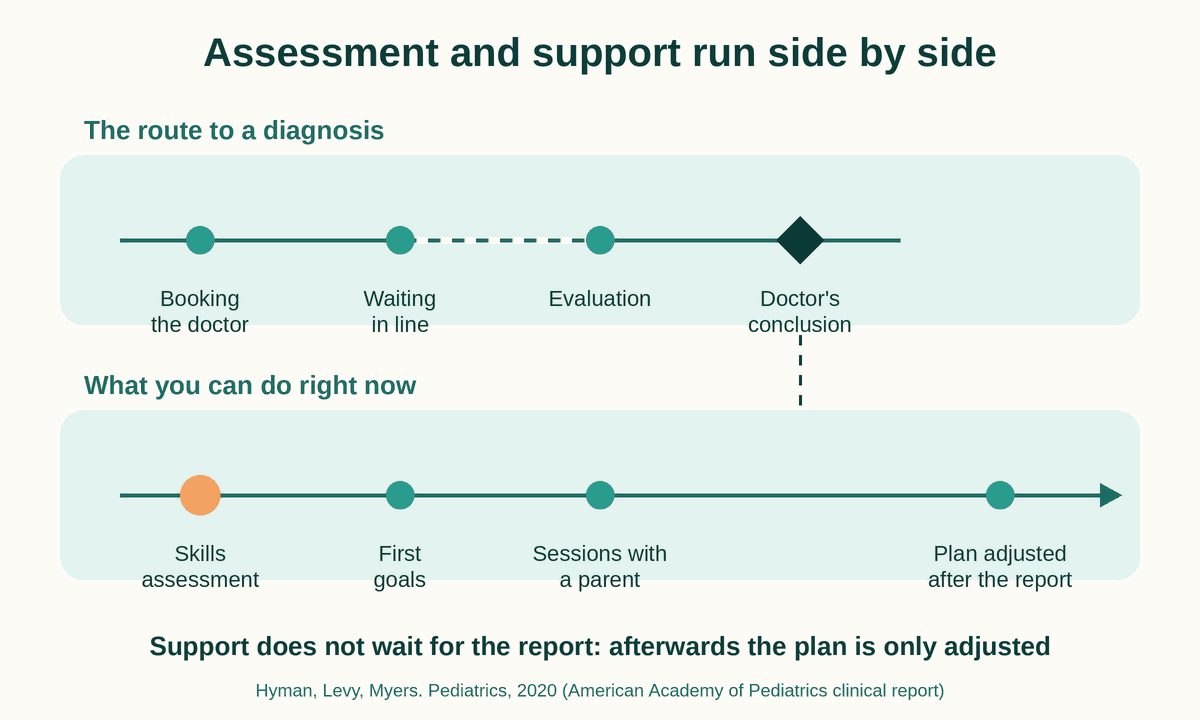
What to do while waiting for your child's diagnosis
- book the evaluation right away and check on the queue once a month, it sometimes moves faster than promised;
- get a skills assessment from a specialist: it shows what your child can already do and where it makes sense to begin;
- work out why your child does what they do, for example screams or runs off, because every behavior has a reason;
- set up a predictable daily routine with pictures and introduce one clear rule at a time;
- film short videos of the hard moments, because they tell a doctor more than any retelling.
If you are not sure yet whether to seek a diagnosis at all, start with what screening tools show and how they differ from an evaluation. We covered it in detail in our article on autism tests for children, and after reading it it is usually clearer what to expect from the appointment. As for the third item on the list, the reason behind behavior, there is a separate breakdown: the function of a child's behavior helps you see a specific request or avoidance behind the screaming.
What to do if the doctor says "wait, they're still little"
Sometimes parents are told it is too early and to simply watch. Watching development is reasonable, but watching does not have to mean doing nothing. While you wait, you can teach your child to ask, to play, to handle a change of activity calmly. These skills help in any outcome, including the case where it later turns out to be a speech delay or a matter of temperament. If it is your child's development that worries you, you are entitled to insist on a referral or to see a second specialist.
How not to waste the time
Without a diagnosis it is easy to grab at everything: diets, supplements, expensive methods with loud promises. A good rule when choosing a specialist is simple: they start with an assessment, set measurable goals, show you data and work together with you. If someone promises a result or a "cure" without any assessment, that is a reason to doubt.
Sessions do not replace medical care and do not guarantee an outcome, but they give the child and the family something to hold on to while you wait.
How to prepare for the doctor's appointment and the first behavior consultation
Pick three situations from the past few days that worry you most and briefly write down what happened before, during and after. It takes about ten minutes and helps two people at once: the doctor at the evaluation and the behavior specialist at the first consultation. And if you already have the report in hand, take a look at the plan for the first 30 days after a diagnosis: most of its steps suit those who are still waiting as well.