Early intervention for autism: from what age and how to get it

Early intervention for autism starts with the first concerns and does not wait for an official diagnosis. It is a combined service for young children who have developmental difficulties or are at risk of them: a team of specialists works with the child, while parents learn to support development during ordinary routines. In Ukraine the service is called “раннє втручання” (early intervention) and covers children from birth to 4 years.
If you have noticed that your toddler started talking late or rarely turns to their name, and the wait for a doctor stretches over months, you are not alone, many families go through this. The good news is that you can look for help right now. Below, in order: what the service includes, how to get it in Ukraine and what research says about early programmes.
What is early intervention for autism and who is on the team
According to Ukraine’s Ministry of Social Policy, early intervention is an interdisciplinary service with the family at its centre. It combines medical, psychological, social and educational help. A team may include a psychologist, a speech and language therapist, a physical therapist, an occupational therapist, a social worker and a child neurologist, and one team supports up to 80 families. Most often the specialists come to the place where the child plays and learns every day, that is, home or a playground.
The specialist’s main partner is the person who spends the most time with the child, a mum or a dad. You are shown how to turn bath time, meals and walks into short exercises for attention and communication. The format is described on the Ministry of Social Policy page about how the service works.
Up to what age does early intervention work, and is a diagnosis required
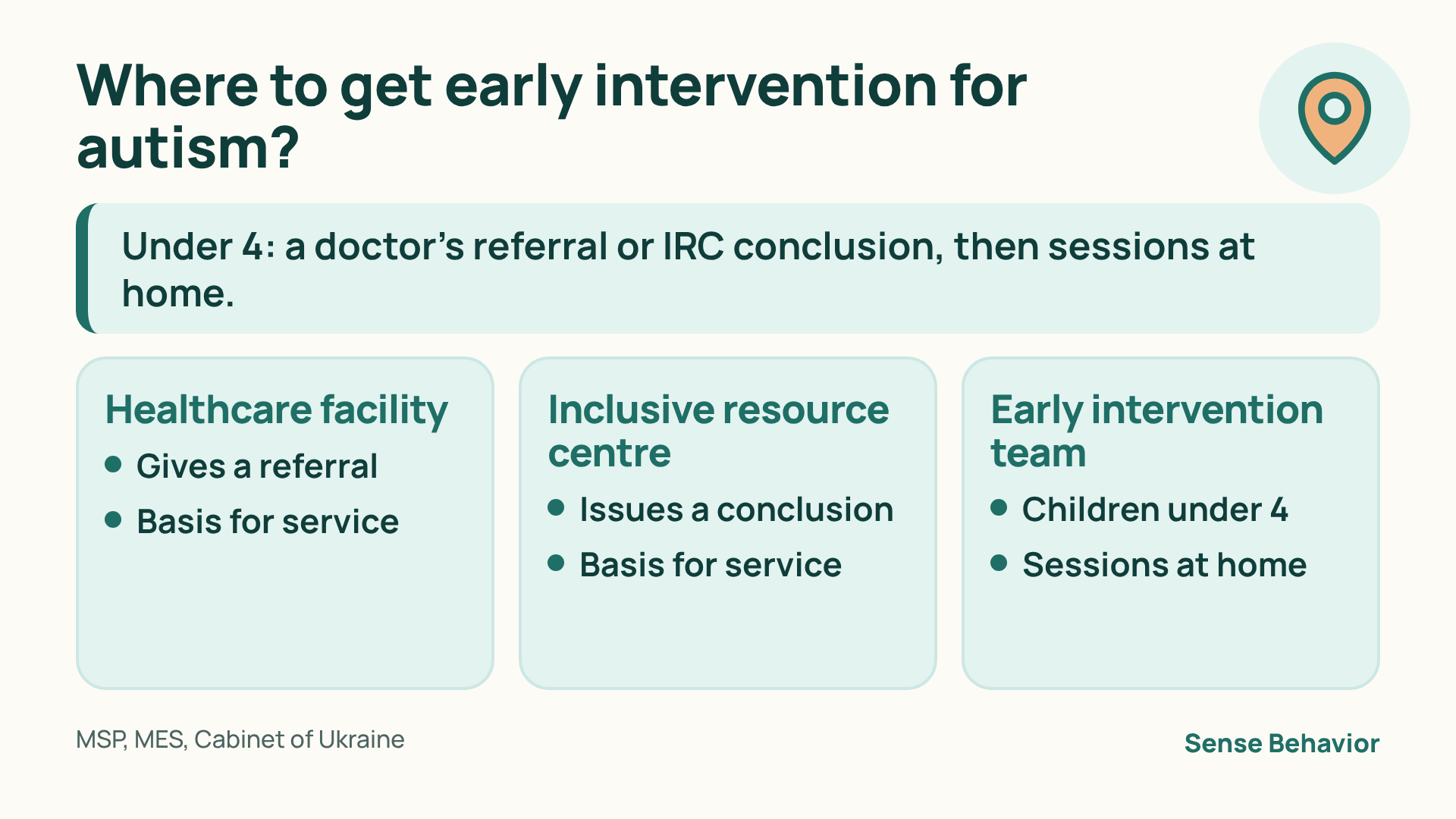
The service is meant for children from birth to 4 years who have developmental disorders or a risk of them. The basis is a referral from a healthcare facility or a conclusion of an inclusive resource centre (IRC). This means something important: an official diagnosis of autism spectrum disorder is not required to start, confirmed difficulties or risk are enough. This is how the service is described in open materials of the Ministry of Education and Science and the Ukrainian government. The exact list of documents is best checked with a family doctor.
How this fits with ABA sessions, and whether they need a document, is covered in Do You Need an Official Diagnosis for Therapy?.
How to get early intervention in Ukraine: steps for parents
The procedure for early detection of developmental disorders in children and for referring families to service providers was approved by Cabinet of Ministers resolution No. 1392 of 27 December 2023. The first step is a visit to the doctor who sees your child. Book a family doctor or paediatrician and ask for a referral to a provider of early intervention. If you already have an IRC conclusion, bring it along.
Teams do not work in every region yet, so ask which one covers your area and how long the wait is. We could not find open data on waiting times by region, so the article gives no figures. What to bring and how to prepare is covered in Where to go if you suspect autism.
What research shows about early programmes for autism
Evidence exists for particular programmes, and it is more modest than we would like. One of the best studied, the Early Start Denver Model (ESDM), has been tested in randomised trials. A meta-analysis by Wang and colleagues (2021) pooled 11 such trials with 624 children: gains in cognition, language and autism symptoms were moderate (g about 0.27 to 0.29), and no significant effect was found for social communication. Another meta-analysis, from 2020 in Brain Sciences, covered 12 studies and 640 children and found an overall effect of about 0.36, mainly driven by cognitive skills and language.
What does this mean for you? Early teaching may support language and thinking, but nobody can guarantee a result. These figures describe one specific model, and Ukrainian early intervention teams use their own programmes, so the numbers cannot be carried over to any service. Children develop at different paces, and your child’s progress is best measured by their own steps.
What to do at home while you wait for early intervention
Start small. Several times a day play face to face at your child’s eye level, name what they are looking at and wait a few seconds, giving them a chance to answer with a gesture or a sound. Note what worked and what did not. Or well, just jot a couple of lines in your phone, the team will find it useful at the first meeting. Ideas for activities are collected in a guide to play activities. If you would like to talk through your family’s situation, Sense Behavior specialists work online with families in different countries, and you can write to us through the link at the bottom of the page.
Sources
- Мінсоцполітики України. Допомога в природному середовищі дитини: як працює послуга раннього втручання.
- Кабінет Міністрів України. В Україні масштабується послуга раннього втручання (рішення Уряду).
- МОН України. Раннє втручання.
- Wang Z. et al. (2021). A meta-analysis of the effect of the Early Start Denver Model in children with autism spectrum disorder. International Journal of Developmental Disabilities, 68(5).
- The Effects of the Early Start Denver Model for Children with Autism Spectrum Disorder: A Meta-Analysis (2020). Brain Sciences.