Behavior plan for a child: how to write one at home

A behavior plan for a child helps every adult in the family act in the same way. It is a short sheet: what worries you, why the child does it, what to prepare in advance, what to teach instead and how to respond.
When the same meltdown repeats several times a week and mom, dad and grandma each react differently, the rules are hard for a child to follow. One shared sheet takes some of that strain away. Gerow and colleagues (2018) gathered 26 studies in which parents taught a child to ask with a word or a card instead of melting down, and overall this teaching reduced challenging behavior.
What goes into a behavior plan for a child
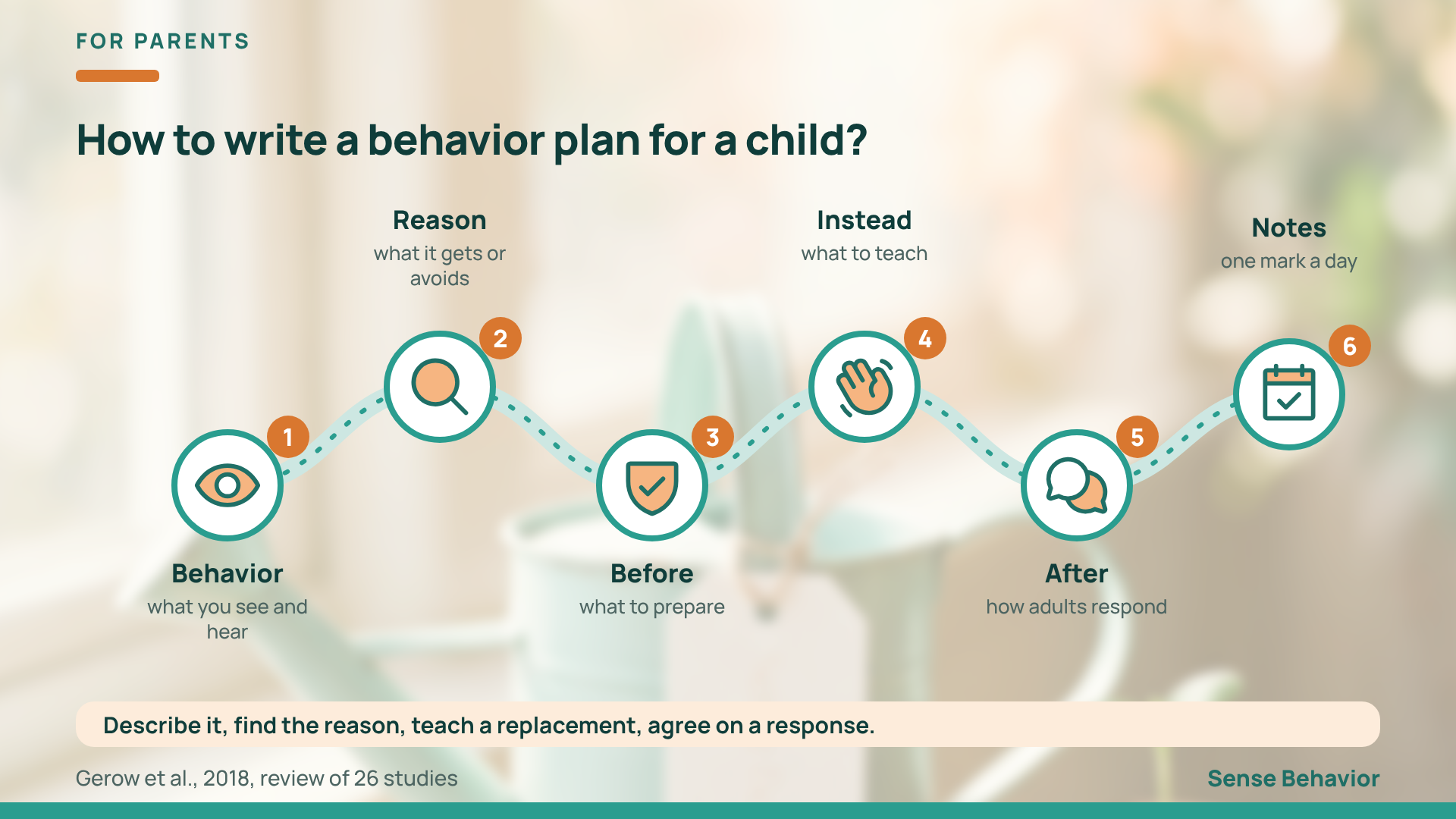
Six parts fit on one page.
- Behavior. Describe what you can see and hear: “screams and throws things”, not “is naughty”.
- Reason. What the child gets or avoids: attention, a toy, a break from a task.
- Before. What to prepare in advance: a warning, a picture, a favorite item within reach.
- Instead. What the child can do in place of it: show a “break” card or say “more”.
- After. How adults respond: the same way each time and without long talks.
- Notes. One mark a day: how many times it happened and what helped.
In short, here is how to write the plan: describe the behavior, find the reason, prepare a replacement and agree on a response. The notes will show whether the plan works.
How to find the reason for the behavior before writing the plan
The reason is found through a chain: what happened before, what the child did, what happened after. Three questions help.
- What does the child want to get: attention, a toy, food?
- What does the child want to avoid: a task, noise, a change of activity?
- What is hard for the child to say in words?
The article on the function of a child’s behavior explains this kind of analysis in more detail. If you have no answers yet, just write down the episodes for a week and change nothing.
How to teach a child to ask instead of melting down
A replacement has to be easier than the meltdown and work just as fast. If a child screams to get a break, the first replacement can be a “break” card or the word “stop”. The adult answers it at once, so that the replacement beats the scream.
- Keep the replacement short: one card or one word.
- Adults answer it straight away and every time while the skill is new.
- Show the new replacement in calm minutes, not in the middle of a meltdown.
What research says about parent involvement
Gerow and colleagues (2018) found 26 studies in which parents used functional communication training. Overall it reduced challenging behavior, and in some studies the result held and carried over to other places and other adults.
The review has limits. Few studies describe how accurately parents followed the plan, and there is little data on how long families keep going. Parent training was often delivered by specialists an ordinary family can hardly reach. So a sheet on the fridge is a start and not a replacement for a specialist.
When a specialist is needed if the plan does not help
Consider discussing the plan with an ABA specialist if any of this happens.
- The behavior is dangerous to the child or others: hitting, running toward the road.
- Several weeks have passed and the notes are not changing.
- The adults in the family cannot agree on a response.
If the meltdowns involve hitting, read the guide on what to do when a child hits mom. And when hard minutes end in screaming and tears, the article on tantrums and what to do in the moment will be useful.
How to start writing the plan tonight
- Pick the one behavior that gets in the way most.
- Write down the last three episodes: what came before, what the child did, what came after.
- Think of one replacement: a single word or a card.
- Show the sheet to a second adult and agree how you both respond.
The sheet will probably come out a bit uneven, and that is fine: it gets corrected from the notes after a week.