Where to go if you suspect autism: the order of steps and how to prepare for the visit

Where to go if you suspect autism? Start with the pediatrician or family doctor who follows your child: they are the one who refers you onward, and almost every route begins there. At the same time it helps to check hearing and to write down what worries you, so the visit runs on facts. A doctor or a team of specialists makes the diagnosis, but you can prepare and act today.
If you are reading this late at night with a quiet "what if" in your head, you are not alone. A suspicion is not a diagnosis, and a clear order of steps takes away a good part of the worry.
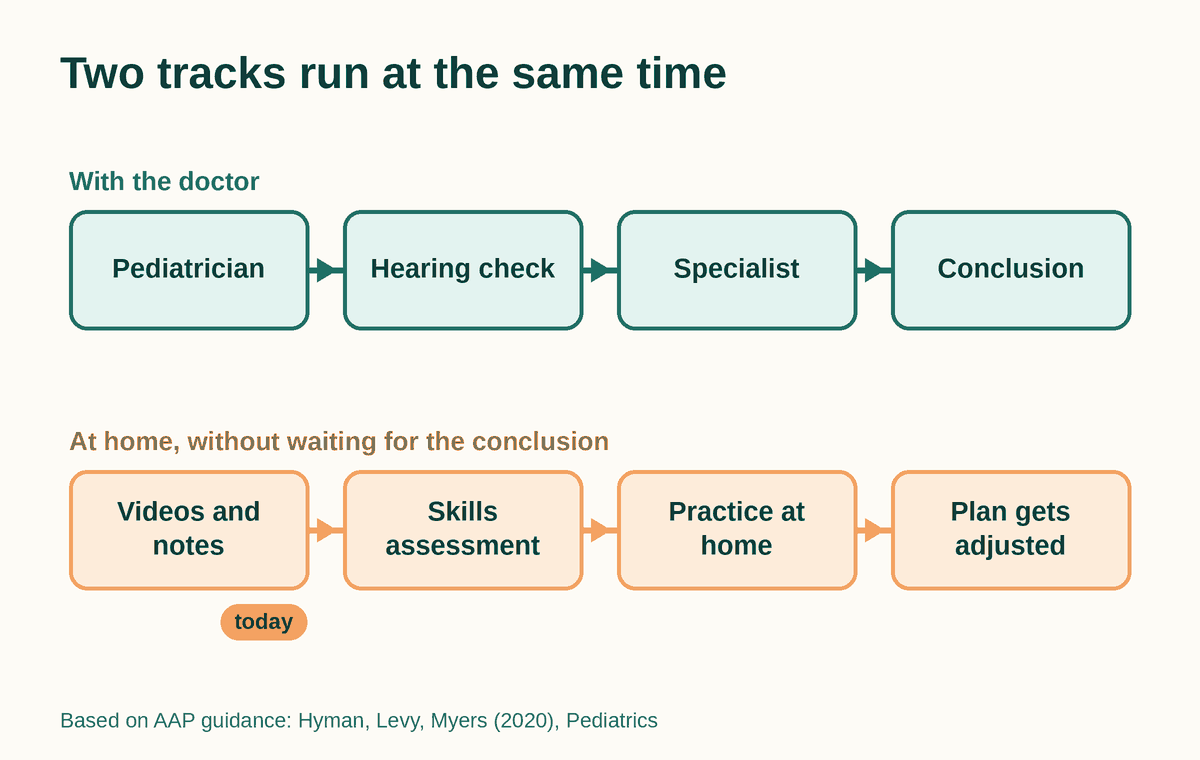
Where to go if you suspect autism, first of all
The first stop is usually the pediatrician or family doctor. They know your child's developmental history, can run a screening and write a referral. According to the American Academy of Pediatrics (Hyman, Levy, Myers, 2020), standardized autism screening is done at 18 and 24 months, together with ongoing developmental surveillance. Primary care is designed as the front door. If your doctor does not bring up screening, you can ask about it yourself.
Doctors then usually check hearing. A child who responds poorly to their name or started talking late sometimes just hears less well, and that needs to be ruled out first.
Who makes the diagnosis
Who exactly makes the diagnosis depends on the country and the health system. In some places it is a child psychiatrist, in others a neurologist or a developmental pediatrician, in others a multidisciplinary team of a doctor, a psychologist and a speech therapist. So the most reliable question for your pediatrician is: which specialist do you refer children with these questions to, and how do we book. Ask for the referral in writing, it will help when you book.
The diagnosis itself usually takes more than one visit. The specialist talks with the parents, observes the child's play and communication, sometimes uses structured tools such as ADOS, and only then writes a conclusion. So do not be alarmed if no diagnosis was named at the first meeting: it is a normal part of the process.
A psychologist and a speech therapist help to see the whole picture, but they do not replace a conclusion about autism on their own. A behavior analyst (BCBA), an ABA specialist, does not diagnose at all. Their job is to assess the child's skills and build a plan for practice. If you want to understand how screening differs from diagnosis, read our guide to the autism test for a child.
What to bring to the appointment
- Short videos. Two or three clips of about a minute: how your child plays, how they respond to their name, what exactly worries you. At home children often behave differently than in the office.
- Five concrete examples. Instead of general words, write down facts, for instance "at two and a half says about ten words and does not point".
- Developmental history. When your child began to hold up their head, walk and talk, and whether any skills were lost.
- Hearing test results and earlier reports, if you have them.
- Two or three questions. What you want to know by the end of the visit.
If you are unsure which signs specialists look at in the first place, have a look at our article on signs of autism in a child at 1 year.
What if the doctor says "let's wait"
It is reasonable to reach out when the worry has lasted several weeks and keeps you from living calmly. There is no need to wait until everyone around you agrees there is a problem. You see your child every day, and your observations matter to the doctor.
Sometimes you hear "they are still little, let's watch for now". Watching is fine in itself, as long as it has a deadline. Ask when the follow-up should be and which signs would make the doctor change the decision. If the timing is vague and the worry does not go away, it is reasonable to ask for a second opinion from another specialist.
Waiting for a conclusion does not stop you from supporting development at home and from getting a skills assessment from a behavior analyst alongside. If the outcome turns out to be developmental delay rather than autism, it helps to understand the difference, and we explain it in autism or developmental delay.
How to prepare for the pediatrician visit if you suspect autism
Film two short videos of an ordinary day and write down five examples of what worries you. Tomorrow call the pediatrician and ask for a visit with one clear request: to talk about your child's development and to get a referral. And one last thing. This text describes the general order and does not replace an in-person exam, and the exact procedures in your country may differ.