Can Autism Appear in Adulthood: Why It Is Noticed Late

"I used to cope, and now it all shows." This is how adults often describe the moment after which they first think about autism: a new job, burnout, a hard period, and the usual ways of holding together suddenly stop working. If you searched for "can autism appear in adulthood," you probably need to understand whether this began now or was always there.
The short answer: autism does not appear in adulthood, it begins in early childhood, and adults usually notice and get it diagnosed later. Below is why this happens and what to do. The article helps you get your bearings, and only a specialist can make a diagnosis.
Does Autism Appear in Adults
No. According to the UK's NICE guideline, an assessment looks at whether the core features, meaning difficulties in social interaction and communication, rigid repetitive behavior, resistance to change, or narrow interests, were present in childhood and continue in adult life (NICE, 2012). If there were no signs at all in childhood, the doctor looks for another explanation. Researchers Meng-Chuan Lai and Simon Baron-Cohen call adults who were missed by diagnosis in their time a "lost generation" and estimate the prevalence of autism at about 1% of the population (Lai & Baron-Cohen, 2015).
Why Autism Becomes Noticeable Only in Adulthood
Because the ways of coping were enough up to a point and then the load exceeded the resources. This is what most often stands behind it:
- Years of compensating. Many learn to hide difficulties, and as long as there is energy for it, everything looks fine from outside.
- A heavier load. A new job, an open-plan office, the birth of a child, a move, or prolonged stress add change, noise, and contact that are harder to handle.
- A support that went away. At school and in the parental family a ready-made structure held much of it, and in adult life you have to create it yourself.
- Burnout. In a qualitative study of autistic adults, burnout was described as chronic exhaustion, loss of skills, and reduced tolerance to stimuli arising from accumulated stress and a mismatch between expectations and abilities (Raymaker et al., 2020).
- Missed diagnosis. It was built around vivid presentations for a long time, and people with a subtler picture were often overlooked (Lai & Baron-Cohen, 2015).
How hiding differences works and what it costs we covered in detail in the piece on masking and burnout in autism.
Men with autism are often seen for years as withdrawn or stubborn, and we looked at how that plays out in the article on autism in adult men.
What Can Look Like Autism Appearing
A sharp decline without a history from childhood is more often explained by other causes, and they are sorted out during the assessment. NICE lists what is ruled out in diagnosis: depression and other mood disorders, anxiety disorders, in particular social anxiety and obsessive-compulsive disorder, and other neurodevelopmental and neurological conditions (NICE, 2012). So it is better to tell the doctor what changed and when and not to guess the cause yourself.
What to Do If You Used to Cope and Now You Don't
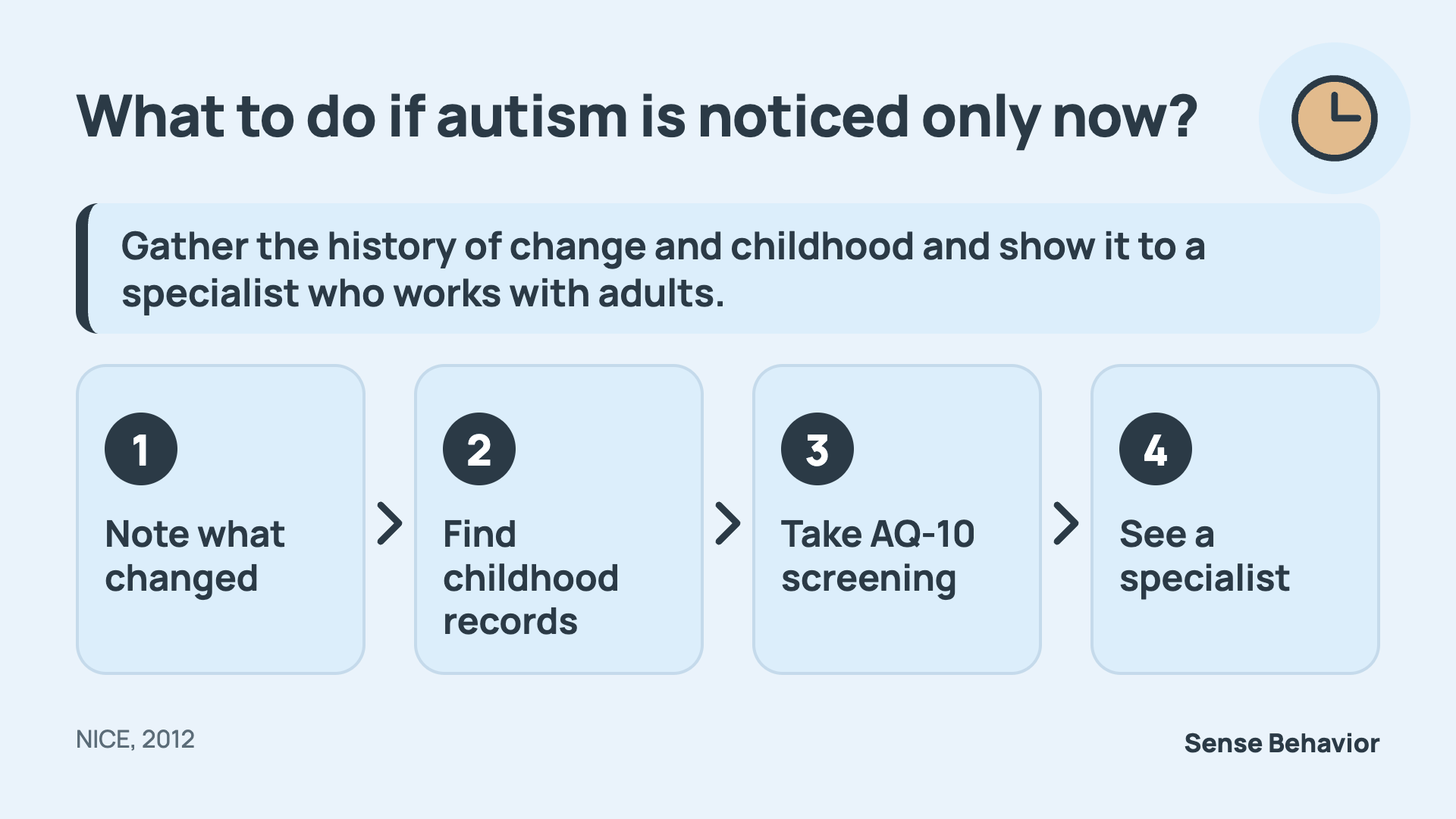
Gather the history of the change and of childhood and show it to a specialist who works with adults. You can start today:
- write down what exactly changed and at what point, and what came before it;
- find school planners and reports and ask your parents what you were like as a child;
- take a short screening, described in more detail in the piece on autism tests for adults, remembering that it is a reason for an assessment;
- if you can, reduce the load for the time of the assessment: more sleep, breaks, and quiet.
How an assessment goes and who to see is described in the piece on autism diagnosis in adults, and what the differences themselves look like in the piece on signs of autism in adults and in the breakdown of what autism in adults is, in simple words.
You can work out where to start in your own situation with no commitment, through the bot, which asks a few questions and suggests a next step, and how the center's work with adults is set up in general is on the For Adults page.
Sources
- NICE (CG142, 2012, updated 2021). Autism spectrum disorder in adults: diagnosis and management.
- Lai M.-C., Baron-Cohen S. (2015). Identifying the lost generation of adults with autism spectrum conditions. The Lancet Psychiatry, 2(11), 1013–1027.
- Raymaker D. M. et al. (2020). Defining Autistic Burnout. Autism in Adulthood, 2(2), 132–143.
This material is for informational purposes only and does not replace a consultation with a specialist.