How to Combine Work and Sessions With Your Child: A Weekly Plan

How to combine work and sessions with your child when there is not enough energy for everything: build short stretches of practice into what you already do rather than adding a separate hour of sessions at the end of the workday. Dressing, meals, bath time and the commute suit this best. The rest of the time stays for rest. Below are a weekly schedule, a list of what can be built in and a way to cut the tasks in a hard week.
If by evening you have no strength even for dinner and the list of sessions from a specialist looks like a second shift, that is not weakness. Such schedules are usually built for a day without a job, and they can be rebuilt around your week.
How to combine work and sessions with your child: a weekly schedule
The schedule rests on a few anchor points rather than on long sessions.
- Two points a day. Morning and evening, ten minutes of practice inside ordinary tasks.
- One longer block a week. A weekend day when you have the energy and time to play to the specialist's plan.
- Work hours without sessions. During this time your child is with a nanny, at kindergarten or with family, and you are not torn between tasks.
- One day without tasks. Rest is needed by you and your child and it does not cost progress.
What to build into an ordinary day
This kind of practice needs neither separate time nor materials.
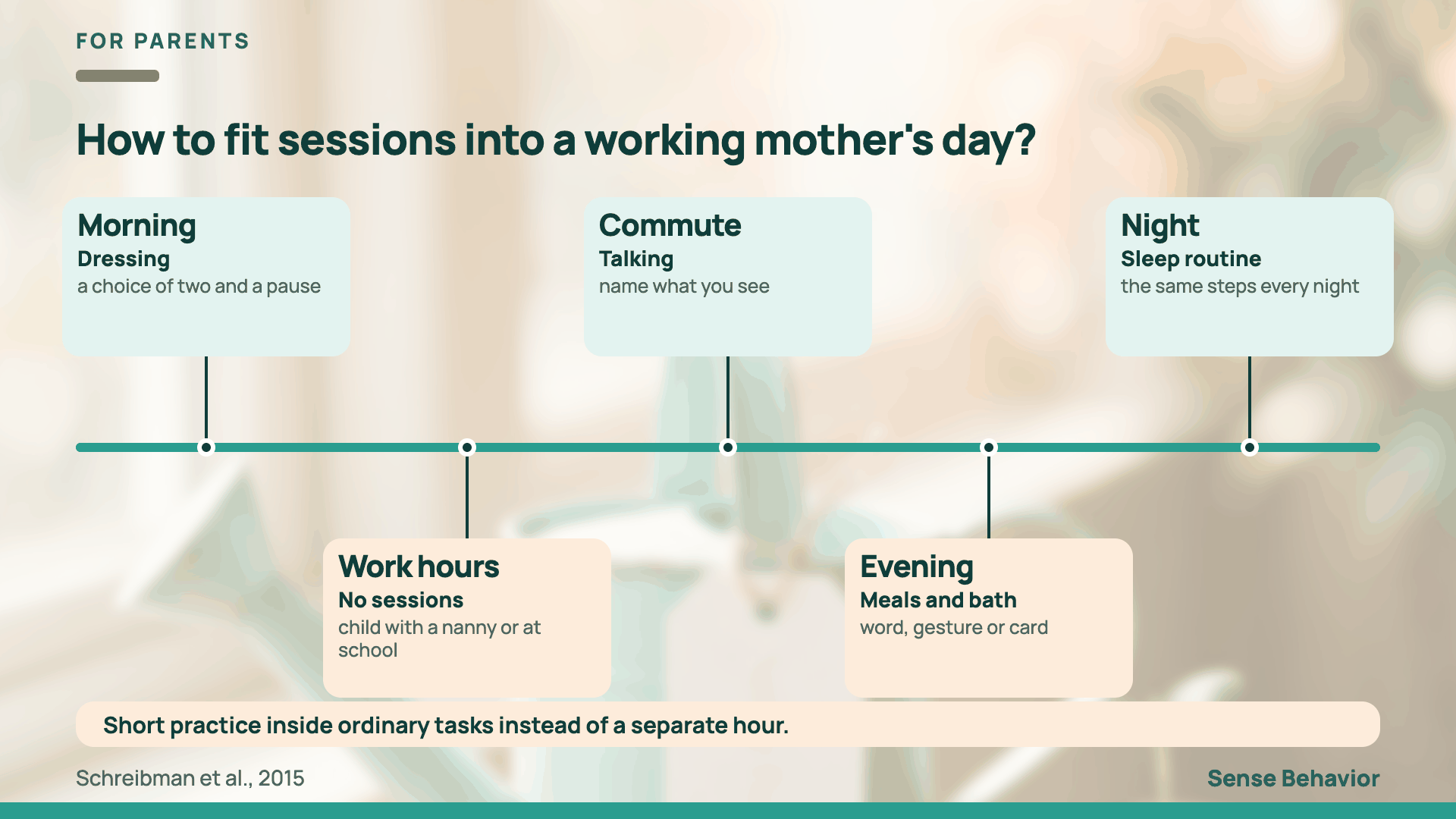
- Dressing. Offer a choice of two shirts and wait until your child points or names one.
- Meals. Let your child ask for more with a word, a gesture or a card instead of getting it at once.
- Bath time. Name body parts and actions and pause before the next step.
- The commute. Name what you see and leave room for an answer.
- Sleep. Repeat the same steps in the same order, as in the article on what to do if a child is not sleeping at night.
What is known about sessions inside the ordinary day
The review by Schreibman and colleagues (2015) describes a group of approaches called naturalistic developmental behavioral interventions. They are delivered in natural settings, the adult and the child share control of the play and the consequences come from the situation itself. That is exactly what can be done at meals and while dressing. The authors point out the shared features of the approaches and stress that further research is needed.
What to do when there is no energy at all
In a hard week the minimum is enough. For ideas see the collection of games to play with your child when you have no energy.
- Pick one situation for the week, for example meals, and add nothing else.
- Tell your specialist the week is hard and ask to shorten the tasks.
- Skip a day without guilt and return to the schedule the next one.
How to share the load with family and a specialist
Sessions do not rest on one mother alone. How parents are brought into a program was shown by the study of parent coaching.
- Show your partner or grandmother two or three phrases you use in the situation.
- Ask the specialist to record a short example so everyone sees how it is done.
- Agree who handles the evening on which days and keep the schedule on the fridge.
When to review the program with a specialist
If the planned sessions have not fitted your week for a month, that is a reason to discuss the program rather than blame yourself. Sense Behavior specialists build a program around a working mother's schedule: online, with short parent training and with sessions built into the ordinary day. You can book a consultation using the link at the bottom of the page.
Where to start today
Pick one everyday situation, for example meals, and one phrase or card for it. Try it tomorrow morning note how it went and decide in the evening whether to keep it.