ABA Therapy at Home With a Parent: What You Can Do Yourself

ABA therapy at home with a parent is possible, but the roles in it are clearly divided. A parent can do a lot within the ordinary routines of the day, while the goals, the order of steps and the plan for difficult behavior are best set together with a specialist. If there is nobody nearby yet, that is no reason to do nothing, so below is where it is safe to begin on your own.
Applied behavior analysis, known as ABA (written АВА in Cyrillic), rests on a simple idea: a child learns where there is a chance to try and get a response. At home there are far more such chances than in one hour of sessions: breakfast, dressing, a walk, play before bed.
What research says about sessions that involve parents
In 2018 Nevill and colleagues published in the journal Autism a meta-analysis of 19 randomized trials in which parents were taught ways of working with children aged 1 to 6. The average effect across domains was about 0.23 on the Hedges scale, which is small. The authors rated the quality of evidence as moderate for symptom severity, language and cognition, and as very low for social skills. They found no significant difference depending on the number of hours.
The finding has limits. It reviews parent programs in general, not only ABA, and in such programs the parent is taught by a specialist. So the study speaks to the value of support at home, and it does not replace a program written by a specialist.
How ABA therapy at home with a parent works in practice
At home a skill is practiced in real situations. What a child can do with one adult in a therapy room often fails to carry over to the kitchen or the street, and an ordinary day is exactly what helps fix that. You can begin with a few simple steps.
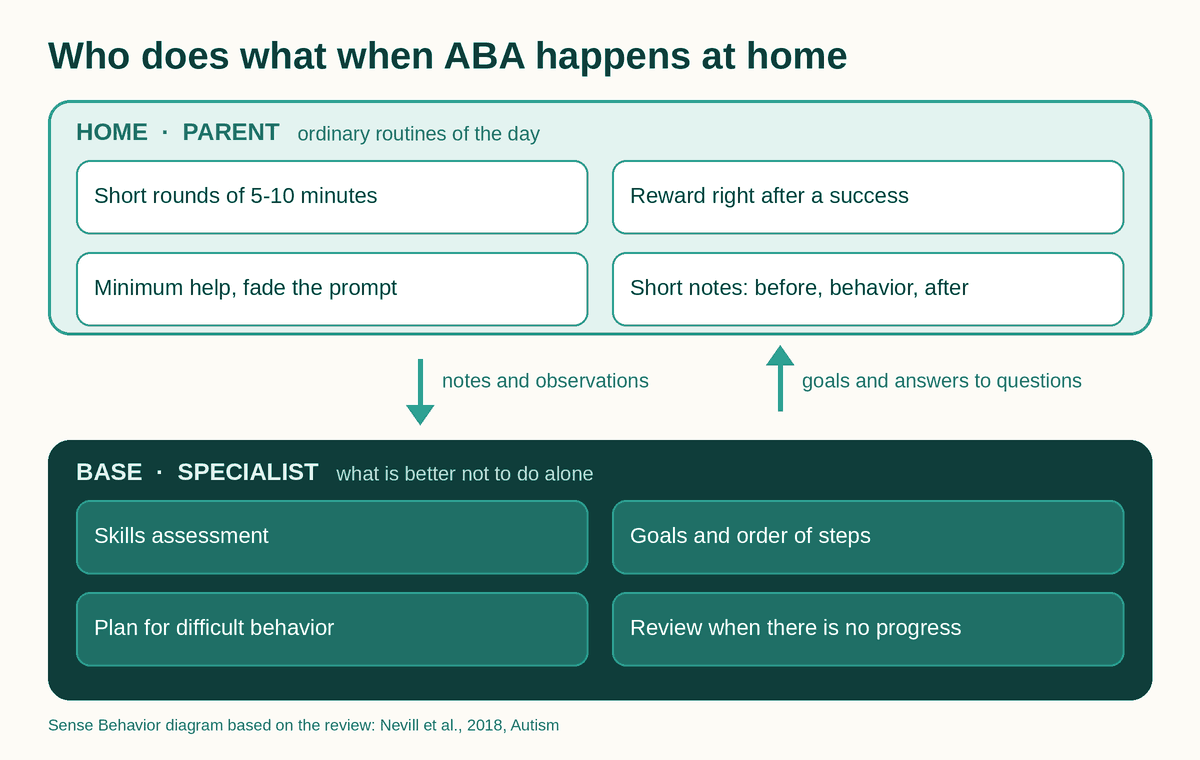
- One situation. Pick a routine that repeats, such as dressing or asking for a favorite toy, and work in short rounds of 5-10 minutes.
- Reward right away. As soon as the child does what you are building, give something they like: praise, a game, a favorite object.
- Minimum help. Help only as much as it takes to succeed, and fade the prompt step by step.
- Short notes. A couple of lines a day about what came before, what the child did and what came after save a specialist weeks of guessing.
Do not try to do everything at once: one situation for a couple of weeks is plenty. If nothing changes in that time, that is a reason to show the notes to a specialist, and no reason to demand even more of yourself.
What is better not to start without a specialist
There are three things not to take on alone. The first concerns choosing goals: without a skills assessment it is easy to pick something the child is not ready for, and how such an assessment goes is described in our article on VB-MAPP, so start there if you have not had one. The second concerns a plan to reduce difficult behavior, because you first need to understand why the child does it, otherwise you can accidentally strengthen what you wanted to remove, and that mechanism is explained in the piece on the function of behavior. The third concerns revising the program when progress is not visible.
The format where a specialist teaches the adult is covered in our article on a parent coaching study, which shows well what it looks like in real life. One more limit concerns your own energy: twenty minutes you can sustain every day give more than a three-hour marathon that leaves nothing in the tank, and that is perfectly normal.
Where to start ABA therapy at home with a parent
Pick one situation that repeats every day and for three days in a row write down what happened before, what the child did and what came after. These notes are not there to grade you, they let a specialist see the picture. If you do not have a specialist yet, at a free Sense Behavior consultation we will look at your notes and suggest where to start.