Child not sleeping at night: causes and what helps

A child not sleeping at night usually has more than one reason: sometimes pain, itching or snoring, sometimes light and noise, sometimes just a routine that has drifted. First a pediatrician rules out medical causes, then you build one consistent bedtime routine. Medicines, melatonin included, are prescribed by a doctor only. Sleep problems are common in autism: according to an expert group of the Autism Treatment Network, they affect 50–80% of children.
If you have watched the sunrise with your exhausted child night after night, you are running on empty, and that is understandable. Below is an order of steps you can start today.
Why is my child not sleeping at night: the most common causes
There is rarely a single cause, several usually stack up. Go through the groups one by one.
- Body. Pain, itching, reflux, allergies, snoring or pauses in breathing make it hard to fall asleep and cause waking.
- Senses. Light from the window, noise, a scratchy pajama or a hot room can be unbearable for a sensitive child.
- Routine. A late nap, a changing bedtime and screens before bed shift the body clock.
- Evening. After a noisy day or worrying thoughts, a child struggles to switch off alone.
- Unclear order. Without the same steps before bed, a child does not know what comes next and pushes back.
If you suspect your home is too loud or bright for a sensitive child, read the piece on sensory overload in children. A children's service page of the NHS in Birmingham (NHS Birmingham Community) also lists sensitivity to light, sound, touch and temperature as a typical barrier to sleep.
Which doctor to see if your child sleeps badly
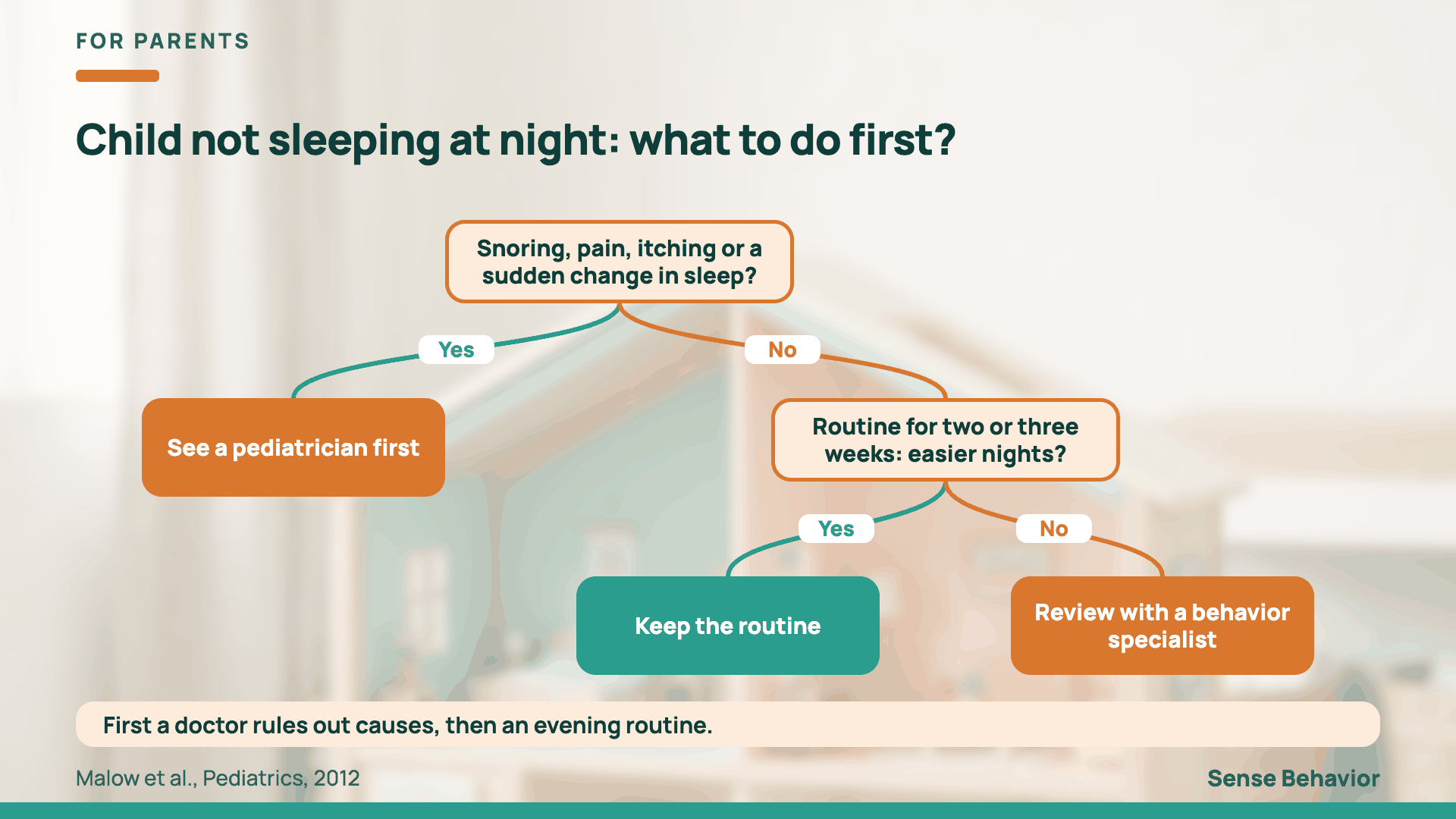
Start with a pediatrician. The practice pathway by Malow and colleagues (Pediatrics, 2012), written by the Autism Treatment Network sleep committee, advises screening children for insomnia, looking for medical contributors and putting behavioral approaches first. Medication is considered only in some situations and under a doctor's supervision.
Tell the doctor if you notice any of the following.
- Loud snoring, mouth breathing or pauses in breathing during sleep.
- Screaming or crying in the night as if in pain.
- Strong itching, coughing, vomiting or reflux after the child is put to bed.
- Daytime sleepiness and irritability that were not there before.
- A sudden drop in sleep quality after an illness, a move or another change.
Medical causes get checked first, and only then do you turn to habits.
How to improve your child's sleep: a two-week evening plan
These are general approaches that help settle sleep, and there is no need to change everything at once. Pick two or three points and keep them identical every evening.
- Go to bed and get up at the same time, weekends included.
- Switch screens off at least an hour before bed.
- Shorten the daytime nap if it runs into the evening.
- Repeat a routine of three or four steps in one order: wash, pajamas, a book, lights out.
- Show the steps with pictures so your child can see what comes next.
- Dim the lights and sounds, and check the pajama fabric and room temperature.
- Keep a sleep diary: when your child went to bed, fell asleep and woke up.
The trial by Malow and colleagues (Journal of Autism and Developmental Disorders, 2014) included 80 children aged 2 to 10 who had trouble falling asleep and a diagnosis of autism spectrum disorder. Parents learned the basics of children's sleep over a few sessions, and a month later the children fell asleep faster. Whether the sessions were individual or in a group made no difference. The study suggests that consistency and a clear plan help, but it does not promise the same result for every child.
What to do if your child wakes at night and cannot fall back asleep
At night, keep everything boring and predictable, which is the most useful rule.
- Avoid bright light and screens.
- Speak quietly and briefly, using the same phrase every time.
- Walk your child back to bed without long games or talks.
- Stay close in the same way as at bedtime and move a little farther away day by day.
- In the morning, do not scold about the night.
For tonight, take a notebook and write down when your child went to bed, fell asleep and woke, and how long they napped. A week of such notes is a solid basis for a talk with the doctor.
Can I give my child melatonin if they will not sleep
That is the doctor's decision. Whether melatonin is needed at all, in what form and for how long, is decided after an examination, and choosing a product or supplement on your own is not advised. In the 2012 pathway, medication comes after behavioral approaches and only for some cases. If a doctor prescribes it, the bedtime routine stays in place, because a pill does not replace it.
When a behavior specialist can help with sleep problems
If you have kept the evening plan for two or three weeks and nights are still hard, a review with a behavior specialist can help. They look at what happens before and after each night waking, how it ends and what keeps the habit going. The approach is described in the article on the function of a child's behavior. Look after yourself too: a tired adult finds it harder to stay even in tone, as the piece on co-regulation explains.
If you would like to discuss your child's sleep, Sense Behavior specialists work online with parents in different countries. You can write to us using the link at the bottom of the page.
Sources
- Malow B.A. et al. (2012). A practice pathway for the identification, evaluation, and management of insomnia in children and adolescents with autism spectrum disorders. Pediatrics, 130 (Suppl 2), S106–S124.
- Malow B.A. et al. (2014). Parent-based sleep education for children with autism spectrum disorders. Journal of Autism and Developmental Disorders, 44, 216–228.
- NHS Birmingham Community. Autism support: sleep.