Parent coaching in ABA therapy: what a new study on remote programs found
Parent coaching in ABA therapy sounds counterintuitive on paper: the specialist works with the parent, and the parent ends up doing the day-to-day work with the child between sessions. The obvious question is whether that actually works as well as a therapist working directly with the child. In January 2026, a study came out that answers this with real numbers rather than general reassurance. It's a study we read closely, because the program it describes echoes, almost point for point, how Sense Behavior itself started back in 2021.
How we arrived at this format ourselves
In 2021, a family came to us for whom an in-person specialist simply wasn't an option: distance, a mismatched time zone, no suitable behavior analyst anywhere nearby. For that specific request, we put together, for the first time, a program where nearly all the direct work with the child is carried out by the parent, while the specialist runs regular online sessions, reviews video of the practice, and adjusts the program as it goes.
More than five years have passed since then, and the format stopped being a one-off fix for a single family a long time ago. This is now how the program is built for most families who come to us: toddlers with no speech yet, teenagers with difficult behavior, acute crises, and calm, steady work on one specific skill, across a wide range of very different situations. That's exactly why we read the 2026 study so closely — it puts numbers behind something we've watched play out in practice for years.
What the study actually found
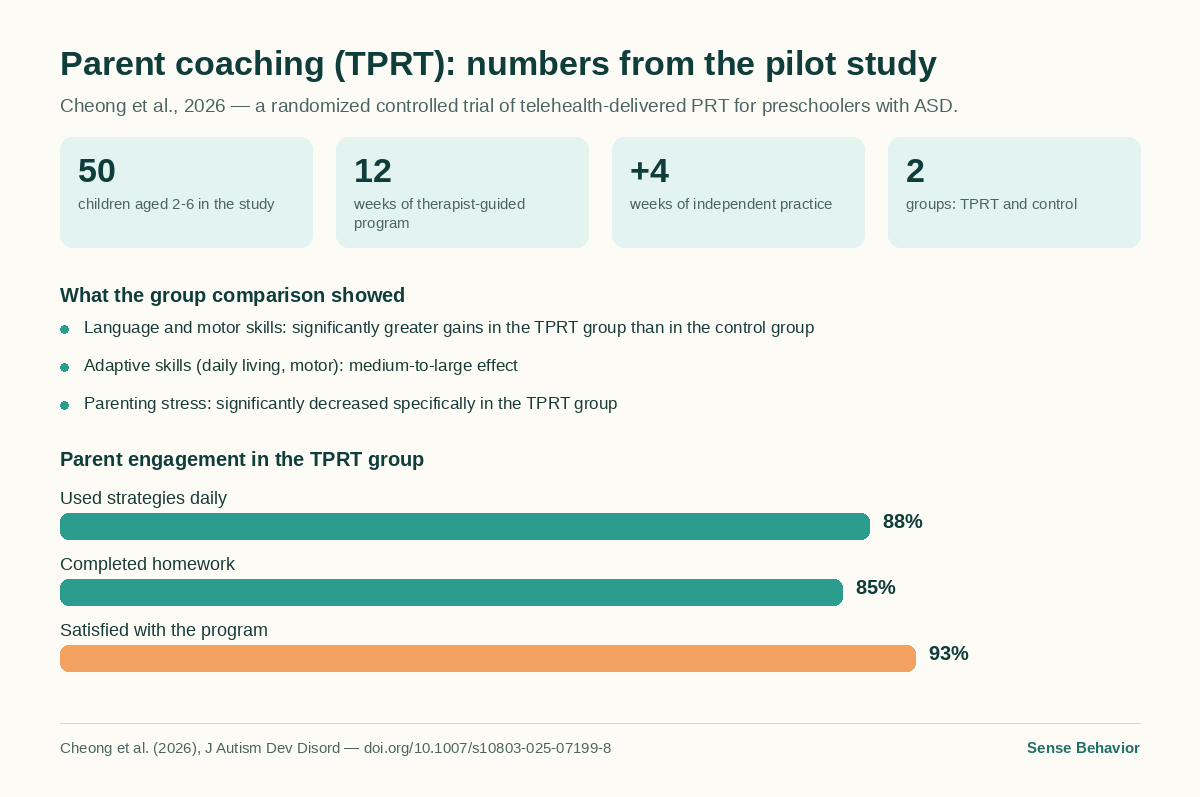
An international research team led by Tzu-Chun Hsu at National Taiwan University ran a pilot randomized controlled trial of a telehealth parent-coaching program called TPRT, short for telehealth-based Pivotal Response Treatment (Cheong et al., 2026). Fifty children aged 2 to 6 with autism spectrum disorder took part.
Children were randomly split into two groups. The first followed the 12-week TPRT program: parents met a specialist online once a week and then practiced the strategies covered in that session with their child at home every day. The second group received general parent support, without a structured program or weekly review of specific techniques.
After the 12-week program, both groups entered a four-week follow-up period during which parents in the TPRT group applied what they'd learned entirely on their own, without a specialist's support. That let the researchers check not just whether the program worked, but whether the effect held up once the structured support was gone. That's a question that matters a great deal for anything delivered remotely.
The comparisons were made at the end of that unsupported follow-up period. Children in the TPRT group showed significantly greater gains in language and motor development than the control group. For adaptive functioning, particularly daily living skills and overall motor skills, the effect was medium to large. Parents' stress levels dropped significantly, and most reported that it had become easier to understand and predict their child's behavior.
The engagement numbers are worth noting on their own: 88% of families used the strategies daily, 85% completed the homework between sessions, and average parent satisfaction with the program came out at 93%. For a format that asks parents to do daily independent work, those are high numbers. The more independence a study asks of its participants, the more discipline usually drops off in practice.
Where Pivotal Response Treatment fits in
TPRT is the telehealth version of Pivotal Response Treatment (PRT), a branch of applied behavior analysis built around natural play rather than tabletop drills, deliberately targeting a handful of «pivotal» areas at once: motivation, initiation, and responding to multiple cues simultaneously.
This isn't the only piece of research on parent coaching within PRT. A year earlier, a systematic review reached a similar conclusion about the effectiveness of this approach delivered in person (Bozkus-Genc & Yucesoy-Ozkan, 2024), and before that, a qualitative study documented rising parental confidence after group PRT training (de Korte et al., 2022). For families with limited access to therapy, the 2026 study is the first of this design to test the remote format of the program directly.
What this means if you're unsure about a remote format
The doubt is a reasonable one: it's hard to believe a weekly video call could stand in for regular in-person sessions. The precise framing matters here: the program doesn't replace daily work with the child, it shifts that work into the environment where the child feels most comfortable and safe, next to someone they're close to, their parent (or grandparent), trained and supported by a specialist on a daily basis. If your question is broader, about telehealth ABA in general rather than parent coaching specifically, we've covered the evidence and the limits of that format separately: does online ABA therapy actually work.
How this works inside Sense Behavior's programs
The mechanics the study tested are built the same way in our own programs, with five years of practice adding detail for specific situations along the way.
- Assessment before anything else. Before building a program, we look at what the child can already do and exactly where progress has stalled. Skip this step and coaching turns into guesswork. How that assessment works, and why it shapes everything that follows, is covered here: VB-MAPP assessment.
- Weekly sessions and video review. A specialist is on chat every day, so you can send a question at any moment and get an answer without waiting for the next scheduled session, even if there's no one nearby who shares the family's language or has the right specific expertise. What that support looks like for families abroad, in detail: an ABA specialist online, from abroad.
- Working with difficult behavior. This kind of coaching also trains how a parent responds to unwanted behavior, one of PRT's «pivotal» areas. We always start by working out what that behavior is actually doing for the child in a given situation. How that plays out in practice: the function of a child's behavior.
- Teaching a child to ask. One of the earliest places parent coaching gets applied is teaching a child to ask for what they need instead of screaming or having a meltdown. A step-by-step breakdown is here: teaching a child to ask.
- Supporting the parent, too. The study specifically documents a drop in parental stress, and that isn't a side effect, it's part of the mechanism: predictable child behavior lowers a parent's anxiety, and a calmer parent applies strategies more consistently. If you're already running on empty before the program even starts, that's worth addressing on its own first: parent burnout.
You can start with a free thirty-minute consultation, where we'll talk through what your child can already do and which step of parent coaching makes sense to start with in your case.
Sources
- Cheong, Lin, Lin, Wang, Lai, Kang, Kuo, Wu & Hsu (2026). Telehealth-Based Parent-Mediated Pivotal Response Treatment for Preschool Children With Autism Spectrum Disorder: A Pilot Randomized Controlled Study. Journal of Autism and Developmental Disorders
- Bozkus-Genc & Yucesoy-Ozkan (2024). Efficacy of a Parent-Implemented Pivotal Response Treatment for Children with Autism Spectrum Disorder. Journal of Autism and Developmental Disorders, 54(11), 3992-4005
- de Korte, Kaijadoe, Buitelaar, Staal & van Dongen-Boomsma (2022). Pivotal Response Treatment (PRT) - Parent Group Training for Young Children with Autism Spectrum Disorder: A Qualitative Study on Perspectives of Parents. Journal of Autism and Developmental Disorders, 52(12), 5414-5427