Low energy games to play with your child: 12 ideas for when you're exhausted
The short answer to «low energy games to play with your child»: games where the child does most of the moving, and you contribute a voice and attention. Being exhausted is not a sign you're doing something wrong — a study of parental burnout across 42 countries found that the share of parents experiencing marked exhaustion varies widely by country, but shows up everywhere (Roskam et al., 2021). Below are 12 games you can play lying on the sofa or sitting in a chair — no running around, no setup, almost no energy required, but with a clear payoff for specific skills.
Why this works just as well as running around
A common mistake in judging your own parenting effort is measuring a game's value by how much movement it involves. In reality, what matters for development is not how much the adult moves, but how responsive they are in the moment — noticing what the child is doing or saying and reacting to that, rather than running their own agenda. A classic longitudinal study found that maternal responsiveness specifically — not overall activity level — predicted when children reached successive language milestones: first words, first phrases, talking about the past (Tamis-LeMonda, Bornstein & Baumwell, 2001).
The practical takeaway: 15 minutes lying down with your eyes closed can be just as useful as 15 minutes at the playground — if they include attention to the child, a pause long enough for them to respond, and a reason for them to speak or show you something rather than just watch.
Three rules so a low-energy game doesn't turn into background noise
- The active role belongs to the child. They run, fetch, search, show; you name, ask, guess, and praise.
- Say up front how much time you have. «Five minutes, then I'll rest a bit more while you play by yourself» is more honest than a game that suddenly cuts off halfway through.
- Don't insist if a game involves touch or closed eyes and the child finds that unpleasant. Some of the games below are sensory ones; if the child avoids touching unfamiliar textures with bare hands, swap in a tool — a spoon, a cup — instead. More on sensory sensitivity: a child afraid of haircuts and toothbrushing.
12 games without running around, by group
The games below are grouped not by age but by what they build. Age guides are noted within each description, but it's more accurate to go by the child's current level than by their date of birth.
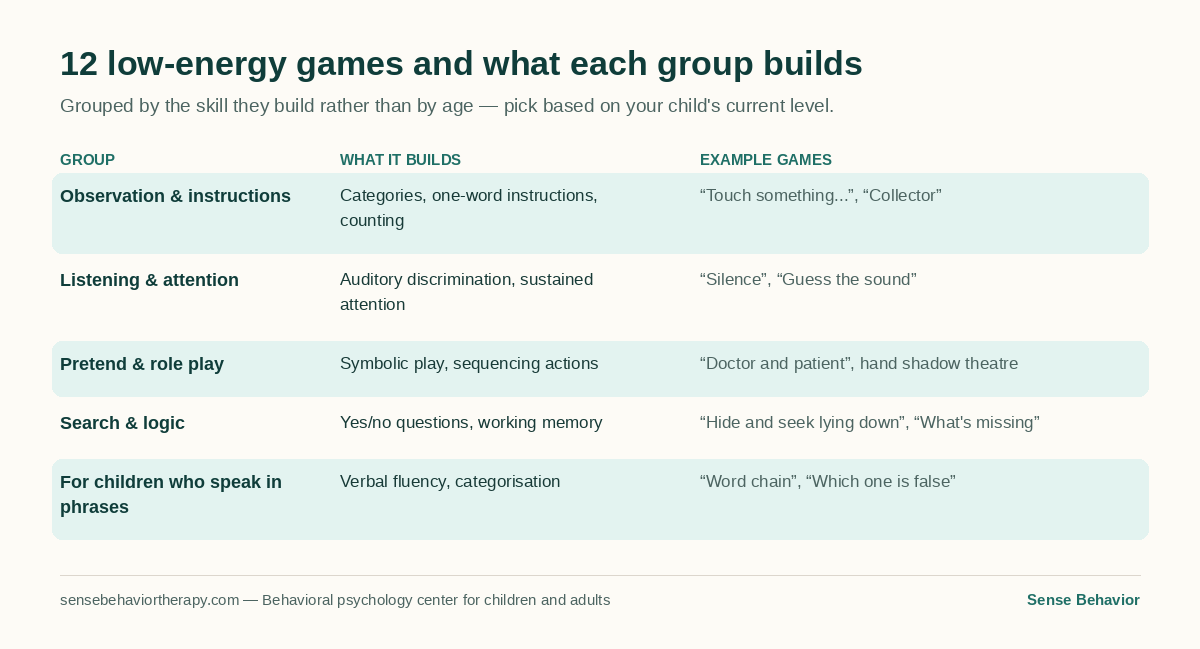
Observation, categories, one-word instructions
These games rest on the child listening to your instruction and acting on it — a basic skill that nursery and school are later built on.
- «Guess what this is». Lie down with your eyes closed while the child places objects on your palm or stomach one at a time and you name them by feel. Builds naming and patience — waiting for you to guess instead of blurting out the answer themselves. A variant for children who can already write: they trace letters on your back with a finger and you name the letter.
- «Touch something...». You name a feature — yellow, round, soft, alive — and the child runs to touch a matching object in the room. Builds understanding of categories and descriptive vocabulary, not just individual object names.
- «Collector». The child fetches items from your list: three red objects, two pairs of socks, something starting with the letter K. Builds holding a multi-part instruction in mind and counting — a good next step for a child who already follows one-step instructions easily.
Listening and attention
These build the ability to pick out and hold onto sound — the same skill that later helps a child catch an instruction in a noisy room.
- «Silence: who heard more». Both of you close your eyes for 20 seconds, then take turns naming the sounds you heard — a clock, a car outside, neighbours, a bird. Builds voluntary auditory attention.
- «Guess the sound». Swap roles from the previous game: now you close your eyes while the child taps, rustles, or rattles an object and you guess what it is. Children usually prefer this role — they're running the game, not just answering.
- «Radio». The child «tunes in» to different stations using their voice — a weather forecast, the news, a song — and you name which station is playing. Builds vocal expressiveness and switching character through voice alone, which doesn't come easily to many children without a model.
Pretend and role play
Pretend play is one of the few natural reasons to practise speech and a sequence of actions at the same time.
- «Doctor and patient». You're a seriously ill patient; the child treats you — listens to your chest, takes your temperature, gives you «medicine», bandages you up. Builds a multi-step sequence and caring for someone else — not an easy skill for every child, which is exactly why it's worth practising.
- «Hand shadow theatre». On a wall or ceiling (a desk lamp helps), make animal silhouettes with your hands for the child to guess and then copy. Builds precise finger-movement imitation and recognising a shape from its outline rather than colour or detail.
Search and logic
These games work like a small detective puzzle — with moves, questions and feedback.
- «Hide and seek lying down». The child hides somewhere in the room; you search using questions they can only answer with «yes» or «no». Builds forming a question and working out which question will actually narrow the search — a piece of reasoning, not just an exchange of lines.
- «Hot and cold». Hide an object while the child isn't looking, then guide them using only «warmer» and «colder». For older children, reverse it: they give the clues and you search. Builds understanding of comparatives, which is a genuinely tricky bit of language on its own.
- «What's missing». Lay out 4–6 objects on a table, the child closes their eyes, you remove one, and they name what's gone. Builds working memory and attention to detail; start with 3 objects if it's too hard at first.
For children who already speak in phrases
The next two games rely on more developed speech and won't suit every child — they work best once a child is already building multi-word phrases.
- «Word chain». Take turns naming words in one category — animals, food, transport — or starting with the last letter of the previous word. Builds verbal fluency and categorical thinking: quickly finding a word within a given group.
- «Which one is false». Tell the child three facts about yourself or your day — two true, one made up — and they guess which is false. Builds distinguishing real from invented, and doubles as a reason for a real conversation.
If your child isn't ready for some of these yet
Several of these games rely on speech the child may not have yet — yes/no questions, naming categories, full-sentence answers. That's not a reason to skip the whole section: start with the games built around action rather than speech («Touch something...», «Collector», hand shadow theatre), and come back to the verbal ones as speech develops. If your child is currently saying only a few single words or short phrases, we've covered where to start separately: a child not talking at 3.
How Sense Behavior helps with this
A list of games solves one problem — what to do with your hands and voice when you have no energy for activity. It doesn't solve another: whether your child is actually ready for a game of this type right now, or needs a simpler level first.
- Assessment first, then games. We look at which of these 12 formats your child is already ready for and which are premature, and choose the next step.
- We teach the parent to run the game from a lying-down position. Online sessions cover concrete moments: where to pause so the child finishes the thought or the request themselves, rather than the adult.
- We review video of your games. A short recording often shows what's invisible from the inside — for instance, that the question comes before the child physically has time to respond.
- We adapt to the energy you actually have that day. If today you have less than yesterday, the specialist helps simplify the task rather than cancel the session outright.
- Ongoing supervision. The programme is revised as progress happens, rather than staying fixed for months.
You can start with a free thirty-minute consultation: enough to work out which of these games to try first with your child.