Returning to Work After Maternity Leave: Where to Start

Returning to work after maternity leave is easier to start with your week than with your résumé: first work out how many hours you can give to a job, and only then negotiate. If your child has a diagnosis or a suspected one, the week is already full of sessions, doctors and night wakings, and that needs to be counted in advance. Below are five steps in order.
If you both want to go back and are afraid to, that is a common state. The worry of “can I manage” almost always sits next to the wish to work. This article is about practical steps. Why income falls for years after a child is born is covered in the article on the motherhood penalty.
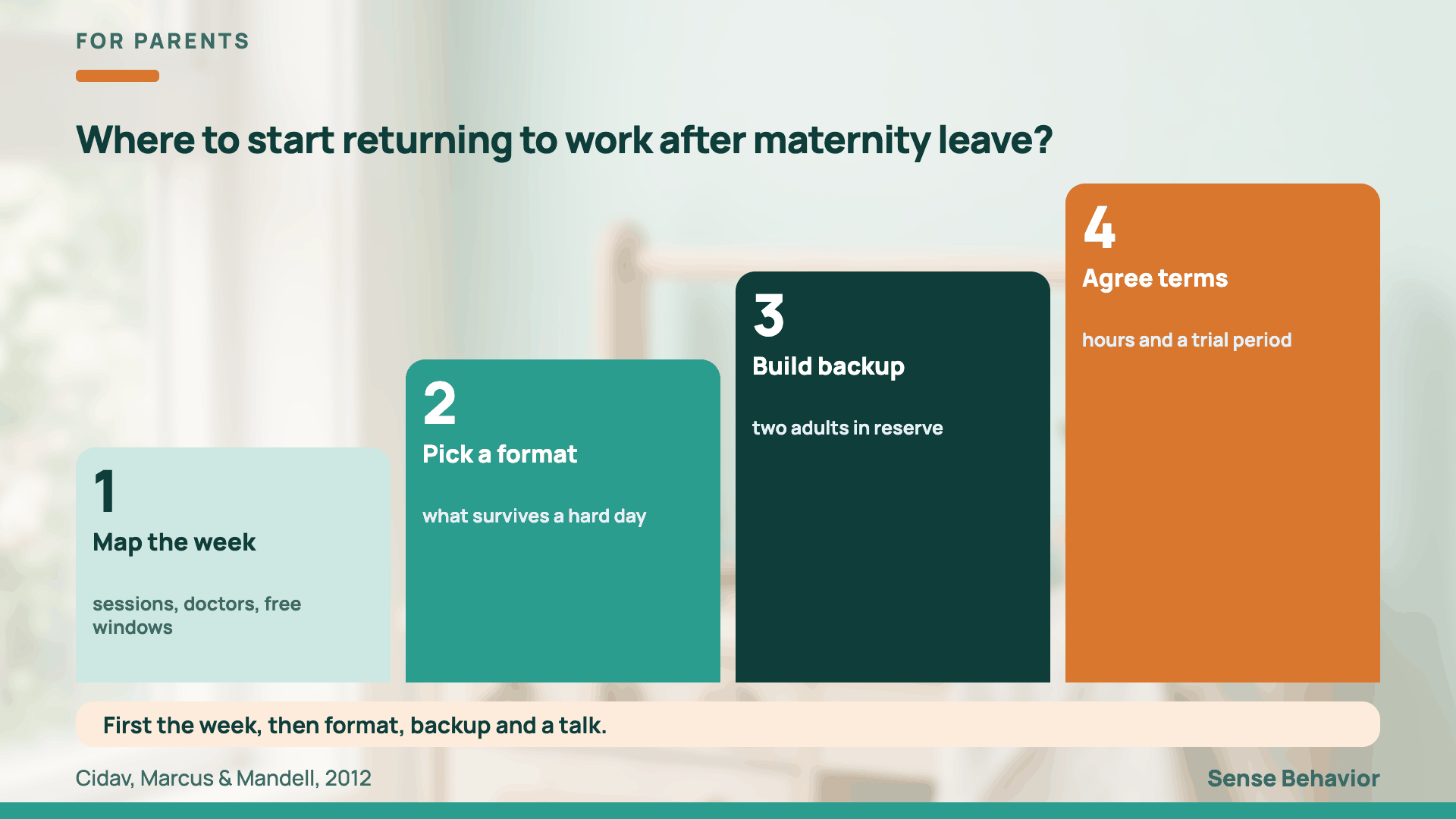
Where to start returning to work after maternity leave: five steps
Go in order. Each step takes one evening.
- Map your week. Write down sessions, doctors, travel, your child's sleep and your own free windows to see how many hours are open.
- Pick a format. Full time, part time, remote or project work: choose what your week can carry on a hard day.
- Build backup. Who collects your child if you are busy and who steps in if they are ill. You need two adults in reserve, not one.
- Talk to the employer. Name the hours you are available and the hours you are not. You do not have to share details of the diagnosis.
- Agree a trial period. Ask for a month or two, after which you review the schedule together and adjust it.
How many hours a week can you give to work
There is no universal number. Plan for your hardest week not your easiest: if the schedule survives it, the others will go more calmly. It is better to start with less and add hours than to take too much and burn out in a month.
What is known about work among mothers of children with ASD
In the study by Cidav, Marcus and Mandell (2012), based on a US national survey, mothers of children with ASD were compared with mothers of children with another health limitation and mothers of children without limitations. Mothers of children with ASD earned 35% less than mothers of children with another health limitation and 56% less than mothers of children without limitations.
They were also less likely to be employed (by 6%) and worked on average 7 hours a week fewer than mothers of children without limitations. No clear differences were found for fathers. These are American data from 2002 to 2008 and the numbers may differ in your country. They do show that difficulties with returning to work are familiar to many.
What to say to an employer
The conversation is easier when it is about hours and results rather than excuses.
- Name the hours when you can be reached and the hours when you cannot.
- Offer a flexible start of the day or one remote day a week.
- Say in advance how to contact you in an urgent case.
- Present the schedule as a working condition, not a favor you are asking.
What to do with therapy when you return to work
Therapy should neither be dropped nor piled on top. Discuss the timing with your specialist: some sessions can move to the evening or the weekend and some can be built into the ordinary day, as the article on ABA at home with a parent describes. If your energy is already low, read about parent burnout.
Where to start today
Take a sheet of paper and write down the whole week: sessions, doctors, your child's sleep and your own free windows. It takes one evening, and after that the conversation with an employer rests on numbers rather than worry.
If you would like to talk through how to fit therapy into a working mother's schedule, the Sense Behavior specialists work online with parents in different countries. You can write to us using the link at the bottom of the page.