Panic attack: what to do right now and how it differs from a heart attack

Panic attack what to do if it has started right now? Sit down or lean against a wall, drop your shoulders and breathe out slowly through your mouth. The wave of fear usually peaks and fades within 5–20 minutes, and by itself it is not dangerous. Below you will find a 10-minute plan and the signs that separate an attack from a heart attack. There is also a list of situations that need an ambulance.
If you are reading this with a pounding heart, you do not have to finish it now. Skip to the plan and come back when it eases. If chest pain, breathlessness or numbness appears for the first time in your life, do not wait and call your emergency number.
Panic attack what to do right now: a 10-minute plan
The plan is written for someone whose heart has already been checked and whose doctor knows about these episodes. If this is your first attack ever, read the red flags section below first. The aim is simple. You give yourself something to hold on to for a few minutes while the wave passes.
- Minute 1. Stop and sit down. Support under your back and feet helps the body register that it is stable.
- Minute 2. Name what is happening, aloud or silently: “This is a panic attack. It is unpleasant and it passes.”
- Minutes 3–6. Breathe slowly: in through the nose for four counts, out through the mouth for six. Repeat about ten times.
- Minutes 6–8. Move your attention outward. Find five things you see, four sounds and three things you touch.
- Minutes 8–10. Sip water and let your shoulders, jaw and hands loosen.
Save a few short phrases in your phone notes in advance, so you can read them in the moment of panic:
- These sensations are unpleasant, but they are not a threat to my life.
- I have been through this before and it ended.
- I only need to wait the wave out.
If the wave is still going, repeat the loop. Leave the room or the street only when it is unsafe there. Running away teaches the brain that the danger was real. One completed step is enough, and breathing often fails on the first try.
During an attack the body switches on the same fight-or-flight response it uses for real danger. The heart speeds up, breathing quickens and muscles tighten. There is no threat outside, yet the body acts as if there were. The sensations frighten more than the trigger itself, and fear of the sensations amplifies them. Knowing the mechanism takes some of the panic out of it, because this is an overloaded alarm system.
Breathing deserves a separate note. A 2023 meta-analysis (Fincham and colleagues, Scientific Reports) pooled 20 studies of anxiety and found a small effect of breathing practices, g = −0.32. The effect is modest, so treat breathing as one tool among several. Three words help you remember the plan in the moment: support, exhale, outside.
What is better avoided in the middle of an attack:
- Arguing with the sensations or ordering yourself to stop being afraid.
- Checking your pulse and blood pressure every half minute.
- Taking someone else’s pills or drinking alcohol to take the edge off.
- Driving or crossing a busy road.
Panic attack or heart attack: how to tell the difference
The symptoms overlap, so nobody can diagnose you from a description online. A doctor decides, and when in doubt it is safer to call an ambulance. An extra call costs less than a missed heart attack.
For a panic attack the UK health service NHS lists a racing heartbeat, sweating, trembling and nausea. It also names chest pain, shortness of breath, tingling fingers and a feeling that you are dying. For a heart attack the same service describes crushing or squeezing chest pain. The pain can spread to the arm, neck and jaw. Severe breathlessness and pale, blue or grey skin are added to the picture.
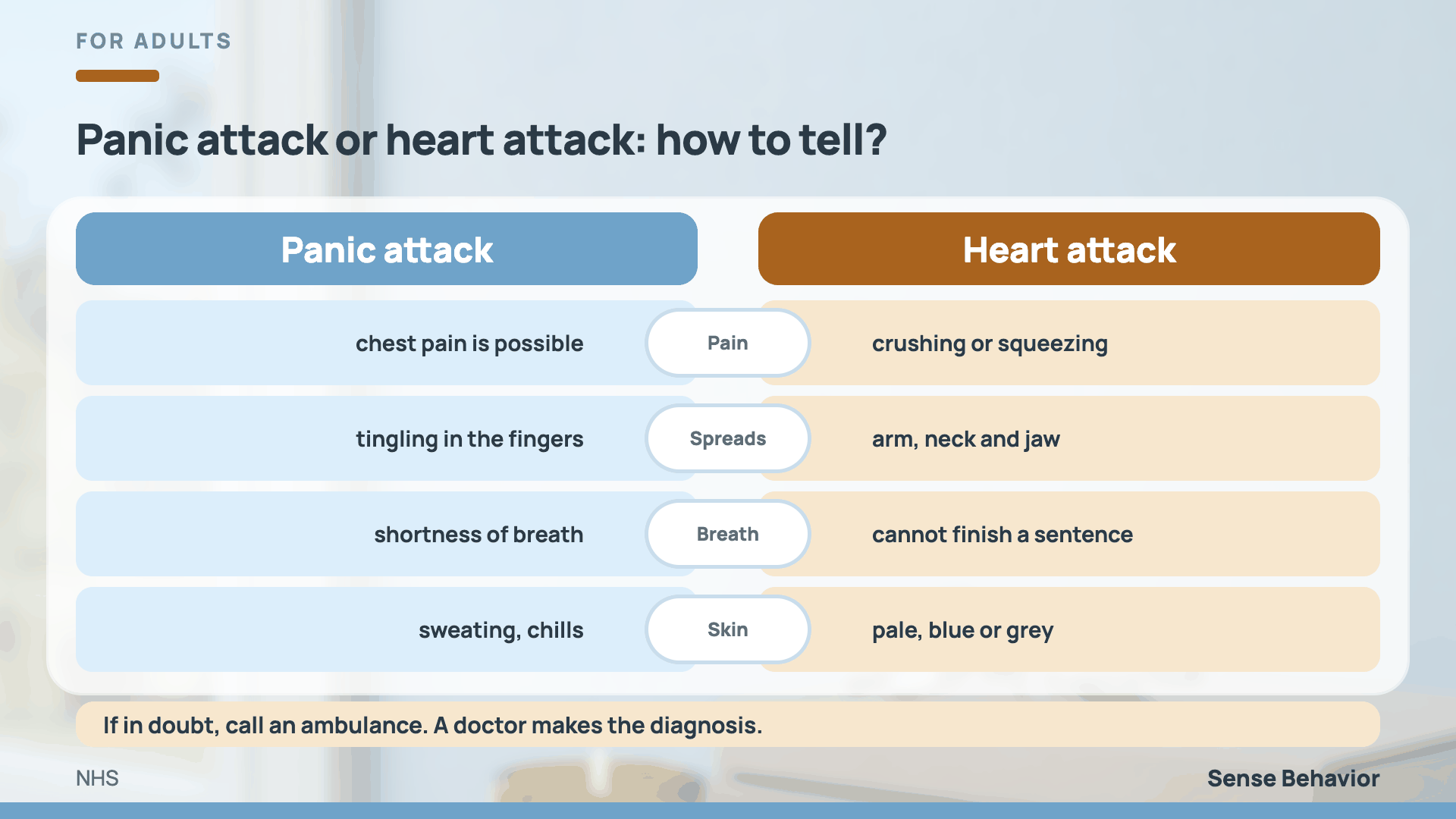
Red flags. Call your local emergency number (112 in most of Europe, 911 in the US, 999 in the UK) if even one item applies.
- Chest pain presses or squeezes and spreads to the arm, neck or jaw.
- You are gasping and cannot finish a sentence.
- One side of the body is numb or weak, the face droops or speech is slurred.
- Your skin has turned pale, blue or grey.
- You lose consciousness, or the person next to you stops responding.
- This is the first episode of your life.
- You are over 40 and have high blood pressure, diabetes, smoking or heart disease in the family.
A panic disorder diagnosis does not cancel the red flags. People with panic attacks get heart disease too, so a new pain needs checking. If today’s episode is stronger, longer or feels different from usual, treat it as new and call.
Do not drive yourself and do not wait for things to become clearer. A doctor makes the diagnosis after an ECG and an examination. People in the middle of an attack often fear “bothering someone for nothing”. In this situation the call is justified.
How long does a panic attack last
According to the NHS, most panic attacks last between 5 and 20 minutes, and some up to an hour. The worst part comes in the first minutes, then the sensations fade. It feels longer because every minute is filled with fear.
A single attack does not mean a disorder. In a national US survey (Kessler and colleagues, 2006), 22.7% of adults had isolated panic attacks at some point in life. Panic disorder without agoraphobia was found in 3.7%. If the state lasts well over an hour or keeps coming back, that is a reason to see a doctor.
Sometimes the waves come one after another, and from the outside it looks as if the attack lasts an hour. What remains afterwards is fatigue and the expectation of the next one. That expectation keeps the circle going, which we come back to below.
How a single episode differs from an anxiety disorder with a constant background is covered in our piece on anxiety in adults. It will help you see where to look next.
Panic attack at night and while falling asleep
A night attack wakes you from sleep with a pounding heart and a sense of catastrophe. Researchers place it in non-REM sleep, and there is no nightmare plot behind it: you wake up already in panic. The review by Craske and Tsao (2005) reports that 44 to 71% of people with panic disorder woke like this at least once.
- Sit up in bed or move to a chair and switch on a soft light.
- Use the same plan: support, a long exhale, five things around you.
- Put a glass of water by the bed in advance and sip it slowly.
- Do not watch the clock or count your pulse, because checking feeds the fear.
If night attacks repeat, tell your doctor about sleep, coffee and evening alcohol. Daily habits that lower the general background are collected in the piece on how to cope with anxiety. Start with one item, not the whole list at once.
If you are afraid to close your eyes after waking, get up. Sit in another room under soft light, drink some water and return to bed when your breathing evens out. Lying there and listening to your heart pushes sleep further away.
How to help another person during a panic attack
When someone beside you is having an attack, your job is to stay with them. First check the red flags from the list above. If even one applies, or you are unsure, call an ambulance.
- Speak in short sentences and quietly: “I am here. It will pass.”
- Ask what they need now: water, a chair, silence or for you to step back.
- Breathe slowly beside them so they can match your rhythm.
- Avoid “pull yourself together” and “it is nothing”, which sound dismissive.
- Leave the causes alone until the wave has passed.
- Stay another ten minutes or so, because the body is still shaking.
If the person refuses help, do not insist. Say you will stay nearby and keep the distance that suits them. In a crowded place, help them move to a quiet corner with less noise and fewer eyes.
What to do after a panic attack
When it eases the body still trembles for a while and feels drained, as after a run. Let it rest and do not demand heroics from yourself.
- Drink water and eat something if you have not eaten for a long time.
- Write down the date, time, place, what came before and how long it lasted. After two weeks the notes will show patterns.
- Cut back on coffee and energy drinks. In the review by Klevebrant and Frick (2022), caffeine at 400–750 mg triggered an attack in 51.1% of 237 patients with panic disorder.
- Return to your routine and to the place where it happened. Avoiding it locks the fear in.
Behavioural logic applies here. Each time you avoid a place or a sensation, the brain concludes the danger was real, and anxious anticipation grows. At Sense Behavior we look at anxiety through the ABA approach: small steps and records that make change visible. There are no promises of results. You do arrive at the doctor or psychologist with facts instead of impressions.
The fear that it will return is often heavier than the attack itself. It makes people check how they feel and skip the metro, the gym, trips. The longer the list of avoided things, the narrower life becomes. Come back in small steps, first walking to the bus stop, then riding one stop. Write each step down.
When to see a doctor and which one
See a doctor after a first attack and after any series of repeats. Start with a general practitioner or family doctor. They will order an ECG and blood tests, including thyroid hormones, and rule out physical causes.
- A general practitioner or cardiologist checks the heart and blood pressure.
- An endocrinologist assesses the thyroid if the tests fall outside the range.
- A psychiatrist or psychotherapist decides whether panic disorder is taking shape.
- A clinical psychologist provides psychotherapy.
To get the most from the appointment, prepare in advance:
- notes on the attacks: date, duration, situation,
- a list of medicines, supplements and energy drinks, including coffee,
- results of earlier ECGs and blood tests,
- the questions you want to ask.
A 2016 Cochrane review (Pompoli and colleagues) pooled 54 studies with 3,021 participants. Cognitive behavioural therapy was studied most and more often gave the best result, although the effect was small and the quality of evidence low. You choose the method together with a specialist.
Do not put the visit off if you notice even one of these:
- attacks keep repeating, or you constantly fear their return,
- you have started avoiding places and situations where you felt bad,
- sleep, work or relationships are suffering,
- you drink alcohol to get through the wave.
The decision about medication belongs to the doctor, and picking pills yourself is not safe. How this works is described in our piece on anxiety pills. If the very idea of seeing a psychiatrist is frightening, read what happens with psychiatric registration in adulthood.
To arrive with facts, you can first try the rating scales. Which ones exist and what they show is explained in the article on the anxiety test. The result is not a diagnosis, but it is a handy way to open the conversation.
If panic comes with thoughts of hurting yourself, do not wait for an appointment. Contact your local emergency service or a crisis line, and use the international directory to find lines by country.
If you want to talk through your situation, write to us using the link at the bottom of the page.
Sources
- NHS. Panic disorder (симптомы, длительность атаки, когда обратиться к врачу).
- NHS. Heart attack, symptoms (признаки инфаркта и когда звонить в скорую).
- Kessler R. C. et al. (2006). The epidemiology of panic attacks, panic disorder, and agoraphobia in the National Comorbidity Survey Replication. Archives of General Psychiatry, 63(4), 415–424.
- Craske M. G., Tsao J. C. I. (2005). Assessment and treatment of nocturnal panic attacks. Sleep Medicine Reviews, 9(3), 173–184.
- Fincham G. W. et al. (2023). Effect of breathwork on stress and mental health: a meta-analysis of randomised-controlled trials. Scientific Reports, 13, 432.
- Klevebrant L., Frick A. (2022). Effects of caffeine on anxiety and panic attacks in patients with panic disorder: a systematic review and meta-analysis. General Hospital Psychiatry, 74, 22–31.
- Find A Helpline: международный каталог кризисных и экстренных линий по странам.
- Pompoli A. et al. (2016). Psychological therapies for panic disorder with or without agoraphobia in adults: a network meta-analysis. Cochrane Database of Systematic Reviews, 4, CD011004.
This material is for informational purposes only and does not replace a consultation with a specialist.