Intrusive thoughts: what they are, when they are normal and what helps

Intrusive thoughts are unwanted thoughts, images or impulses that arrive on their own, frighten you and refuse to leave. Most people have them: in a study across 13 countries, 93.6% of participants noticed at least one in three months. Below we look at how ordinary unwanted thoughts differ from OCD, what helps and when to see a specialist.
If the content of your thoughts scares you and you tell no one about it, you are far from alone. Shame stays silent the longest. A frightening thought is not a wish, and we explain why further down.
What are intrusive thoughts
Intrusive thoughts arrive suddenly and feel foreign. A person is usually horrified by them precisely because they contradict what the person wants. They can look different from one person to another.
- Doubt: “Did I lock the door?” and being unable to let the question go.
- An image: a flash of a picture of disaster happening to someone close.
- An impulse: a sudden thought of “what if I do something terrible”.
- An unacceptable theme: sexual, violent or religious.
There is a huge gap between a thought and an action. A thought arrives regardless of your wishes, and the horror you feel shows that it clashes with your values. Such a thought does not make you a dangerous person.
Anxious worry sounds like your own voice working through a problem: “what if I run late”. An intrusive thought feels foreign, absurd or repugnant, and you disagree with it. This difference helps you describe the state to a doctor.
The theme of a thought often matches what you value. A caring parent gets pictures of harm coming to a child, a tidy person gets thoughts about dirt, a believer gets blasphemous images. Specialists often notice this link, and it helps to see that a frightening thought appears where a value sits, not a wish.
Thoughts about death come in different forms. Sometimes it is fear for loved ones or a frightening picture without any wish to die. If a wish for life to end appears, that is a separate signal, and we cover it in the section on urgent help below.
Do healthy people have intrusive thoughts
They do, and very often. In the study by Radomsky and colleagues (2014), an international group interviewed 777 university students at 15 sites in 13 countries on six continents. 93.6% of participants, roughly 94 people out of 100, reported an unwanted thought, image or impulse in the previous three months. The other 6 out of 100 reported none. Doubting thoughts were the most common. Repugnant themes, for example sexual and blasphemous ones, were the least common.
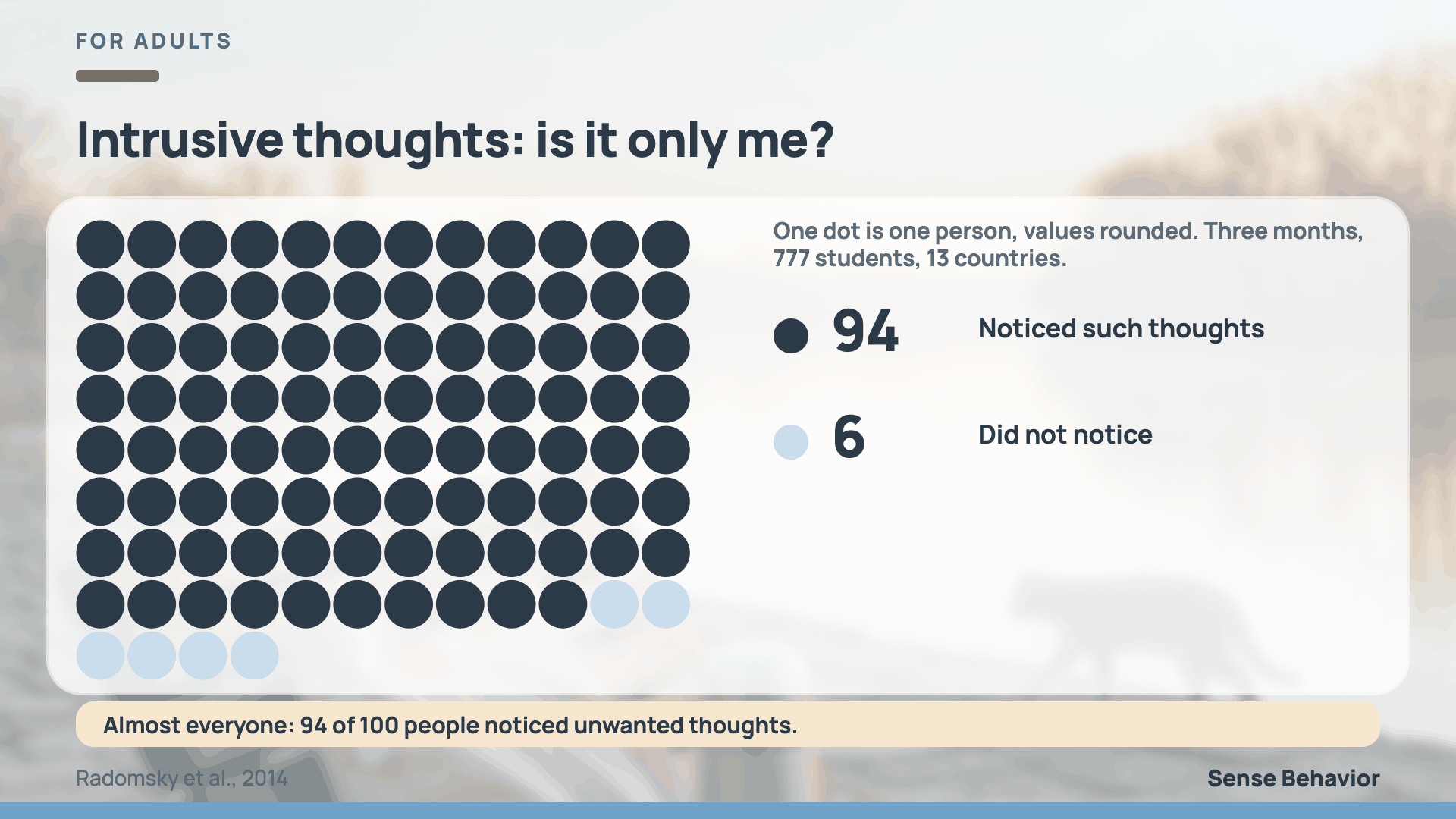
Earlier data came mostly from the US, the UK and other “westernised” countries. Radomsky and colleagues checked whether unwanted thoughts occur in people from other regions, and found them on all six continents.
One limitation matters: the sample consisted of students, and it shows how widespread such thoughts are, not that they are harmless for everyone. For you the conclusion is still direct. The mere fact of an unwanted thought says nothing about something being “wrong” with you.
What this means for you:
- Having such a thought says nothing about your character.
- The stronger the shame and the fight with the thought, the firmer it sets.
- Telling a specialist is safer than carrying it alone.
The authors rely on a cognitive model. Unwanted thoughts are not a problem in themselves until they are judged dangerous and people try to control them in unhelpful ways. This is an explanation without a diagnosis, and it shows where the lever is: in your reaction to the thought.
Intrusive thoughts and OCD: where is the boundary
OCD, obsessive-compulsive disorder, consists of obsessions and repeated actions or rituals that bring only brief relief. Only a specialist can diagnose it. The boundary depends on how much space the thoughts take in your life and how you react to them. The content of a thought plays no role.
The difference is easy to see in an example. Two people get the same thought: “what if I left the iron on”. One shrugs and drives on. The other goes back home, checks five times and texts the neighbours. The thought is the same and the reaction differs.
In a national US survey (Ruscio and colleagues, 2010), more than a quarter of respondents had experienced obsessions or compulsions at some point in life. Only 2.3% met full DSM-IV criteria for lifetime OCD. The gap shows that isolated intrusive thoughts are very common and the disorder is much rarer.
What is worth discussing with a specialist:
- The thoughts take up much of the day and interfere with work, study or relationships.
- You repeat actions to “neutralise” the thought: checking, washing, counting, repeating phrases.
- You mentally review events or seek reassurance from close people again and again.
- You avoid people, places or objects because of the thought.
- You spend a lot of effort to keep the thought from appearing.
A doctor assesses such signs in conversation and, if needed, with rating scales. An online questionnaire cannot replace that, because it counts only answers and not your life as a whole.
The list is a guide for a conversation with a doctor and gives no diagnosis. If you recognised yourself in it, that is a reason to book an appointment.
Intrusive thoughts with anxiety, ADHD and autism
Intrusive thoughts often travel with other conditions. According to Ruscio and colleagues, OCD frequently co-occurs with anxiety and mood disorders. We describe the wider picture of anxiety in the piece on anxiety in adults.
- Anxiety. A tired and tense mind gets stuck on frightening scenarios more easily, and the thought feels like a warning.
- ADHD. Switching from a thought to a task can be harder, and the link with anxiety is covered in the piece on ADHD and anxiety.
- Autism. Repetitive thoughts and a need for predictability are easy to confuse with obsessions from a description, so a specialist familiar with both should assess them. Read more in the article on autism and anxiety in adults.
If the thoughts grew stronger during a period of stress, lost sleep or loss, they often fade together with the cause. So look at the general background: sleep, workload, caffeine. How to do that is shown in the piece on anxiety for no reason.
Sometimes it is hard to tell a thought from a feeling. If that sounds familiar, the piece on alexithymia in adults explains why naming what you feel can be difficult.
What helps: do not argue, do not push away, do not check
The three rules look simple but cancel familiar reactions. Each one removes fuel from the loop in which a thought causes anxiety, an action brings brief relief and the thought returns.
- Do not argue. Proofs that “I am not like that” bring relief for minutes and start a new round of doubts.
- Do not push away. In the meta-analysis by Abramowitz and colleagues (2001), attempts to suppress a thought produced a small to moderate rebound: the thought came back more often.
- Do not check. Rechecking, reassurance seeking and mental review reinforce the feeling that the thought is dangerous.
Searching online for “is this OCD” is also a form of checking. It brings brief relief and starts a new loop. Write the question down and discuss it with a doctor.
Instead you can take one small step today:
- Call a thought a thought: “I am having the thought that...”. This separates it from fact.
- Let the thought stay nearby and return to what you were doing.
- Notice what you feel in the body and take a slow breath out.
- In the evening write down how many times the thought came and what you did in response.
Letting a thought stay nearby does not mean agreeing with it. You do not accept its content and promise it nothing. You simply stop spending energy on the fight, and the loop gets less fuel.
A behavioural view explains the loop without a diagnosis. A thought causes anxiety, an action or avoidance brings relief, and the brain learns that it cannot manage without the action. Compulsions and avoidance hold the loop in place. So we look at what a person does in response and record it in notes. You never have to retell the content of the thought to anyone. This approach does not guarantee a result, yet it makes the picture visible.
An example of a small step: if you want to check or ask, wait five minutes and do something else. Next time wait a little longer. This is how the behavioural approach measures steps, and it is better to choose them with a specialist, especially if rituals are already present.
Everyday methods that lower the general background are gathered in the piece on how to cope with anxiety. If you fight the thoughts with all your strength and nothing works that is expected and says nothing bad about you.
What to do if thoughts of harming yourself or others frighten you
If a thought of harming someone or yourself came and horrified you, that is the most common scenario. Such thoughts frighten precisely because they contradict what you want. The thought itself is not a wish.
The situation changes when a wish, a plan or a feeling that you might not hold back joins the thought. Urgent help is needed in these cases.
- You are thinking about ending your life or wish that everything would end.
- You have a plan or access to means.
- You feel you could harm another person and not hold back.
- The thoughts come with voices or a sense that what is happening is unreal.
At such a moment do not stay alone. Call your local emergency number or a crisis line, and use the international directory to find lines by country. Tell someone close that you need help. Asking for it is normal.
If you decide to tell someone close, a simple phrase works: “I sometimes have frightening thoughts. I do not want anything bad, I need support.” It makes clear that you are asking for help, not confessing to plans.
If your thoughts touch on faith and “sin”, that is a well-known theme too. A specialist hears it not for the first time, and whether to also turn to a spiritual adviser stays your decision.
When to see a specialist and which one
Book a doctor if the thoughts last for weeks, take up a lot of energy, push you toward rituals or make you avoid usual things. You do not need to wait until it becomes very hard.
- A general practitioner or family doctor rules out physical causes.
- A psychiatrist assesses the condition and discusses medication if needed, and the decision stays with the doctor.
- A psychotherapist or clinical psychologist provides cognitive behavioural therapy.
The meta-analysis by Olatunji and colleagues (2013) covered 16 randomised trials with 756 participants who had OCD. Cognitive behavioural therapy outperformed control conditions right after the course (g = 1.39) and at follow-up (g = 0.43). The effect at follow-up is smaller than right after the course, and the method does not help everyone, so discuss the plan with a specialist.
At the appointment the specialist will ask about thoughts, rituals, avoidance, sleep and mood. You may stop the conversation and ask for anything unclear to be explained. Details can be shared at a pace you can manage.
It is better to prepare for the appointment and bring a few notes:
- How often the thought comes and how much time it takes in a day.
- What you do in response: checking, rituals, seeking reassurance.
- What you have started to avoid in recent months.
- Which medicines and supplements you take.
- Questions you want to ask.
Tell the specialist the content of your thoughts directly, even if it feels shameful. Such thoughts are heard often, and details help to tell ordinary unwanted thoughts from obsessive ones. If the very idea of seeing a psychiatrist frightens you, read what happens with psychiatric registration in adulthood.
If you want to talk through your situation, write to us using the link at the bottom of the page.
Sources
- Radomsky A. S. et al. (2014). Part 1: You can run but you can't hide: Intrusive thoughts on six continents. Journal of Obsessive-Compulsive and Related Disorders, 3(3), 269–279.
- Ruscio A. M., Stein D. J., Chiu W. T., Kessler R. C. (2010). The epidemiology of obsessive-compulsive disorder in the National Comorbidity Survey Replication. Molecular Psychiatry, 15(1), 53–63.
- Abramowitz J. S., Tolin D. F., Street G. P. (2001). Paradoxical effects of thought suppression: a meta-analysis of controlled studies. Clinical Psychology Review, 21(5), 683–703.
- Olatunji B. O., Davis M. L., Powers M. B., Smits J. A. J. (2013). Cognitive-behavioral therapy for obsessive-compulsive disorder: a meta-analysis of treatment outcome and moderators. Journal of Psychiatric Research, 47(1), 33–41.
- Find A Helpline: международный каталог кризисных и экстренных линий по странам.
This material is for informational purposes only and does not replace a consultation with a specialist.