Anxiety for no reason: why it appears and what to do

Anxiety for no reason shows up when tension builds inside and you cannot name a trigger. Most often there is a cause that has simply not been seen yet: lost sleep, caffeine, hormones, accumulated fatigue or traits such as ADHD. Below we go through what to check with a doctor, which conditions hide behind this kind of anxiety and what you can do today.
If you catch yourself thinking “something is wrong with me”, you are in large company. According to the review by Bandelow and Michaelis (2015), up to 33.7% of people have an anxiety disorder at some point in life, and many go unrecognised and untreated. Worry without an obvious trigger says nothing about your character.
What is anxiety for no reason
It is a state in which worry, tension or a sense of dread appears without any clear event. The person cannot answer “because of what?”, and having no answer makes the anxiety louder. There is no diagnosis with this name. It describes an experience that can have many sources.
Anxiety is not an enemy in itself. It is a built-in signal that helps you notice a threat and get ready for tasks. The trouble starts when the signal is loud, long and has no clear cause, and a person spends energy on it.
It helps to separate the trigger from the background. A trigger sets off a specific surge: an email, a conversation, noise. The background decides how easily that surge happens: fatigue, little sleep, a lot of coffee, workload. When the trigger is invisible and the background is overloaded, anxiety seems to come from nowhere. That is why the first step is almost always to look at the background.
Here is how it often looks from the inside.
- Inner trembling and a feeling that something is about to happen.
- A pounding heart, a lump in the throat, tight shoulders and jaw for no obvious reason.
- Trouble concentrating, thoughts jumping from one thing to another.
- Irritability and fatigue that arrives early in the evening.
- Difficulty falling asleep or sleep that keeps breaking.
Anxiety can feel different in the morning and before sleep, and we will cover that separately. Here the wider picture matters more: what lies behind the state across a day and a week.
Many people recognise these signs, but nobody can diagnose from a description. An assessment needs a conversation with a specialist, and it starts with questions about sleep, habits and health.
Why anxiety appears without an obvious trigger
Body signals of anxiety are easy to mistake for illness, and illness for anxiety. That is why only an assessment gives a reliable answer, and self-diagnosis from a description cannot replace it.
The body reacts to tension before the mind finds an explanation. That is why the sensation comes first and the words arrive later or never. Usually several factors contribute at once.
- Sleep. In the study by Ben Simon and colleagues (Nature Human Behaviour, 2020), even modest reductions in sleep across a general sample predicted higher anxiety the next day.
- Caffeine. In the review by Klevebrant and Frick (2022), a panic attack followed caffeine in 53.9% of patients with panic disorder and in 1.7% of healthy participants.
- Hormones. Too much thyroid hormone causes nervousness, anxiety and trouble sleeping. According to the NHS, this condition is about 10 times more common in women and usually begins between the ages of 20 and 40.
- Accumulated stress. Load can build for weeks, and the anxiety arrives when the trigger is long forgotten.
- Alcohol, nicotine, some medicines and supplements. Some of them intensify anxiety, so these are worth discussing with a doctor.
Caffeine is worth thinking about more widely than the morning cup. It is in tea, colas, energy drinks and some sports supplements. If anxiety rises toward evening, compare your day with the number of such drinks.
Bandelow and Michaelis also remind us of something broader. Anxiety disorders usually follow a chronic course, they are often not recognised, and on average they become less frequent with age. The practical conclusion is simple: anxiety is better observed and discussed with a doctor than waited out in the hope that it passes by itself.
A behavioural view adds one more layer. It looks for a pattern: when and where anxiety is stronger, what came before it and what you did in response. Such observations turn “for no reason” into “on Wednesdays after meetings”, and that is something you can work with.
Which conditions hide behind anxiety for no reason
Sometimes the anxiety is secondary and another condition comes first. ADHD, autism and depression are the most frequent neighbours, and they often travel together with anxiety.
- ADHD. Chronic inner tension, forgetfulness and lateness breed anxious anticipation. In the review by Katzman and colleagues (2017), anxiety and mood disorders are named among the most frequent companions of adult ADHD. More on the link is in the piece on ADHD and anxiety.
- Autism. In the meta-analysis by Hollocks and colleagues (2019), anxiety disorders in autistic adults stood at 27% at the time of study and 42% over a lifetime. Noise, light and uncertainty can easily look like “unexplained” anxiety, as covered in the article on autism and anxiety in adults.
- Depression. Anxiety and low mood often sit side by side. Low mood, loss of interest and changes in sleep and appetite deserve a doctor’s attention of their own.
The NHS notes separately that low mood and depression are common alongside an anxiety disorder. That is why a doctor usually asks about both states at once, and it is a normal part of the appointment.
Chaos in daily tasks and missed deadlines feed anxiety too. For a person with ADHD it can be hard to tell anxiety from the usual background, and then it feels like simply how life is.
Questions to yourself help you build a picture for the doctor. They help describe your experience, and nobody diagnoses from them.
- Does the anxiety flare in specific conditions: noise, crowds, changed plans, conversation?
- Does it come with absent-mindedness, lost items and putting things off?
- Have low energy and loss of interest lasted several weeks in a row?
- Did the anxiety grow after you started a new medicine or supplement?
If even one answer is yes, tell your doctor. The appointment goes faster and your questions get sharper.
We do not diagnose from a description. We point to where to look so that your questions to a doctor are sharper. If you already suspect ADHD, read which doctor to see and what an assessment includes.
What to check with a doctor
Start with a general practitioner or family doctor. They will rule out physical causes and decide whether a psychiatrist is needed. The NHS notes that when a thyroid problem is suspected, the doctor arranges a blood test.
- A full blood count and any other tests the doctor considers useful.
- TSH, the hormone used to judge how the thyroid is working.
- Blood pressure, pulse and, if needed, an ECG.
- Medicines and supplements you take. Do not stop them on your own.
- Coffee, energy drinks, alcohol, nicotine and sleep routine.
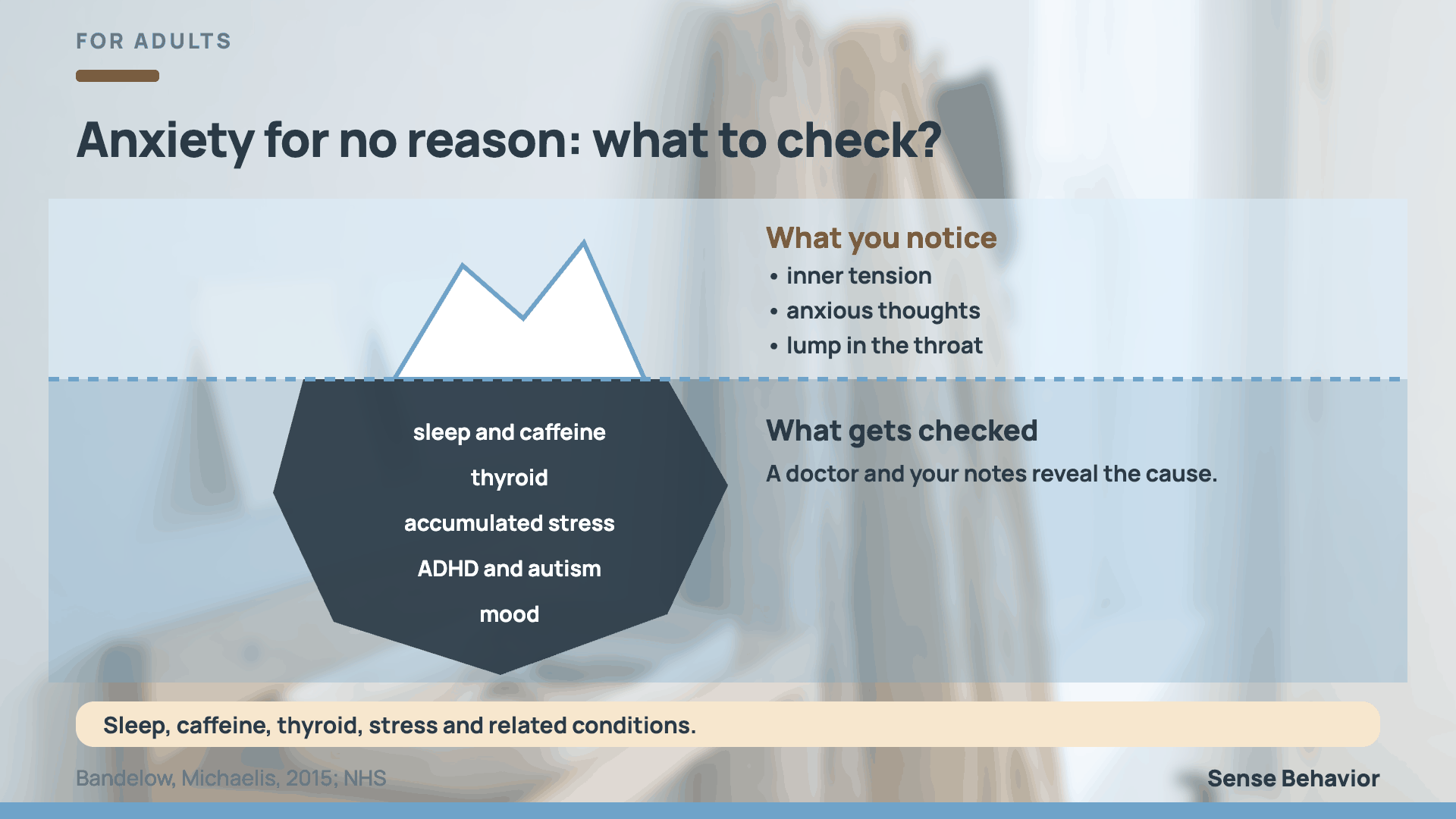
The doctor reads the TSH result together with your complaints. If the thyroid is more active than normal, the NHS says the condition is usually treatable. That is why the test is worth doing even when you believe stress is the cause.
Appointments are short, so prepare a few facts in advance.
- How many weeks or months the anxiety has lasted and how it has changed.
- At what time of day and in which situations it is stronger.
- How you sleep and how much coffee and alcohol you drink.
- Which medicines and supplements you take.
- Whether relatives have had similar states.
To arrive with numbers first try the standard rating scales. Which ones exist and what they show is explained in the piece on the anxiety test. The result is not a diagnosis, but it is a handy way to open the conversation.
What to do on your own today
Here are a few simple steps that lower the overall tension and give your doctor data. This is not treatment, and results differ from person to person.
- Pause for a minute and describe the feeling through the body: where the tension is and how you breathe.
- Write three lines: when it started, what came before and what you did in response.
- For a week keep to one cup of coffee before noon and compare your notes.
- Go to bed and get up at the same time for several days in a row.
- Step outside for ten minutes and talk to someone close.
Run a one-week experiment. For the first three days only write things down and change nothing. For the next four days change one item, for example move the last coffee to the morning. At the end compare your notes. This gives you facts instead of guesses, and you can show them to a doctor.
Here is what an entry might look like. “Tuesday, 5:30 pm. Tension, lump in the throat. Before that three hours without a break and two coffees. Answered emails until late, fell asleep late.” After two weeks of such lines you will see that the hard evenings follow days without breaks. That is a concrete handle for the conversation with a doctor.
More everyday methods are gathered in the piece on how to cope with anxiety. Pick one item, not the whole list at once.
What is better avoided: constantly checking how you feel, looking for the cause in your own character and narrowing your usual life until things get easier. Each of these strategies brings short relief but locks the anxiety in. The brain concludes that it cannot cope without checks and workarounds.
The strength of notes is that they reveal a pattern. The behavioural approach is built on this: first observation, then a small step, then a check against the notes. It promises no outcome, yet it makes the picture visible to you and to your doctor.
When to see a specialist
The NHS offers a rule of thumb: an anxiety disorder is more likely when you feel anxious most of the time and it affects everyday life. Isolated surges rarely fit that description, though you can discuss them with a doctor too.
Book a doctor if the anxiety lasts more than a few weeks and interferes with work, sleep or relationships. It is also a good reason to come in when you have started avoiding usual activities.
At the appointment the specialist usually asks when the anxiety began, what makes it stronger and how it affects your life. Your notes shorten this conversation a lot. If further assessment is needed, the doctor will explain which steps are possible.
The path to help usually looks like this.
- A general practitioner or family doctor rules out physical causes.
- A psychologist or psychotherapist helps you sort out anxiety and habits, for example in a cognitive behavioural format.
- A psychiatrist assesses the condition and discusses medication if needed.
Seeking such help is normal, and you can start with any of these specialists.
Urgent help is needed in these situations.
- Thoughts of harming yourself have appeared.
- The anxiety comes with chest pain, severe breathlessness or numbness.
- Your condition has worsened sharply in a short time.
In these cases call your local emergency number or a crisis line. The international directory lists lines by country. You do not have to carry this alone. We describe the wider picture of anxiety in adults in the piece on anxiety in adults.
If you want to talk through your situation, write to us using the link at the bottom of the page.
Sources
- Bandelow B., Michaelis S. (2015). Epidemiology of anxiety disorders in the 21st century. Dialogues in Clinical Neuroscience, 17(3), 327–335.
- Hollocks M. J., Lerh J. W., Magiati I., Meiser-Stedman R., Brugha T. S. (2019). Anxiety and depression in adults with autism spectrum disorder: a systematic review and meta-analysis. Psychological Medicine, 49(4), 559–572.
- Katzman M. A., Bilkey T. S., Chokka P. R., Fallu A., Klassen L. J. (2017). Adult ADHD and comorbid disorders: clinical implications of a dimensional approach. BMC Psychiatry, 17, 302.
- Ben Simon E., Rossi A., Harvey A. G., Walker M. P. (2020). Overanxious and underslept. Nature Human Behaviour, 4, 100–110.
- Klevebrant L., Frick A. (2022). Effects of caffeine on anxiety and panic attacks in patients with panic disorder: a systematic review and meta-analysis. General Hospital Psychiatry, 74, 22–31.
- NHS. Overactive thyroid (hyperthyroidism): symptoms and diagnosis.
- NHS. Generalised anxiety disorder in adults: symptoms and when to see a GP.
- Find A Helpline: международный каталог кризисных и экстренных линий по странам.
This material is for informational purposes only and does not replace a consultation with a specialist.