Cost of ABA Therapy in Serbia: What a Price Is Made Of and What to Ask

The cost of ABA therapy in Serbia depends on the format, the frequency of sessions, the specialist’s qualifications and what the programme includes. There are no figures in this article, on purpose. Prices change, each specialist has their own terms, and it is more reliable to get a written quote before sessions begin. Here we look at what a price is made of, how the services of a speech therapist, a psychologist and an ABA specialist differ, and which questions to ask so that you can compare offers and avoid overpaying.

Cost of ABA therapy in Serbia: what the price of sessions is made of
The price of sessions is made of several parts, and different specialists count them differently. So compare the composition, not the final sum.
- The specialist. Qualifications, experience and who exactly leads sessions, a lead specialist or an assistant.
- The format. In-person sessions at home, remote support or a hybrid option.
- Frequency and length. How many meetings a week and how long each lasts.
- The initial assessment. Whether the price includes a skills assessment and building the programme.
- Supervision. Who oversees the programme and how often it is reviewed.
- Work with parents. Training the family and reviewing sessions.
- Travel and materials. Whether a home visit, teaching aids and cards are paid for.
- Payment terms. A single session or a package, and the rules for rescheduling and cancelling.
If one offer looks cheaper than another, check that the assessment, supervision or travel have not been left out.
What an ABA programme price includes and what to ask
An ABA programme is not only hours of sessions. It usually includes a skills assessment, an individual plan, the sessions themselves, work with parents and a review of the plan. We described how the assessment goes in the article on VB-MAPP testing. On hours per week, read the article on how many hours of ABA a child needs, and on budgeting the article on the cost of ABA therapy.
- Ask which stages are in the price and which are paid separately.
- Ask who makes the plan and who leads the sessions.
- Ask how and when the programme is reviewed.
- Ask how progress will be shown to you, in what units and how often.
- Ask what happens if a session is missed.
In-person, remote and hybrid sessions: how the format affects spending
The format changes what the spending is made of, not only the sum. The same specialist may offer different options, and it is worth asking for a quote for each.
- In-person sessions. The specialist comes to your home. The quote may include travel and travel time, but the child works in a familiar setting and the specialist sees the family’s routine.
- Remote support. You need a device, a stable connection and a helper beside the child, often a parent. More on how this works in the article on remote ABA therapy.
- Hybrid format. In-person meetings are combined with video work. This lets you tune how often the in-person visits happen to what the family can manage.
Choose the format by the child’s needs and the family’s rhythm, not only by price. If you are unsure, agree a trial period and assess together what works.
A speech therapist, a psychologist and an ABA specialist: how the services differ
These specialists have different tasks, and it is worth paying for the service that solves your task. There is no universal “most needed” specialist.
- A speech therapist works on speech and communication. How to choose a speech therapist in your own language in Belgrade is covered in the article on a speech therapist in Belgrade.
- A psychologist. Under Serbian law, psychological activity includes psychological examinations, psychological treatments and counselling. The law forbids carrying out such work if it is not based on psychological science and profession.
- An ABA specialist builds a programme for teaching skills and works with behaviour. One specialist may not replace another, and they often complement each other.
If you are unsure where to start, describe your task to the specialist and ask them to explain whether their service fits. A good specialist will say if you need a different one.
How to check a specialist’s qualifications before paying
Checking takes a few minutes and protects you from unneeded spending. You are entitled to ask for documents, and a serious specialist will not take offence.
- A psychologist. Under the law on conditions for psychological activity (in the version published on the Paragraf portal, 25/96 and 101/2005), a graduate psychologist who has passed the professional exam may practise. Independent practice requires premises for work and conditions for storing assessment instruments, and the ministry confirms that the conditions are met. Check that the version of the law is current.
- An ABA specialist. The BACB certificant registry is open to searching. If a specialist calls themselves a BCBA, you can check whether they are in the registry.
- A speech therapist. Ask for a diploma and a description of experience with children of your child’s age and with multilingual families. We found no single public register for speech therapists.
- Any specialist. Ask how supervision is organised and who is responsible for the programme.
Under the law a psychologist must keep secret personal data that may harm a person’s reputation or is of a private nature. Ask how the specialist stores data about your child and family.
A family’s rights when seeking help: information, a second opinion, an interpreter
In Serbia’s health care system the rules of the Law on Patients’ Rights apply. They concern health workers, but they are also useful as a guide for a conversation with any specialist.
- The right to information. A patient is entitled to receive information about all proposed measures, including the aim and benefit, possible risks and alternative methods.
- An interpreter. If the patient does not know the language in official use at the institution, an interpreter must be provided.
- A second opinion. A patient may ask for a second opinion from a doctor who did not take part in the treatment.
- Confidentiality. A patient may rely on the secrecy of personal information given to a worker.
How insurance works and what it pays for children, we described in the article on a child’s health insurance in Serbia. Insurance usually does not pay for private specialists, and this depends on the fund’s contract with the institution.
Questions worth asking before you pay
- What exactly is included in the price of one session and of a package?
- Is the initial assessment included, or paid separately?
- Who leads the sessions and who is responsible for the programme?
- What are your qualifications, and where can they be checked?
- How often do you review the plan and how do you show progress?
- What happens when a session is rescheduled or cancelled?
- Is prepayment needed and can unused funds be returned?
- Do you work in our native language, or is an interpreter needed?
- How do you store data about the child?
- Can we start with a short trial period?
How to compare offers from different specialists and avoid overpaying
Write the same request for each specialist and compare the answers. That way you will see the difference in composition, not only in the final sum.
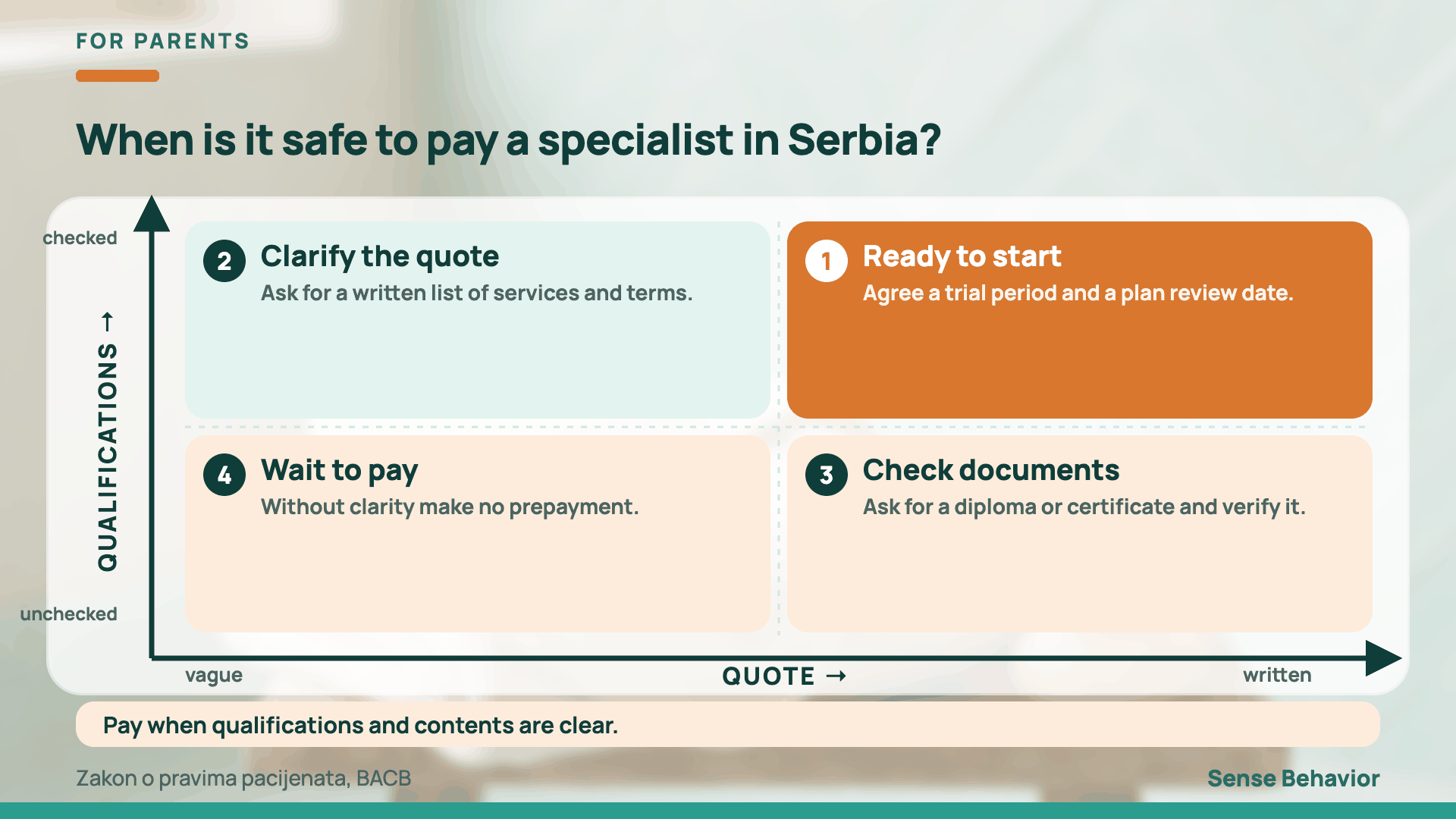
- Ask for a written quote with a list of services.
- Compare the composition, not only the sum. A cheap offer without an assessment and supervision may cost more in the end.
- Start with a skills assessment. It shows what help is needed and helps you avoid buying extras.
- Agree a date by which you will review the plan together.
- Use state services where they are available. Medical examinations and rehabilitation for a child may be paid by insurance.
- Do not decide under pressure. A good specialist gives you time to think.
How to plan a therapy budget without exact prices
Even without figures you can build a spending plan. It helps you make decisions calmly.
- Step 1. State the main task for the next few months. For example speech, behaviour or self-care skills.
- Step 2. List the services needed for that task and decide what can be obtained through insurance.
- Step 3. Ask two or three specialists for written quotes using the same list of questions.
- Step 4. Add a reserve to the budget for changes. The frequency of sessions and the services may change after the plan is reviewed.
- Step 5. Set a date when you will review spending together with the specialist.
How to talk to a specialist about money without feeling awkward
A question about cost is a normal one, and a serious specialist answers it calmly. Put it briefly and concretely.
- Explain that you want to understand what the service includes and the overall budget.
- Ask for a written proposal so that you can discuss it with your family.
- Ask what options exist if your budget is limited, for example another frequency or format.
- Agree what the specialist will warn you about in advance if the terms change.
What to do if your budget is limited
A limited budget does not mean help is impossible. It matters to set priorities and not spend on what is not needed.
- Start with a skills assessment. It shows where the child needs help and helps you avoid buying extras.
- Parent training. Skills you learn work every day. On sessions at home with a parent, read the article on ABA therapy at home with a parent.
- State services. Ask the chosen paediatrician what insurance pays for.
- Parent associations. They can suggest affordable options, more in the article on parent communities for autism in Serbia.
- Lower frequency. Ask the specialist whether meetings can be fewer with more work at home.
Red flags: when to turn an offer down
- They promise a cure or a guaranteed result.
- They refuse to name their qualifications or show documents.
- They ask for a large prepayment without a contract.
- They skip the assessment and immediately offer a long package.
- They press on urgency and fear, for example saying the window of opportunity is closing.
- They do not explain how progress will be measured.
- They do not answer questions in writing.
Contract and payment: what to put in writing
Even a small agreement is better in writing than spoken. Ask for the terms in a message or a contract.
- The list of services and the length of one session.
- The price and currency, and what exactly is included.
- The rules for rescheduling, cancelling and missed sessions.
- How a prepayment is refunded.
- The deadlines for reviewing the plan.
- How the child’s data is handled.
Sense Behavior in-person sessions in Belgrade and Novi Sad
At the time of writing (October–November 2026) our specialists run sessions in Belgrade and Novi Sad. About five families in Serbia are currently in in-person and hybrid support. That number refers only to the in-person and hybrid format and changes over time.
- Format. In-person sessions take place at the family’s home. There is also remote support and a hybrid format that combines in-person meetings with video work.
- Age. We mostly work with children from one year to 10 years old.
- Who leads. Sessions are led by Yulia Kozlova and other specialists of the centre.
- Language. Sessions are held in the family’s native language, and Serbian can be added if needed.
- Price. We give the current price at the consultation, and this article gives no figures.
- Booking. You can leave a request on our website. The activity is registered in Serbia, and the registration details are at the bottom of the site.
We do not promise results, and every programme starts with an assessment of the child’s skills. At the consultation you can ask any question from the list above.
Frequently asked questions about the cost of a speech therapist, a psychologist and ABA in Serbia
Why are there no prices in the article? Prices change and depend on the specialist, the format and what the services include. It is more reliable to get a written quote.
Does insurance pay for private sessions? Usually not. Insurance pays for services of institutions that have a contract with the fund.
Are in-person sessions more expensive than remote ones? The composition of the price differs, for example travel and format. Ask for a quote for both options.
Can we start with a trial period? You can ask the specialist about it. A good specialist will explain the terms.
How do I know the programme is working? Ask to be shown progress measurements and the date of the plan review.
How can I check an ABA specialist? Ask about certification and look the specialist up in the BACB registry if they call themselves a BCBA.
Neighboring topics for Serbia are covered separately, and these articles may help next.
- Our in-person home sessions and online support are described in ABA therapy in Belgrade and Novi Sad.
- A general overview of help in the country is in ABA therapy in Serbia.
- If you suspect ASD and do not know where to go, the steps are described in autism in a child in Belgrade.
If you need help drafting a list of questions for a specialist, write to us through the website.