Speech therapist in Belgrade for a child: how to choose and what to check

Parents looking for a speech therapist in Belgrade for a child growing up with two or three languages tend to follow the same script. They type a query, find several practices and cannot tell what to choose by. A shared language helps, but what makes a specialist suitable is training, method and a clear plan for sessions. We do not name private therapists because we cannot verify their work. Instead we give questions and checks that fit any practice in Belgrade or Novi Sad.

How to choose a speech therapist in Belgrade if you speak another language at home
A suitable speech therapist has relevant training, explains the goals of sessions in plain words and accounts for the fact that your child hears several languages. A shared language with your family is useful, yet it does not replace checking training and method, so begin there.
In Serbia, speech and language therapists are trained, among others, at the Faculty of Special Education and Rehabilitation of the University of Belgrade (FASPER). According to its website, the programme lasts four years (240 ECTS credits) and leads to the title "diplomirani logoped", and the next level awards the title "master logoped". The site also lists where graduates work: developmental counseling services, health centers, clinics, schools, kindergartens and private practices.
We found no publicly available register of speech therapists in Serbia that lets you verify a specialist. So ask the therapist directly about their diploma, where they studied and their experience. It is an ordinary question, and a conscientious specialist answers it calmly.
What to check before booking:
- Training: a profile in speech therapy (logopedija) or defectology, and the name of the institution.
- Experience with children of your child's age, especially under three if the child does not yet talk.
- Experience with children from multilingual families and an approach to assessment in several languages.
- Session format: in the practice, at home or remote, plus length and frequency.
- How the specialist reports: written conclusions, video, regular meetings with the parent.
What a speech therapist assesses and how the first meeting goes
A speech therapist looks at speech more widely than the pronunciation of sounds. They assess how the child understands spoken language, which words and phrases they use, how their speech sounds and how they communicate with people.
A first meeting usually follows a similar plan, although details depend on the specialist.
- A conversation with the parent about pregnancy, birth, development, hearing and the languages the child hears.
- Observation of the child's play and communication in a relaxed setting.
- Standardized tasks, if the child's age allows them.
- A discussion of results and a preliminary plan for the coming months.
- Advice on hearing checks and other specialists, if the therapist sees a reason.
The review by Hambly and colleagues (2013) notes that bilingual children with speech sound disorder are likely to be under-referred. The suggested reason is that adults find it hard to tell typical features of bilingual speech from a disorder. An assessment by someone who knows these features is therefore especially useful.
What to ask a speech therapist at the first meeting
A good first meeting ends with you understanding what will be done with your child's speech, why and how it will be checked. The six questions below help you get that answer.
- What exactly will you assess: sound production, understanding, vocabulary, phrases or communication overall?
- How do you assess a child who hears several languages at home, and do you take all of the child's languages into account?
- What goals do you set for the first two or three months, and how will we know they are reached?
- What do we do at home between sessions, and how much of a parent's time will it take?
- Are there cases where you recommend an assessment wider than speech therapy, and whom do you then refer to?
- How do you work with the child's other specialists, if there are any?
If the answers are vague, ask again in writing. A clear written plan helps you and the specialist see, a few months on, where the work is heading.
When a speech delay needs more than a speech therapist
Speech therapy should be paired with a wider assessment when difficulties in communication, play or response to the child's name are visible alongside the speech delay, or when the child has lost skills they had. A speech delay is then no longer only a speech matter, and the first step is taken by a pediatrician.
Serbia's national autism guidelines name the signs that call for urgent screening. These are cues to see a doctor, and the diagnosis is made by a specialist.
- By 12 months: no cooing or babbling, no social smile, no response to being called, no joint attention.
- By 16 months: not a single spoken word.
- By 24 months: no spontaneous two-word phrases that are not echoes of an adult.
- At any age: loss of language or social skills the child already had.
We described the steps for such signs in the article autism in a child in Belgrade: where to go if you suspect ASD. It helps if the speech therapist advises a wider assessment. For the broader picture, it is also worth reading about how autism differs from developmental delay.
Speech in several languages: what research says about bilingualism
Research does not show that several languages in a family cause a speech delay or harm the development of a child with developmental difficulties. The quality of the evidence is modest, though, so the language plan is discussed with a specialist, and nobody should decide it alone.
What the verified sources say:
- A systematic review by Hambly and colleagues (2013, 66 studies) found limited evidence that bilingual children develop speech more slowly. It did note qualitative differences and greater variation in their speech.
- A review by Uljarević and colleagues (2016, 50 studies) concluded that there is little evidence that multilingualism harms children with neurodevelopmental disorders. The number of studies is small, and few are of high quality.
- In the work of Hambly and Fombonne (2012), children with ASD from bilingual homes had no additional delays in language development.
- In a trial by Ebert and colleagues (2014) with 59 children with a language impairment, all kinds of treatment improved results, but there were fewer significant changes in Spanish than in English.
A practical conclusion follows. There is no need to change the language at home only because of a speech delay, and assessment and sessions are best planned so that the specialist sees the child's speech in every language they communicate in. If you are advised to drop one language, ask for the reasons and for a source.
If you wonder whether to wait for the child to start talking on their own, read child not talking at 3: wait or take action. It describes which signs mean the visit to a specialist should not be put off.
Where to look for a speech therapist in Belgrade and Novi Sad
Speech therapists work in state developmental counseling services and health centers, in kindergartens and schools, in clinics and in private practices. State places are limited, so many families combine a queue in the state service with private visits.
What we could confirm from official sources:
- Dom zdravlja Novi Sad. Savetovalište razvojne pedijatrije (Zmaj Ognjena Vuka 19, phone 021/4879-451) has a speech therapist, a defectologist-re-educator, three psychologists and two pedagogues on staff. Visits are by appointment, and the service covers children from birth to 6 (10) years.
- Belgrade. According to UNICEF in 2022, the city has 11 developmental counseling services at health centers. Your pediatrician can tell you which one covers your district.
- The national autism guidelines (2023) list a shortage of speech therapists, defectologists and psychologists as one barrier to early help.
A 021.rs report from May 2025 shows how this looks in practice. Dom zdravlja Novi Sad then employed one speech therapist, and the mother in the story had appointments booked through the whole of May. It is a single case from the past, so ask about current waiting times when you book.
Whether state insurance covers speech therapy sessions, and on what terms, we could not confirm from a primary source. Ask your chosen pediatrician and the RFZO branch. We give no prices for visits because there is no single set of verified data.
How to tell whether speech therapy is working
Results show in written goals, in progress on video and in the parent understanding what to do at home. If after two or three months none of this is present, review the plan together with the specialist.
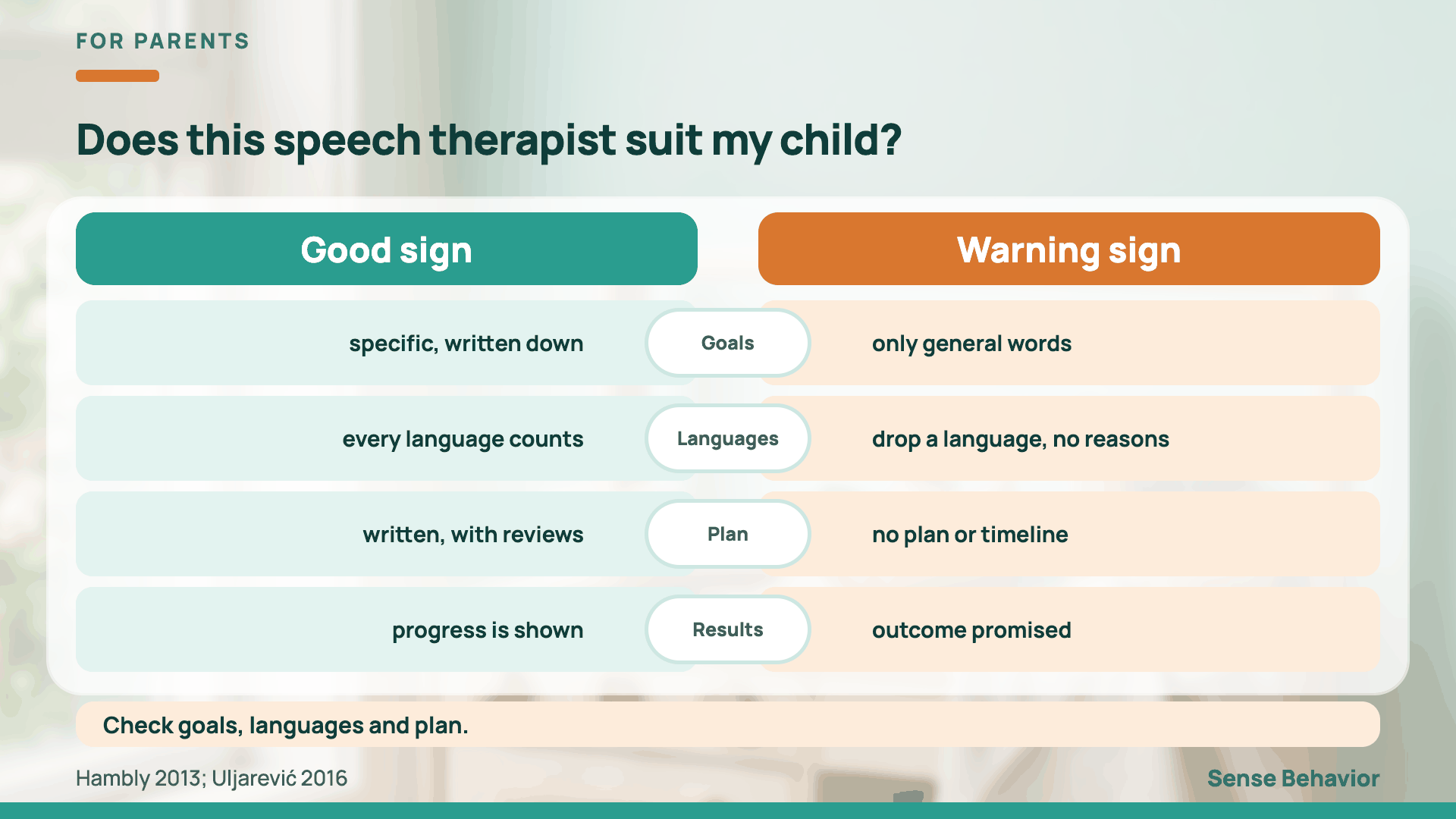
- Goals are specific, for example "names ten familiar objects", with no general "develop speech".
- Once a month you see progress on video or in the specialist's notes.
- You are taught things you can repeat at home, and they take a manageable amount of time.
- The child goes to sessions calmly or at least without strong resistance.
- The specialist changes the plan if something is not working and explains why.
If you are already attending but see no movement, go through the situation step by step with the article speech therapy is not helping my child: what to do and what to check.
Signs to watch for in a speech therapist's office
A warning sign is anything that keeps you from following what happens or pressures your decision. A good specialist does not rush and is ready to explain any step, explains every step without irritation.
- A promise of a specific result within a set number of sessions.
- Advice to drop one language entirely with no reasons and no source.
- A refusal to show how a session goes, or a ban on parents being present without explanation.
- Pressure to buy a large package of sessions at once, before a first trial period.
- No written plan and no way to explain how progress is measured.
What to bring to the first meeting with a speech therapist
A prepared folder helps the specialist see development as a whole and saves appointment time. Parents usually already have most of these documents.
- Reports from the pediatrician, neurologist, audiologist and other doctors, if there were any.
- The result of a hearing test, if one was done.
- Short videos of the child talking or communicating at home in an ordinary setting.
- A list of the words and gestures the child uses, in each of their languages.
- Your questions, written down in advance so none is lost in the office.
In person or remote: choosing the format for speech therapy
In-person sessions usually suit small children and those who find it hard to hold attention at a screen. Remote sessions are convenient when there is no specialist nearby in the language you need and the parent is ready to take part.
A review by Parsons and colleagues (2017) found preliminary evidence of benefit from remote parent training for children with ASD. The studies had a high risk of bias, though, with small samples and too few control groups. So choose the remote format together with a specialist and check it against progress over the first months.
What to do at home between speech therapy sessions
Simple things help at home: short phrases, a pause for a reply and shared activities where speech appears naturally. These techniques do not replace sessions with a specialist, they support them between visits.
- Name what you do together in one or two words or a short phrase.
- After a question, count to five silently and give the child time to answer.
- Offer a choice of two options, showing both objects.
- Read the same books together and return to them several days in a row.
- Speak to the child in the language in which you yourself feel most comfortable and natural.
If the child hardly uses words yet, start by teaching them to ask with a gesture or a card. The article how to teach a child to ask instead of screaming helps with this.
Sense Behavior sessions in Belgrade and Novi Sad
At the time of writing (October–November 2026), our specialists hold sessions in Belgrade and Novi Sad. Sessions are in person, at the family's home, and we mostly work with children from one to 10 years old. Our sessions do not replace speech therapy. We work on behavior, communication and the skills from which speech grows, and we can align goals with a speech therapist if the child already has one.
- Formats: in-person sessions, online support and a hybrid format that combines in-person visits with remote support.
- Sessions are led by Yulia Kozlova and other specialists of the center.
- The session language matches your family's language, and we add Serbian if needed.
- At the time of writing (October–November 2026), about five families in Serbia receive in-person or hybrid support.
- We state the cost at the consultation, and booking is through the website.
- The center's activity is registered in Serbia, and the details are at the bottom of the website.
If you are choosing between specialists and are unsure where to start, first read how to choose an ABA specialist and what to ask before the first session. Its questions suit a speech therapist too.
Frequently asked questions about a speech therapist in Belgrade
Do we need a speech therapist if we suspect ASD? A speech therapist can be part of the support, but a wider assessment is worth doing in parallel. You can start with your chosen pediatrician, and the steps are in our article on autism in Belgrade.
Should I pick a specialist in our language or a local one who speaks Serbian? Both are possible. What matters is that the specialist sees the child's speech in every language they communicate in and that you understand the plan.
Will my child start talking later because of three languages? There is no evidence that multilingualism causes a speech delay. If you notice signs from the list above, do not put off an assessment, however many languages are heard at home.
Is a referral to a speech therapist needed? For a state service a referral is usually issued by the chosen doctor, but the exact procedure depends on the institution. Confirm it by phone when you book.
Neighboring topics for Serbia are covered separately, and these articles may help next.
- If a child hears several languages and speech is delayed, see speech delay in a child with three languages in Serbia.
- Our in-person home sessions and online support are described in ABA therapy in Belgrade and Novi Sad.
- How to compare offers by price and content is explained in the cost of ABA therapy in Serbia.
- A general overview of help in the country is in ABA therapy in Serbia.
The information in this article was checked against the official sources available to us as of 28 October 2026. Conditions for appointments change, so confirm them before you visit. This article does not replace a specialist's appointment.
Sources
- FASPER, Univerzitet u Beogradu, studijski program Logopedija
- Dom zdravlja Novi Sad, Savetovalište razvojne pedijatrije
- Smernice za skrining, dijagnostiku i intervenciju za decu i odrasle sa poremećajem iz spektra autizma (Institut za mentalno zdravlje, Beograd, 2023)
- UNICEF Srbija, Građani Beograda, UNICEF i JKP Infostan za decu sa teškoćama u razvoju (12. 10. 2022)
- 021.rs, Novi Sad: jedan logoped, dođi i čekaj (12. 5. 2025)
- Hambly et al. (2013). The influence of bilingualism on speech production: a systematic review. Int J Lang Commun Disord
- Uljarević et al. (2016). Practitioner Review: Multilingualism and neurodevelopmental disorders. J Child Psychol Psychiatry
- Hambly & Fombonne (2012). The impact of bilingual environments on language development in children with ASD. J Autism Dev Disord
- Ebert et al. (2014). Three treatments for bilingual children with primary language impairment. J Speech Lang Hear Res
- Parsons et al. (2017). Parent-mediated intervention training delivered remotely for children with ASD living outside of urban areas: systematic review. J Med Internet Res